GrapheneOS Supported Devices in 2026: Every Supported Pixel, Pixel 11 Status and Motorola’s 2027 Expansion


Introduction
Most people searching for GrapheneOS compatible devices want a simple shopping list. The useful answer is more complicated because GrapheneOS does not decide whether to support a phone simply by asking whether Android can boot on it.
As of September 2026, GrapheneOS has official production support for 21 Google Pixel family devices, beginning with the Pixel 6 generation and extending through the Pixel 10a. The list also includes the original Pixel Fold and Pixel Tablet. There is currently no officially supported iPhone, Samsung Galaxy, OnePlus, Xiaomi, Nothing Phone, Fairphone or retail Motorola device.
The short device list is deliberate. GrapheneOS treats the hardware, firmware, secure element, boot process and manufacturer update policy as parts of the operating system’s security model. That is why an old Pixel can age out of meaningful security support even while it still works, and why an Android phone with an unlockable bootloader does not automatically qualify.
It also explains two developments that make 2026 unusually important for GrapheneOS. Google’s new Pixel 11 generation is still not officially supported because of questions around hardware memory tagging, while Motorola is working with the GrapheneOS Foundation on future devices designed to satisfy its requirements from the hardware level upward.
For anyone buying a hardened phone, those developments reveal something more important than the compatibility list itself: GrapheneOS support is ultimately a hardware security decision, not a brand decision.
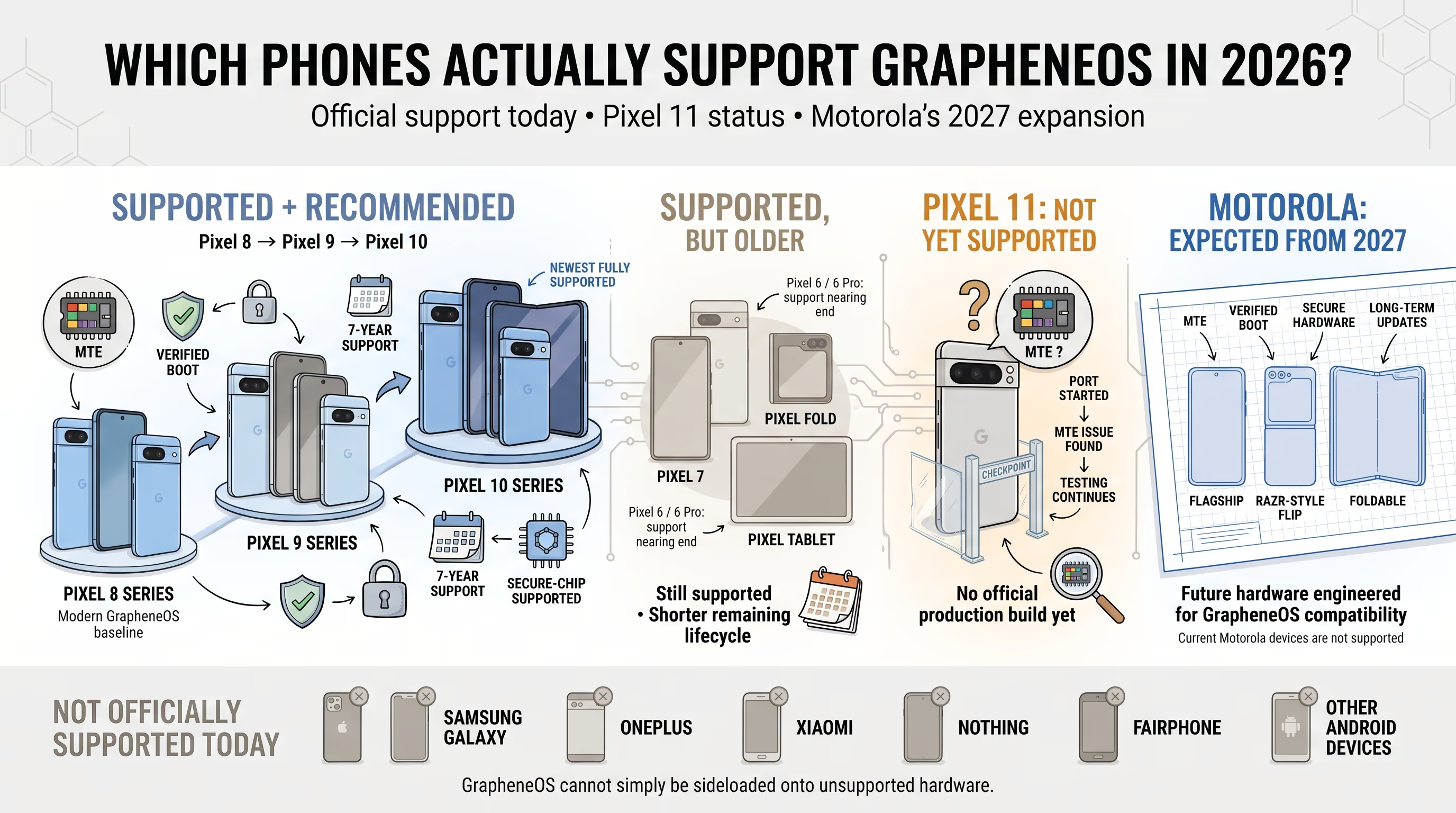
Which phones actually support GrapheneOS in 2026.
Which Phones Support GrapheneOS Right Now?
GrapheneOS currently lists the following devices as having official production support.
There is an important difference between officially supported and recommended to buy today. GrapheneOS specifically recommends Pixel 8 and newer supported devices for new purchases because that generation introduced both Google’s seven year support commitment and ARM hardware Memory Tagging Extension, or MTE.
That makes Pixel 8 the more useful starting point for a buyer, even though several older Pixels continue receiving GrapheneOS releases.
Is your cellphone vulnerable to SIM Swap? Get a FREE scan now!
Please ensure your number is in the correct format.
Valid for US numbers only!
Why GrapheneOS Supports So Few Devices
GrapheneOS is frequently described as a custom Android ROM. That description is technically understandable but can create the wrong expectations.
A conventional Android modding project may consider a device supported once developers can unlock it, boot custom software, make the major peripherals work and distribute an image. GrapheneOS sets a much higher bar because its security architecture extends below Android applications and into the kernel, firmware, secure hardware and boot chain.
An unlockable bootloader is therefore only one requirement.
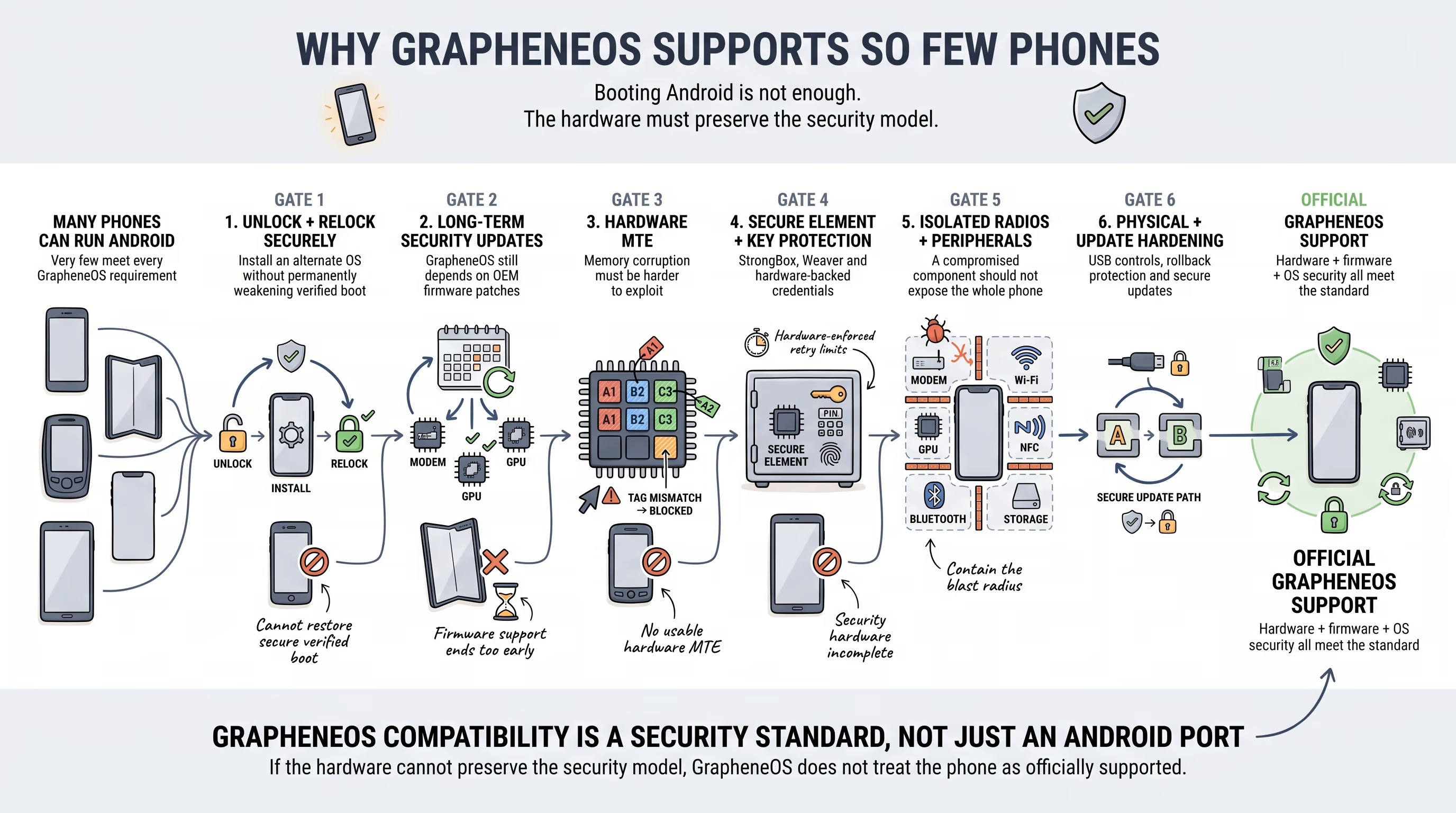
Why GrapheneOS supports so few phones, compatibility is a security standard, not just an Android port.
The Bootloader Must Be Relockable
Installing GrapheneOS normally involves unlocking the bootloader, installing the operating system and then relocking the device so verified boot can enforce the integrity of GrapheneOS itself.
That final step matters. Leaving a phone permanently unlocked weakens the protection against physical modification of the operating system.
A useful GrapheneOS device therefore needs to support an alternate OS without forcing the owner to permanently abandon secure verified boot.
Firmware Support Is Part of OS Support
A modern smartphone contains multiple computing environments outside the main Android operating system. These can include the cellular modem, Wi-Fi and Bluetooth firmware, GPU components, secure elements, storage controllers, camera processors, media hardware and vendor-specific low-level code.
GrapheneOS can maintain its own operating system, but it cannot independently replace every proprietary firmware patch that an OEM stops producing.
That is why manufacturer support lifetimes matter so much. When a device vendor stops fixing the underlying firmware, GrapheneOS eventually loses the ability to provide complete security updates regardless of how well maintained its own source code remains.
Hardware Memory Tagging Has Become a Major Requirement
ARM Memory Tagging Extension is one of the most important additions to GrapheneOS’s recent hardware baseline.
MTE associates memory regions and pointers with small tags. If software later attempts to access memory using an incompatible tag, the processor can detect the violation. This makes many memory corruption flaws, including certain use-after-free and buffer overflow vulnerabilities, substantially harder to exploit reliably.
GrapheneOS uses hardware memory tagging across its base operating system and hardened memory allocator on supported hardware. It now considers hardware MTE, or an equivalent capability, an important requirement when adding new device platforms.
This is why the Pixel 11 situation became much more than a normal porting delay.
Secure Hardware Must Protect Credentials and Keys
GrapheneOS also relies on secure hardware features such as StrongBox and Weaver.
StrongBox provides isolated hardware-backed protection for cryptographic keys. Weaver allows credential-derived encryption to use hardware-enforced throttling, making repeated offline PIN or password guessing dramatically more difficult.
These protections illustrate why security cannot be judged solely by Android version or CPU speed. An operating system can only use hardware isolation that the device actually provides.
Peripheral Isolation Matters
GrapheneOS also evaluates how components such as the cellular modem, Wi-Fi, Bluetooth, NFC, GPU, storage and media processors are isolated from the main application processor.
A vulnerability in one subsystem should not automatically provide unrestricted control over everything else.
The project also requires capabilities around A/B updates, rollback protection, hardware-backed encryption, Wi-Fi privacy, USB control and locked-state protection for debugging interfaces.
The practical conclusion is straightforward: GrapheneOS compatibility is a hardware and firmware qualification process, not simply an Android compatibility test.
Which Pixel Should You Buy for GrapheneOS?
The official list begins with Pixel 6, but I would divide today’s hardware into three practical categories.
Pixel 6 and Pixel 7: Supported, but No Longer Ideal New Purchases
Pixel 6 and Pixel 6 Pro remain officially supported as of this article, but Google’s minimum support commitment ends in October 2026. Pixel 6a lasts until July 2027.
GrapheneOS may continue issuing temporary extended-support releases after OEM support ends, but those releases cannot include proprietary firmware patches that Google no longer supplies. They are best understood as harm reduction while users migrate, not as equivalent long-term support.
Pixel 7, Pixel 7 Pro and Pixel 7a have more life remaining. Pixel 7 and Pixel 7 Pro run through October 2027, while Pixel 7a reaches May 2028. These are still legitimate devices for existing owners, but they predate the Pixel 8 hardware MTE baseline and have much shorter remaining support windows than newer hardware.
The original Pixel Fold and Pixel Tablet also remain officially supported through June 2028. They are useful examples of GrapheneOS supporting form factors beyond conventional phones, but they belong to the same pre-Pixel-8 hardware generation.
Pixel 8: The Beginning of the Current Recommended Baseline
Pixel 8, Pixel 8 Pro and Pixel 8a are the oldest devices GrapheneOS currently recommends for new purchases.
The Pixel 8 generation introduced ARMv9 cores with hardware MTE and moved Google to a seven year minimum support policy. Pixel 8 and Pixel 8 Pro are covered through October 2030, while Pixel 8a reaches May 2031.
For someone who wants a modern GrapheneOS platform without buying the newest flagship, this remains a sensible entry point.
The Pixel 8a is particularly relevant because it shows that GrapheneOS does not reserve its current security baseline for expensive Pro hardware. There are normal differences in cameras, displays and other components, but an A-series phone can still belong to the project’s recommended security generation.
Pixel 9: A Strong Middle Ground
The Pixel 9, Pixel 9 Pro, Pixel 9 Pro XL, Pixel 9 Pro Fold and Pixel 9a are all officially supported, with guaranteed OEM lifetimes extending into 2031 and 2032.
For many users, these devices may offer the best balance between purchase price, mature GrapheneOS support and remaining security lifetime. As Pixel 10 becomes more established, discounted Pixel 9 hardware may become especially attractive.
Pixel 10: The Newest Fully Supported Generation
The Pixel 10, Pixel 10 Pro, Pixel 10 Pro XL, Pixel 10 Pro Fold and Pixel 10a are currently the newest generation with official GrapheneOS production support.
The Pixel 10 flagship models have support commitments extending into 2032, while Pixel 10a reaches March 2033. That gives the 10a the furthest listed support date among currently supported GrapheneOS devices.
If someone wants to buy now and maximize remaining support rather than minimize purchase cost, the Pixel 10 generation is currently the clearest choice.
That may seem counterintuitive with Pixel 11 already available, but Pixel 11 is where the normal upgrade pattern breaks.
Does Pixel 11 Support GrapheneOS?
As of September 11, 2026, no Pixel 11 model has official GrapheneOS production support.
That includes the Pixel 11, Pixel 11 Pro, Pixel 11 Pro XL and Pixel 11 Pro Fold.
GrapheneOS did begin porting its operating system to the new devices and reported making substantial early progress. The obstacle was not ordinary application or driver compatibility. The project found that the hardware memory tagging capability it expects from new platforms was unavailable in the production configuration.
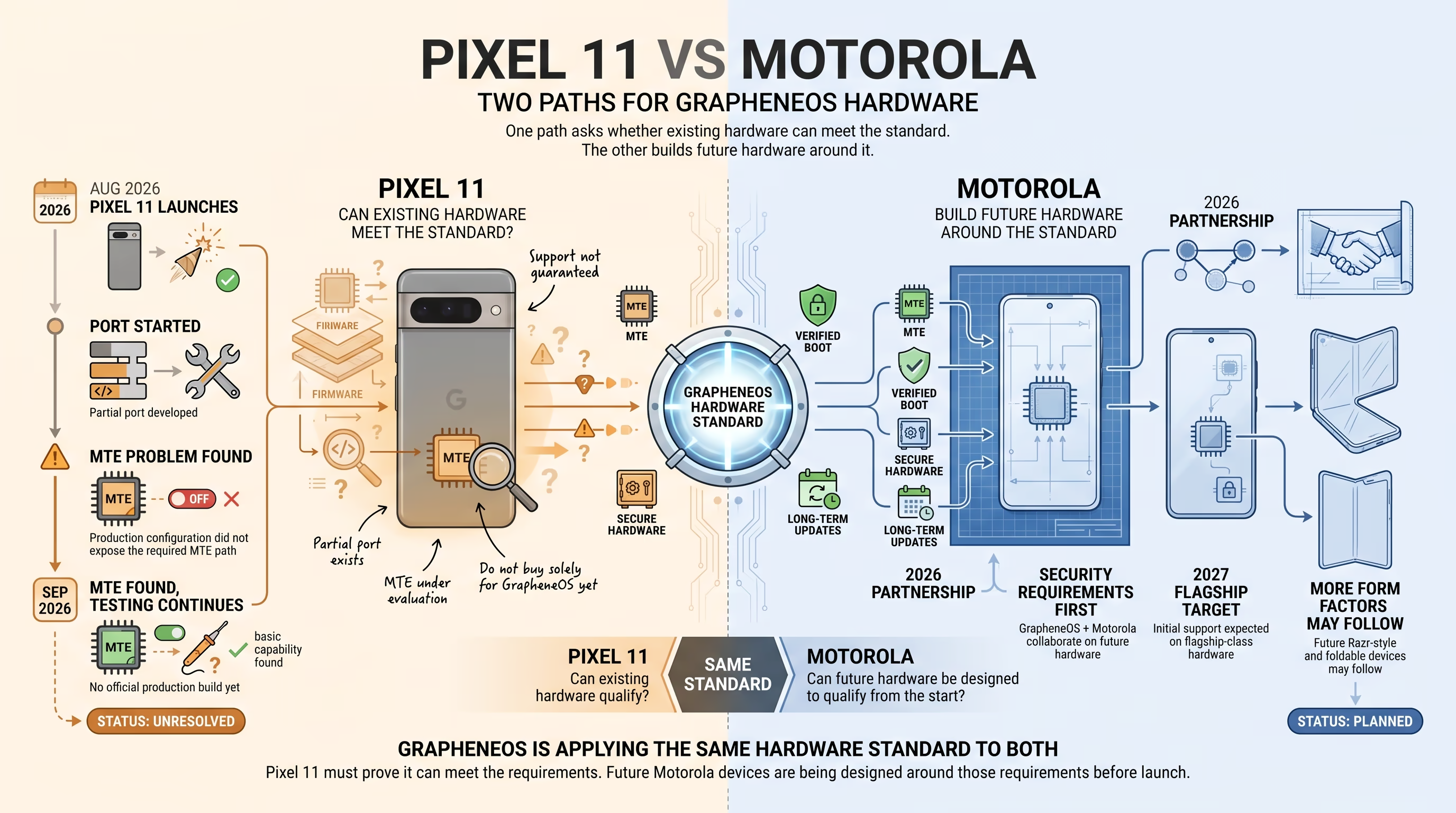
Two paths for GrapheneOS hardware: prove existing Pixel 11 can qualify, or design future Motorola hardware around the standard.
Why GrapheneOS Considered Skipping Pixel 11
GrapheneOS had already established hardware MTE as part of its modern device requirements. Making a special exception for Google’s newest flagship would therefore have weakened a requirement the project was simultaneously asking future Motorola hardware to meet.
That gave GrapheneOS three possible paths: reduce its standard, attempt to restore the missing functionality itself, or skip Pixel 11.
The project publicly considered the final option.
I think this episode is one of the strongest pieces of evidence that GrapheneOS’s Pixel preference is conditional rather than automatic. Google’s newest phone did not receive a pass simply because it was a Pixel.
MTE Was Not Completely Gone
The situation changed when GrapheneOS investigated firmware from Android 17 QPR2 Beta 4.
The project found that at least a basic hardware MTE implementation remained available. GrapheneOS modified its kernel configuration and was able to activate and test the functionality.
This weakened the earlier assumption that Pixel 11 had completely lost MTE at the silicon level.
GrapheneOS has speculated that changes to the underlying implementation may explain why Google disabled MTE in normal production firmware, but Google’s reasoning has not been publicly established. More importantly, GrapheneOS’s own early tests did not show the severe performance problems initially feared.
The current question is therefore no longer whether any MTE capability exists. It is whether GrapheneOS can rely on that capability as a stable, maintainable part of Pixel 11’s security architecture.
Should You Buy Pixel 11 for GrapheneOS?
If GrapheneOS is a requirement today, I would not.
The project may ultimately support Pixel 11, but there is no production release to install at the time of writing. Security planning should be based on capabilities that exist, not capabilities that might arrive later.
A Pixel 8, 9 or 10 generation device already provides a supported path.
Pixel 11’s status is fast moving, so this section should be treated as dated information rather than a permanent verdict.
Motorola Could End the Pixel-Only Era
At Mobile World Congress 2026, Motorola and the GrapheneOS Foundation announced a long-term partnership around future hardware engineered for GrapheneOS compatibility.
That wording is important because this is not simply a community port being attempted after a phone reaches stores. Motorola can make hardware and firmware decisions during development with GrapheneOS requirements already known.
Which Motorola Phones Are Expected to Support GrapheneOS?
The project has indicated that the first Motorola support should focus on 2027 flagship-class devices comparable to the current Motorola Signature, Razr Fold and Razr Ultra families.
Those names should be treated as product families or hardware classes, not as confirmation that today’s retail devices will receive GrapheneOS.
Current Motorola phones are not officially supported, and buyers should not purchase a 2026 Razr on the assumption that the partnership will make it compatible later.
Many of GrapheneOS’s requirements cannot be retrofitted after manufacturing. If the necessary memory-tagging hardware, secure-element integration or other low-level capabilities are missing, an operating-system update cannot create them.
Why Motorola Matters
For GrapheneOS itself, Motorola could reduce one of the project’s largest strategic dependencies.
Until now, GrapheneOS has relied overwhelmingly on Google’s device roadmap. Pixel 11 demonstrates the risk of that arrangement: if Google changes hardware in a way GrapheneOS cannot accept, there may be no immediate alternative.
A successful Motorola program could provide a second OEM, Qualcomm-based hardware, additional form factors and a manufacturer that considers alternative-OS requirements during product development rather than after release.
It could also establish a useful precedent. If secure third-party operating-system support becomes a design consideration instead of an enthusiast afterthought, other manufacturers may eventually have reason to compete on it.
That remains a future possibility rather than a current market reality.
Will Motorola Ship GrapheneOS Preinstalled?
That has not been confirmed.
Motorola has announced future GrapheneOS-compatible hardware, but compatibility does not necessarily mean standard retail devices will arrive with GrapheneOS already installed.
Until the companies publish a concrete distribution model, factory preinstallation should be treated as an open question.
SIM Swap Protection
Get our SAFE plan for guaranteed SIM swap protection.
Can I Run GrapheneOS on iPhone?
No current iPhone supports GrapheneOS, and there is no official GrapheneOS build for iPhone.
This is not simply a missing installer. GrapheneOS depends on the Android platform architecture, Linux kernel, Android hardware interfaces, device-specific drivers and a boot model that lets users install a third-party operating system while later returning the device to a securely verified state.
Apple does not provide that supported operating-system replacement model on the iPhone.
Jailbreaking does not change the answer. A jailbreak can bypass restrictions within Apple’s software environment, but it does not create GrapheneOS-compatible drivers, Android hardware abstraction layers, modem integration, secure-element support or a supported third-party verified-boot architecture.
There is also no supported GrapheneOS and iOS dual-boot configuration.
The correct conclusion is not that iPhones are inherently insecure. Apple uses its own tightly integrated security architecture. It simply does not expose the kind of alternate operating-system path GrapheneOS needs.
Can GrapheneOS Be Sideloaded by Samsung?
No, because sideloading is the wrong concept.
Sideloading normally refers to installing an Android application package outside an app store. GrapheneOS replaces the operating system itself and requires device-specific system images, kernel integration, firmware support and a secure installation path.
There is currently no Samsung Galaxy phone with official GrapheneOS production support.
Samsung’s platform presents additional complications. On models and markets where bootloader unlocking is available, unlocking can alter Knox-related security state and disable certain Samsung services. Policies vary by device, carrier and region, so it would be inaccurate to claim every Samsung behaves identically.
The broader issue is more important: even an unlockable Galaxy would still need to meet GrapheneOS’s requirements for verified boot, secure hardware, firmware updates, memory tagging, peripheral isolation, encryption and other low-level capabilities.
Interestingly, GrapheneOS historically supported the Samsung Galaxy S4. That old entry in the project’s end-of-life list is useful context because it shows that modern Samsung exclusion is not an ideological ban. The hardware requirements and platform architectures have changed.
What About OnePlus, Xiaomi, Nothing, Fairphone and Sony?
None currently has an officially supported GrapheneOS device.
GrapheneOS acknowledges that its source code can be adapted to more Android hardware than appears on its production list. That does not make such ports equivalent to official support.
A device may boot GrapheneOS-derived code while lacking the firmware maintenance, secure hardware, kernel changes or isolation properties that the official project depends on.
This distinction is especially relevant to devices marketed around repairability, openness or privacy. Those can be worthwhile qualities, but they are not substitutes for the hardware security characteristics GrapheneOS evaluates.
Can GrapheneOS Be Installed on Any Android Phone?
No, and Android’s Generic System Image system does not change that.
A GSI allows standardized Android userspace software to run on compatible vendor implementations, but GrapheneOS hardening extends into the kernel and device-specific platform. A universal userspace image running over arbitrary manufacturer kernels would not reproduce the same security properties.
GrapheneOS therefore does not offer an official universal GSI.
An unofficial build labeled “GrapheneOS GSI” should not be confused with an official signed GrapheneOS production release.
Carrier-Unlocked Is Not the Same as Bootloader-Unlocked
This is one of the easiest mistakes to make when buying a Pixel.
A carrier-unlocked phone can use service from different cellular providers. A bootloader-unlockable phone allows the operating system to be replaced.
One does not guarantee the other.
Some carrier-sold Pixel variants, particularly in the United States, can restrict OEM unlocking even after the phone is network-unlocked. If GrapheneOS is the goal, I would generally prefer a factory-unlocked device and verify that OEM unlocking is available before relying on it.
This also answers a common question about Verizon Pixels. Whether a particular unit can install GrapheneOS depends on bootloader policy, not simply whether the phone accepts another carrier’s SIM.
Why You Should Relock the Bootloader After Installation
GrapheneOS is intended to return to a locked verified-boot state after installation.
The normal process is to unlock the bootloader, install GrapheneOS and relock it so the device can once again verify the operating system during startup.
This is not merely a cosmetic warning screen. It restores an important part of the security boundary against physical modification of the system software.
Any guide suggesting that users should routinely operate GrapheneOS with an unlocked bootloader is describing a weaker deployment than the project intends.
What Happens When a Pixel Reaches End of Life?
GrapheneOS eventually retires devices because the project cannot manufacture vendor firmware patches after the OEM stops supplying them.
Its historical support list includes the Pixel 5 generation, Pixel 4, Pixel 3, Pixel 2, original Pixels, Nexus hardware and the old Galaxy S4.
GrapheneOS may temporarily provide extended-support releases after full manufacturer support ends, but these are migration tools rather than a continuation of complete patch coverage.
This is worth remembering when shopping for preconfigured “privacy phones.” A seller can install an operating system on old hardware, but they cannot restore firmware maintenance that the manufacturer has already abandoned.
For a high-risk user, an unsupported Pixel running GrapheneOS should not be treated as equivalent to a current supported Pixel merely because the interface looks the same.
Monthly
Yearly
What Is the Best GrapheneOS Phone to Buy in 2026?What Is the Best GrapheneOS Phone to Buy in 2026?
There is no single answer because budget, form factor and expected ownership period differ, but this is how I would currently divide the market:
This is my buying interpretation rather than an official GrapheneOS ranking. GrapheneOS’s simpler guidance is to choose Pixel 8 or newer supported hardware.
GrapheneOS Protects the Phone, Not the Entire Mobile Identity
One distinction matters especially for Efani’s audience.
GrapheneOS hardens the endpoint. It can reduce exposure to operating-system exploitation, memory corruption, malicious applications, weak permissions, boot tampering, USB attacks and theft of locally protected data.
It does not control the systems your carrier uses to provision your phone number.
A SIM swap can occur without compromising the GrapheneOS phone at all. If an attacker successfully impersonates the victim to a carrier and convinces it to move the number to another SIM or eSIM, the transaction occurs in carrier infrastructure.
The victim’s hardened phone can remain encrypted and uncompromised while incoming calls, texts and SMS verification codes start reaching someone else.
The inverse is also true. A secure carrier cannot patch an endpoint exploit or isolate a malicious application.
This is why mobile security should be designed as a stack.
Where GrapheneOS and Efani Fit Together
GrapheneOS and Efani address different parts of that stack.
GrapheneOS focuses primarily on the device and operating-system layer: exploit mitigations, sandboxing, verified boot, hardware-backed keys, memory protection, permission controls and local data security.
Efani focuses primarily on the mobile-identity and carrier layer, particularly sensitive actions involving SIM changes, eSIM provisioning, number transfers and carrier-account authentication.
Efani’s SIM change process blocks changes by default and applies multiple verification layers rather than relying on an ordinary support interaction.
Neither layer replaces the other. For someone whose phone number can unlock email, financial accounts, corporate systems or cryptocurrency infrastructure, it makes more sense to harden both the endpoint and the number attached to it.
That is the broader lesson behind the GrapheneOS compatibility list. Security depends not only on choosing secure software, but on whether every layer underneath and around that software can enforce the assumptions the security model makes.
Frequently Asked Questions
What phones support GrapheneOS in 2026?
GrapheneOS currently supports selected Google Pixel devices from Pixel 6 through Pixel 10a, including the original Pixel Fold and Pixel Tablet. For new purchases, GrapheneOS recommends Pixel 8 and newer supported models.
Does Pixel 11 support GrapheneOS?
Not as of September 11, 2026. GrapheneOS has developed a partial port and successfully investigated Pixel 11’s underlying MTE capability, but it has not released official production builds.
Can I run GrapheneOS on my iPhone?
No. There is no supported GrapheneOS build or installation path for any iPhone.
Can GrapheneOS be sideloaded to Samsung?
No. GrapheneOS is a complete operating system, not an Android application, and no current Samsung Galaxy device has official GrapheneOS support.
Does Motorola support GrapheneOS?
Not on current retail models. Motorola and the GrapheneOS Foundation are collaborating on future compatible hardware, with the first flagship-class devices expected in 2027.
Can I install GrapheneOS on any Android phone with an unlocked bootloader?
No. GrapheneOS requires far more than bootloader access, including secure verified boot, suitable firmware support, secure hardware, memory tagging, kernel support and long-term OEM maintenance.
Does GrapheneOS support the Pixel Tablet?
Yes. The Pixel Tablet remains officially supported, although it belongs to the older pre-Pixel-8 hardware generation.
Is Pixel 5 still supported?
No. Pixel 5 has reached end of life for GrapheneOS and should not be purchased today as a high-security GrapheneOS device.
The Device List Is Short for a Reason
What stands out to me about GrapheneOS is that its hardware compatibility list functions as a security policy.
If the goal were simply to make AOSP boot on as many phones as possible, the list could be far larger. Instead, GrapheneOS limits support because secure boot, firmware maintenance, memory protection, secure elements, peripheral isolation and the hardware lifecycle all determine what the operating system can realistically promise.
Pixel 11 illustrates that discipline unusually well. Even Google’s newest flagship has not automatically qualified. Motorola illustrates the other side of the same policy: another manufacturer can potentially join the ecosystem, but it has to build hardware that satisfies the requirements rather than expecting GrapheneOS to lower them.
For someone buying today, the recommendation is much simpler than the technical explanation behind it. Choose an officially supported Pixel 8, Pixel 9 or Pixel 10 generation device, verify that the bootloader can be unlocked, install GrapheneOS through the official process and relock the device afterward. If Pixel 11 or a future Motorola is the phone you want, wait until GrapheneOS publishes production support for the exact model.
For high-risk users, I would treat that hardened endpoint as one component of a wider architecture that also protects accounts, recovery channels, communications and the mobile number itself. The strongest mobile security model is rarely one product. It is a collection of independent controls that do not all fail through the same path.