
GrapheneOS Review: How secure is it, who is it for, and what can it actually protect you from?


Introduction
GrapheneOS is frequently described as "de-Googled Android," which is not entirely wrong, but that description misses much of what makes the operating system technically interesting. Its more consequential engineering happens deeper inside the phone, where it changes memory allocation, process creation, application permissions, browser behavior, physical interfaces, boot integrity, encryption, and the conditions an attacker has to satisfy after finding a vulnerability.
This distinction matters because privacy and security are often collapsed into the same conversation. Removing Google services can reduce one category of data exposure, but it does not automatically make a phone harder to exploit. Conversely, strengthening memory-corruption defenses can make exploitation significantly harder without making the user anonymous to their carrier, websites, or online accounts.
For this review, my team at Efani and I examined GrapheneOS's public technical documentation, Android's upstream security documentation, independent analysis of GrapheneOS's hardened memory allocator, current device-support information, recent forensic research, and the project's developing relationship with Motorola. We have not independently audited the GrapheneOS source code, nor have we performed hands-on exploit or forensic testing. Based on the public evidence we reviewed, I think the defensible conclusion is narrower than some of the mythology surrounding "secure phones," but it is still significant.
GrapheneOS is one of the more technically serious attempts to make a general-purpose smartphone harder to compromise without abandoning Android application compatibility. Its strongest case is not that attackers cannot break it, but that the operating system tries to force them through more expensive, less reliable, and more narrowly targeted routes. For someone carrying little of exceptional value, that additional friction may be unnecessary. For an executive, high-net-worth individual, cryptocurrency holder, journalist, attorney, founder, or public figure who may be selected because of who they are, the calculation changes considerably.
What GrapheneOS Actually Is
GrapheneOS is an open-source mobile operating system built from the Android Open Source Project, commonly called AOSP. It is developed through the nonprofit GrapheneOS Foundation and is designed to preserve normal Android application compatibility while applying additional security and privacy hardening.
It is important not to picture GrapheneOS as Google's Pixel operating system with Google apps deleted. GrapheneOS builds an operating-system distribution from AOSP and the device-specific components required to support selected hardware. Much of Android therefore remains underneath it, but GrapheneOS replaces or modifies security-sensitive parts of the platform and adds its own components.
The most important differences are generally not visible in screenshots because they exist in areas such as memory allocation, application spawning, kernel configuration, application permissions, WebView, operating-system services, USB behavior, verified boot, update integrity, network behavior, and hardware-backed credential protection. This also means GrapheneOS should not receive credit for every security property of a modern Android phone.
Modern Android Is Already a Secure Starting Point
A credible GrapheneOS review has to begin by giving Android credit. Modern AOSP already isolates applications using separate Linux identities and process boundaries, applies SELinux mandatory access controls and seccomp filtering, restricts permissions, implements scoped storage, supports hardware-backed keys, encrypts user data, verifies the operating system during boot, restricts rollback to older vulnerable builds, and deploys multiple exploit mitigations.
Google has continued to harden this baseline. Android 16 now includes Advanced Protection Mode for people at elevated risk, with restrictions that include disabling 2G and weak WEP networking, blocking ordinary sideloading, enabling additional forensic logging, restricting unknown callers, and activating other protective behaviors.
The right question is therefore not whether GrapheneOS has security while Android does not. The more useful question is how much further GrapheneOS pushes those boundaries, which protections are genuinely different, and whether the additional protection matters against the adversary a particular user is likely to face.
How GrapheneOS Approaches a Compromise
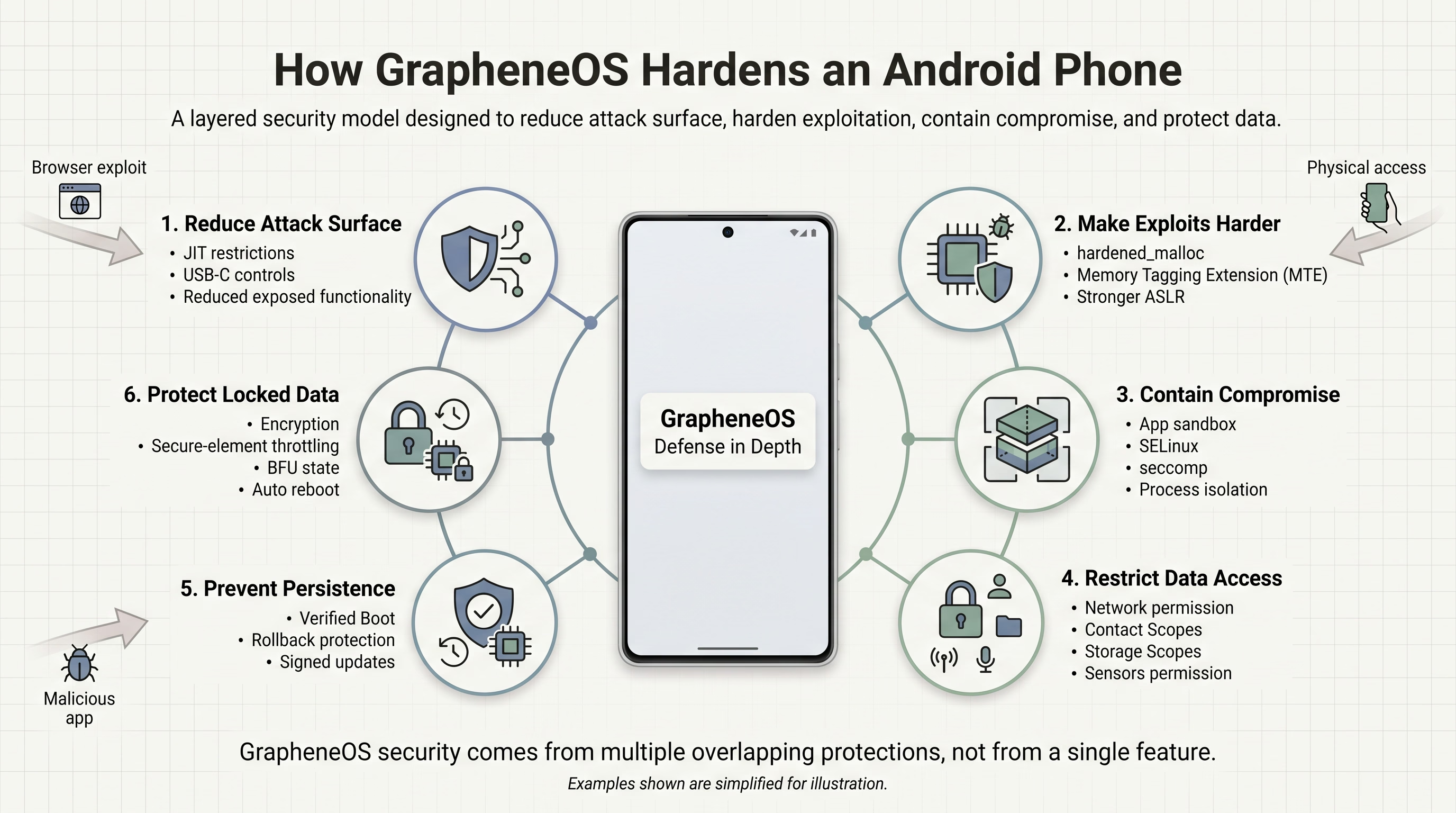
The GrapheneOS security model makes most sense when viewed as a sequence. The first goal is to reduce the amount of functionality an attacker can reach. The next is to make the vulnerabilities that remain harder to exploit. If exploitation succeeds, the attacker should still encounter sandbox boundaries. Even legitimate applications should receive less sensitive data than they otherwise might, while verified boot and signed updates should make unauthorized persistence more difficult. Finally, encryption and physical-interface controls aim to make extraction harder when possession of the device changes.
No single layer needs to be perfect for this strategy to provide value. Suppose an attacker has a browser vulnerability. If memory hardening causes the exploit to crash instead of producing reliable code execution, the chain can fail immediately. If the initial exploit succeeds but cannot escape the browser renderer, access remains constrained. If a sandbox escape succeeds but privilege escalation fails, the attacker may still be contained, while successful deep access still leaves persistence and reboot-related problems to solve.
Security researchers often describe these as exploit chains because sophisticated compromise is rarely one magical vulnerability that instantly grants access to everything. GrapheneOS tries to place additional barriers between each stage.
hardened_malloc: Making Heap Corruption Harder to Weaponize
One of GrapheneOS's best-known technical components is hardened_malloc, its security-focused user space memory allocator. Programs written in memory-unsafe languages such as C and C++ routinely request and release chunks of memory from a heap, and vulnerabilities involving those operations have historically been central to high-end exploitation.
Common examples include use-after-free bugs, where software continues using memory after it has been released, and buffer overflows, where software writes beyond the memory region it was given. GrapheneOS's allocator is designed so that a programming mistake is less likely to give an attacker a predictable exploitation primitive.
Its defenses include separating allocator metadata from ordinary heap contents, randomizing allocation behavior, inserting inaccessible guard regions, delaying and randomizing reuse of freed memory, detecting invalid frees, wiping released memory, and integrating hardware memory tagging on capable processors. The objective is not to remove the underlying bug, but to make a bug that might have produced attacker-controlled memory corruption on another configuration crash, become unreliable, or require considerably more work to exploit.
This is one area where there is useful evidence beyond GrapheneOS's own documentation. French security firm Synacktiv performed a detailed technical examination of hardened_malloc in 2025 using GrapheneOS devices and source-code analysis. Its researchers confirmed many of the allocator's protections and concluded that the combination significantly reduces opportunities to exploit common heap-corruption vulnerabilities, particularly when hardware memory tagging is available. They also identified limitations, including different protections for large allocations, which is why hardened_malloc should be described as an exploit mitigation rather than proof that heap exploitation becomes impossible.
Is your cellphone vulnerable to SIM Swap? Get a FREE scan now!
Please ensure your number is in the correct format.
Valid for US numbers only!
Memory Tagging Extension: Hardware Joins the Defense
Pixel 8 generation and newer devices add another important layer through Arm's Memory Tagging Extension, or MTE. MTE adds metadata tags to regions of memory and to pointers referencing those regions, allowing the processor to check whether the pointer and memory tags match when memory is accessed. A mismatch can expose operations such as an out-of-bounds access or use of a pointer after its original allocation has been freed.
Android itself supports MTE and has deployed it in selected security-sensitive components. Google's own technical documentation describes MTE as a hardware mechanism for detecting common memory-safety failures and encourages vendors to apply it where the performance tradeoff is appropriate. GrapheneOS's differentiator is therefore not that Android has no MTE, but that GrapheneOS deploys memory tagging more aggressively across the operating system and known-compatible user applications on supported hardware, while allowing incompatible applications to be excluded individually.
That matters because an attacker who relies on precisely manipulating freed or adjacent memory can encounter a hardware-enforced validity check in addition to allocator-level defenses. MTE is still probabilistic, its tag space is finite, and it does nothing against broad classes of vulnerabilities such as authorization mistakes, stolen credentials, logic bugs, phishing, or misuse of legitimate functionality.
Even with those limitations, MTE is one of the reasons I would not recommend buying an old Pixel solely because it technically remains on the GrapheneOS support list. For a new GrapheneOS deployment in 2026, Pixel 8 generation or later is the meaningful floor because that is where newer Armv9 security architecture, MTE, Pointer Authentication, Branch Target Identification, and seven-year support windows come together.
GrapheneOS Changes How Android Starts Applications
Another less visible defense concerns application process creation. Standard Android traditionally uses a process called Zygote, which creates a prepared parent process and forks new applications from it instead of building every application process from nothing. This approach improves speed and memory efficiency, but child processes can inherit randomized security state from the same parent.
GrapheneOS uses an exec based application spawning system that creates fresh process state instead. The project says this gives applications independently randomized address-space layouts, stack and heap canaries, memory tags, and other process secrets. Independent Synacktiv testing observed GrapheneOS's expanded address-space randomization and process-level differences during analysis.
The cost is mainly additional cold-start latency and some memory overhead, with GrapheneOS estimating roughly a few hundred milliseconds on current flagship hardware. This is representative of the project's engineering philosophy, which accepts a small usability or performance cost when it believes the change materially reduces shared exploitation state.
Applications that genuinely fail because of these protections can use GrapheneOS's Exploit Protection Compatibility Mode. That mode can restore Android's standard allocator, reduce the available address space, disable memory tagging for that application, and permit native debugging, so it should be understood as a controlled per-app security downgrade rather than merely a troubleshooting checkbox.
More Address Space Means More ASLR Entropy
Address Space Layout Randomization, or ASLR, makes exploitation more difficult by randomizing where useful code and memory structures appear. GrapheneOS uses a larger 48-bit user space virtual address space rather than Android's conventional 39-bit arrangement and reports increasing available ASLR entropy from about 24 bits to about 33 bits.
Synacktiv independently observed this larger address space during its hardened_malloc analysis. ASLR does not stop a vulnerability from existing, but it makes reliable exploitation harder because the attacker has less certainty about where useful targets are located.
The effect becomes more meaningful when combined with secure application spawning, stronger ASLR, allocator hardening, MTE, and sandboxing. None of these mechanisms should be judged entirely in isolation because GrapheneOS's central security argument is cumulative.
The Kernel Has to Be Hardened Too
Application sandboxing eventually depends on the kernel. If a browser or application is compromised, a kernel vulnerability can become the route to broader system privileges, so GrapheneOS applies additional hardening below the application layer, including memory-clearing protections, allocator defenses, reduced debugging and profiling exposure, stronger randomization, module-signing enforcement, and hardware memory tagging where its chosen configuration supports it.
For non-specialist readers, the useful point is that securing the browser while leaving the kernel comparatively easy to exploit would create a weak second stage in the chain. GrapheneOS focuses heavily on transitions between privilege boundaries rather than merely the first vulnerability.
Sandboxing Is About Limiting the Damage After Something Goes Wrong
Android applications already live inside sandboxes, and GrapheneOS strengthens that model rather than replacing it. A malicious application does not automatically receive another application's private files merely because both are installed on the same phone, while a compromised browser renderer should not automatically gain access to the microphone, financial applications, password manager, or another user's data.
For an attacker, escaping these boundaries requires another vulnerability or a permission the user has already granted. This becomes especially useful when combined with GrapheneOS's additional privacy permissions, which reduce how much information legitimate software receives in the first place.
Network Permission: Installing an App Does Not Have to Mean Letting It Go Online
GrapheneOS exposes a user-facing Network permission that can prevent an installed application from directly accessing Wi-Fi, cellular networking, localhost, and certain indirect networking mechanisms provided by cooperating operating-system services.
This is useful for applications that have no legitimate reason to communicate remotely. An authenticator, offline document reader, calculator, local media utility, or similar tool may be functional without internet access, and if such software is compromised or overly aggressive about analytics, removing network access reduces the obvious exfiltration route.
The control is not universal data-loss prevention because applications inside the same profile may intentionally communicate through legitimate operating-system mechanisms, and a cooperating application with network permission may create another path. When stronger separation is required, GrapheneOS's user-profile architecture is more appropriate.
Sensors Permission Closes Another Quiet Data Channel
Modern phones contain more sensors than most users think about when reviewing privacy. Accelerometers, gyroscopes, compasses, and related sensors can reveal motion and environmental information, while security research has also explored their use in behavioral inference and fingerprinting.
GrapheneOS provides a user-facing Sensors permission for classes of sensors that conventional users may otherwise never consider restricting. This does not make fingerprinting impossible because applications and websites can correlate many other characteristics, but it applies the same least-privilege philosophy to another category of hardware.
Storage Scopes: Let the App Think It Has Access Without Giving It Everything
Storage Scopes is one of the more practical GrapheneOS privacy features because some Android applications expect broad storage permissions and may behave poorly when users refuse them. GrapheneOS can satisfy the application's expected permission state while exposing only files the application created itself plus specific files or folders the user has selected.
This avoids a common security tradeoff where the user either grants far too much access or abandons the application. Storage Scopes does not protect information the user deliberately selects or uploads, but it can sharply reduce bulk access the application never needed.
Contact Scopes Matter More for High-Value Users Than They First Appear
A personal address book can function as an intelligence database. For an executive or high-net-worth individual, contacts may identify family members, assistants, attorneys, executives, investors, advisers, business counterparties, accountants, security personnel, and account-recovery relationships.
GrapheneOS Contact Scopes allows a user to expose selected contacts rather than handing an application the entire address book. If an application is later compromised, the amount of relationship data available to the attacker may therefore be significantly smaller.
For the high-risk users we focus on at Efani, I consider this one of GrapheneOS's more underrated features because protecting a high-value individual often also means protecting the network of people around them.
Multiple Profiles Turn One Device Into Several Compartments
GrapheneOS substantially embraces Android's multi-user model. Separate profiles can maintain their own applications, accounts, app data, permissions, and encryption keys, while GrapheneOS also lets users log those profiles out, which stops their applications and returns protected data to an at-rest state.
A practical high-risk deployment might keep ordinary communications separate from financial applications, Google-dependent software, corporate systems, or sensitive travel data. The benefit is blast-radius reduction because an application compromised in one profile does not automatically inherit direct access to applications and private data inside another profile.
Profiles are not separate physical phones and still share the same kernel, firmware, baseband, processor, and other hardware. A sufficiently deep kernel or firmware compromise may cross those boundaries. For many targeted users, however, profile compartmentalization is a much stronger architecture than installing every aspect of their identity into one permanently active environment.
Vanadium Hardens More Than the Browser
GrapheneOS ships Vanadium, a Chromium-based browser that also serves as Android's WebView provider. The WebView role is important because many Android applications display web content internally rather than opening a separate browser, meaning Vanadium's hardening affects a much larger attack surface than the browser icon alone suggests.
GrapheneOS documents Vanadium protections including additional memory hardening, stricter site isolation, control-flow protections, reduced dynamic code execution, JavaScript JIT disabled by default, WebGPU restrictions, privacy-oriented WebRTC handling, state partitioning, and content filtering.
Turning off JavaScript just-in-time compilation is a particularly meaningful example because JIT engines process attacker-controlled JavaScript and dynamically generate native machine code, making them valuable exploitation targets. Removing that mechanism by default reduces attack surface, although some sophisticated web applications may run more slowly or require a per-site exception.
Vanadium should still not be confused with an anonymity browser such as Tor Browser. It does not inherently hide the user's IP address, anonymize authenticated sessions, or guarantee that websites cannot fingerprint the browser. Its stronger case is exploit resistance and privacy-oriented browser behavior.
Sandboxed Google Play Is the Feature Most People Misunderstand
GrapheneOS does not ship Google Play services by default, but users who want them can install Google's genuine Play Store and Play services components. The important difference is where those components sit in the privilege model.
On GrapheneOS, Google Play runs as ordinary sandboxed applications rather than receiving the extensive privileged operating-system integration it gets in a standard Google-certified environment. GrapheneOS's compatibility layer teaches the software how to operate from inside that sandbox, while Google Play is also installed per profile. A user can therefore maintain one profile with Play services for applications that require them and another profile completely free of Google applications.
This allows GrapheneOS to preserve much of the mainstream Android ecosystem without restoring Google Play to a privileged system role. The vast majority of Play-dependent application functionality can operate this way, including push notifications, Play Store downloads, purchases, licensing, and many dynamically delivered Google components.
Does Installing Google Play Defeat the Point of GrapheneOS?
Not necessarily, although it changes the privacy model. Sandboxing limits what Google Play can access automatically, but it does not change information the user voluntarily gives Google.
If you sign into Gmail, Google knows about the Gmail activity associated with that account. If you upload photographs to Google Photos, Google receives those photographs. If you grant a Google app location access, it can process the location information the operating system provides.
GrapheneOS therefore makes Google optional and less privileged rather than making authenticated Google services anonymous. That is a much more accurate definition of GrapheneOS's "de-Googling" than saying Google disappears completely.
How De-Googled Is GrapheneOS Really?
A fresh GrapheneOS installation has no mandatory Google account and does not bundle Google Play. The project says its baseline operating-system connections are directed primarily to GrapheneOS infrastructure and network-provided DNS rather than Google's normal consumer-service stack, and that GrapheneOS contains no built-in analytics or telemetry.
Still, "independent of Google" would be an overstatement. AOSP itself is largely stewarded by Google, current officially supported GrapheneOS phones are Pixels, device firmware and proprietary hardware components depend on Google and its suppliers, Android application compatibility exists inside Google's wider platform ecosystem, and some upstream data or provisioning mechanisms ultimately originate with external providers even when GrapheneOS proxies or caches those interactions.
The more precise conclusion is that GrapheneOS removes Google's mandatory privileged role from the operating-system experience while continuing to rely on parts of the Android and Pixel ecosystem underneath it. Privacy is rarely about eliminating every dependency; more often, it is about reducing compulsory trust and limiting privileges.
GrapheneOS Does Not Make Cellular Service Anonymous
This may be the most important limitation for readers who confuse privacy-oriented operating systems with anonymity tools. GrapheneOS explicitly treats cellular networks as untrusted, which means sensitive information should use encrypted transport and, where appropriate, end-to-end encrypted protocols rather than assuming the carrier network itself is confidential.
A phone still has to participate in cellular network identity and routing procedures to receive service. GrapheneOS states plainly that a carrier can identify and locate a device connected to its cellular network. Airplane mode is the reliable mechanism for disabling cellular radio connectivity and therefore stopping that radio from participating in carrier tracking, while Wi-Fi can then be enabled independently if needed.
GrapheneOS also cannot arbitrarily replace the production phone's IMEI with whatever identity the user chooses. A hardened operating system is therefore not an invisibility system.
SIM Swap Protection
Get our SAFE plan for guaranteed SIM swap protection.
Baseband Isolation Helps, but the Modem Remains Part of the Threat Model
The cellular modem, or baseband, runs its own substantial firmware and processes hostile radio traffic. Supported GrapheneOS hardware uses hardware memory-access controls such as IOMMU isolation to restrict what the baseband can access on the main system.
This changes the consequence of a modem compromise because compromising the baseband should not automatically grant unrestricted access to application-processor memory. It does not mean the modem itself cannot contain vulnerabilities, and GrapheneOS documentation acknowledges that the drivers and software interfaces between radio components and the operating system still create a substantial attack surface.
Baseband isolation is therefore better understood as containment than immunity.
LTE-Only Mode Is Not a Secure Communications Protocol
GrapheneOS includes LTE-only functionality that can disable older and newer cellular protocol stacks and leave only LTE enabled. The purpose is attack-surface reduction because if 2G, 3G, and 5G protocol implementations are not active, vulnerabilities in those particular code paths are less reachable.
GrapheneOS explicitly warns against confusing this with carrier security. LTE-only mode does not provide end-to-end encryption for ordinary SMS or carrier voice calls, hide the subscriber from the carrier, stop location tracking, or prevent a SIM swap.
Encryption, Secure Hardware, and Why Lock Credentials Work Differently on a Phone
GrapheneOS builds on Android's file-based encryption system and uses the hardware security capabilities of supported devices. Its documentation describes AES-256 based protection for file contents and names, separate key derivation, encrypted filesystem metadata, profile-specific credentials, secure-element backed secrets, and hardware-bound key derivation.
The important practical consequence is that an attacker cannot necessarily take an encrypted image from the phone and test PIN guesses at arbitrary speed on a GPU farm. Supported GrapheneOS devices use Weaver-style secure-element throttling, where failed credential attempts trigger increasingly severe delays enforced through secure hardware. GrapheneOS currently documents an escalation that eventually reaches days, months, years, and finally no further permitted qualifying attempts after the twentieth failure.
This is why simple comparisons such as "a six-digit PIN only has one million combinations" miss part of the security model. The attacker's problem is not merely calculating combinations, but bypassing hardware-enforced limits or compromising another part of the device sufficiently to avoid them.
For high-risk users, this still does not justify a weak credential. Strong random PINs or passphrases provide additional resilience if another part of the hardware-backed model eventually fails.
BFU and AFU: Why the Same Locked Phone Can Have Different Security States
One of the most useful concepts for understanding mobile forensics is the difference between Before First Unlock, or BFU, and After First Unlock, or AFU.
Immediately after the phone boots, credential-protected profile keys have not yet been made available in the normal operational environment, so the device is in BFU. Once the user enters their credential, the phone enters AFU because the operating system now needs access to more keys and data so normal applications can function.
Locking the screen again restricts interface access, but it does not return every part of the device to the original post-boot condition. That is why claims such as "this forensic tool can unlock GrapheneOS" are incomplete unless they specify the device model, patch level, and device state. A tool facing an unlocked phone is dealing with a very different target from the same phone freshly rebooted into BFU.
Auto Reboot Reduces the AFU Window
GrapheneOS's automatic reboot feature exists largely because of this distinction. The current default is 18 hours after the device remains locked, with options ranging from 10 minutes to 72 hours. After reboot, the device returns to BFU until the proper credential is entered again.
For a lost, stolen, confiscated, or unattended phone, this can materially change an attacker's opportunity. If a phone is taken shortly after the owner used it and remains in AFU, a shorter auto-reboot interval reduces how long the attacker can preserve that state before the phone returns to the stronger post-boot condition.
This does not make forensic acquisition impossible, but it can narrow the attack window in a meaningful way.
Monthly
Yearly
GrapheneOS Restricts USB When the Device Is Locked
Physical ports represent another attack surface. GrapheneOS offers multiple USB-C modes and, by default, prevents new USB data connections while the device is locked. It can disable the relevant data path at both the operating-system and hardware-controller level once existing sessions end.
This can reduce exposure to hostile USB accessories and certain physical exploitation or forensic workflows. It is another example of the project's approach to high-risk security, where functionality that is convenient while the phone is actively used can become an unnecessary attack surface once the device is locked.
The Duress PIN Is Powerful, and Legally Complicated
GrapheneOS also offers configurable duress credentials that, instead of unlocking the phone, trigger destructive deletion of device data and installed eSIM information.
Technically, this addresses a specific physical-threat model in which a user under coercion may want a credential that appears to satisfy a request while actually making protected information unavailable. The operational and legal implications are far less straightforward.
In July 2026, TechCrunch reported that US federal prosecutors are pursuing a case against Samuel Tunick after alleging that a passcode he supplied during a border inspection caused the contents of his GrapheneOS phone to be deleted. Tunick has pleaded not guilty, and his attorneys argue that the underlying detention and seizure were unlawful. The case remains unresolved.
That case does not establish that GrapheneOS duress credentials are generally illegal, but it demonstrates why destructive security controls cannot be evaluated only as technical features. Jurisdiction, timing, legal obligations, physical safety, and the circumstances of a seizure can change the consequences significantly. For some high-risk travelers, carrying less sensitive information may be a cleaner security strategy than relying on destruction after a confrontation has already begun.
Auditor and Hardware Attestation
GrapheneOS includes an Auditor application designed to verify the hardware-backed state of another supported device or to use remote attestation. Attestation can check properties such as the device model, expected operating-system signing identity, verified boot state, security version, and related hardware-backed information.
This can be useful after a device leaves the owner's control. An executive, journalist, or security team could use attestation to determine whether a device still presents the expected cryptographically verified state after travel or temporary loss of possession.
Auditor cannot prove that every installed application is safe, that the user never disclosed a credential, or that no unknown vulnerability exists. Its value is narrower because it provides hardware-rooted evidence about platform integrity.
Can Cellebrite or GrayKey Unlock GrapheneOS?
This is where GrapheneOS discussions often become less disciplined. Leaked commercial forensic documentation has shown that vendors such as Cellebrite and GrayKey track GrapheneOS capabilities separately from standard Android configurations, while reporting around leaked Cellebrite material has shown that extraction support depends heavily on device generation, software version, patch level, and lock state.
The stronger evidence comes from academic research. In March 2026, researchers Katharina De Rentiis, Julian Geus, and Felix Freiling published what they described as the first forensic analysis of GrapheneOS in Forensic Science International: Digital Investigation. They reviewed GrapheneOS security and privacy features, investigated acquisition-tool support, and analyzed network behavior.
Their conclusion was that GrapheneOS improves Android security and that its privacy features considerably complicate remote acquisition of user information. That is meaningful independent support, but it is not proof that GrapheneOS is "Cellebrite-proof."
Commercial forensic vendors routinely keep capabilities private, new exploits appear, and device state matters. A vulnerability working against one GrapheneOS version may be patched later, while a previously inaccessible version may become exploitable after a new technique is developed. The publication-safe conclusion is that current evidence indicates meaningful forensic resistance, particularly when the device is fully updated and in a strong locked state.
Can Pegasus or Other Commercial Spyware Hack GrapheneOS?
A sophisticated spyware platform could potentially compromise GrapheneOS, and no responsible operating-system review should promise otherwise.
Commercial spyware platforms such as Pegasus depend on finding paths through a device's security model. That may involve a vulnerability capable of triggering remote code execution, followed by one or more sandbox escapes or privilege-escalation steps, depending on the target and desired capabilities.
GrapheneOS hardens precisely those transitions. MTE may interfere with memory corruption, hardened_malloc may make heap manipulation less reliable, secure application spawning reduces shared randomized state, Vanadium can remove browser attack surface, sandboxing limits initial access, kernel hardening raises the cost of privilege escalation, and verified boot complicates persistence.
An exploit chain written and validated against ordinary Android might therefore fail on GrapheneOS. A sufficiently well-funded commercial or government exploit developer can still search for GrapheneOS-specific vulnerabilities, target components not covered by the same mitigations, attack firmware, exploit user accounts instead of the phone, or wait for a new weakness.
This is why attacker economics is the better way to understand the value of GrapheneOS.
The Real Security Win May Be Making You More Expensive to Attack
Security controls do not have to produce mathematical impossibility to be worthwhile. Attackers have finite budgets, valuable zero-days have opportunity costs, and exploit developers would generally rather build one chain that works reliably against millions of common devices than maintain highly specialized chains for smaller hardened populations unless the target justifies the investment.
GrapheneOS can therefore create value by changing the economics of compromise. If an attacker now requires a second zero-day, a GrapheneOS-specific adaptation, physical access, an account-recovery attack, or much more detailed social engineering, the user's risk has changed even though compromise remains theoretically possible.
This matters particularly for high-value targets. Someone controlling $50 million in digital assets does not need a statistically high chance of being targeted before additional security becomes rational because the potential consequence of compromise may be enough to justify inconvenience that would be excessive for another user.
Supported GrapheneOS Devices in August 2026
GrapheneOS remains officially supported on selected Google Pixel devices today.
GrapheneOS specifically recommends Pixel 8 generation and later. Those models combine seven-year OEM support guarantees with Armv9 hardware capabilities including memory tagging.
The minimum OEM support dates currently published by GrapheneOS range from October 2026 for the Pixel 6 and 6 Pro through March 2033 for the Pixel 10a. That makes hardware age a security property, not merely a buying consideration.
Once Google stops providing firmware for components GrapheneOS does not itself control, GrapheneOS cannot independently manufacture all missing security patches. Extended-support builds can reduce harm while users migrate, but they are not equivalent to full firmware support.
Why Has GrapheneOS Been Pixel-Only?
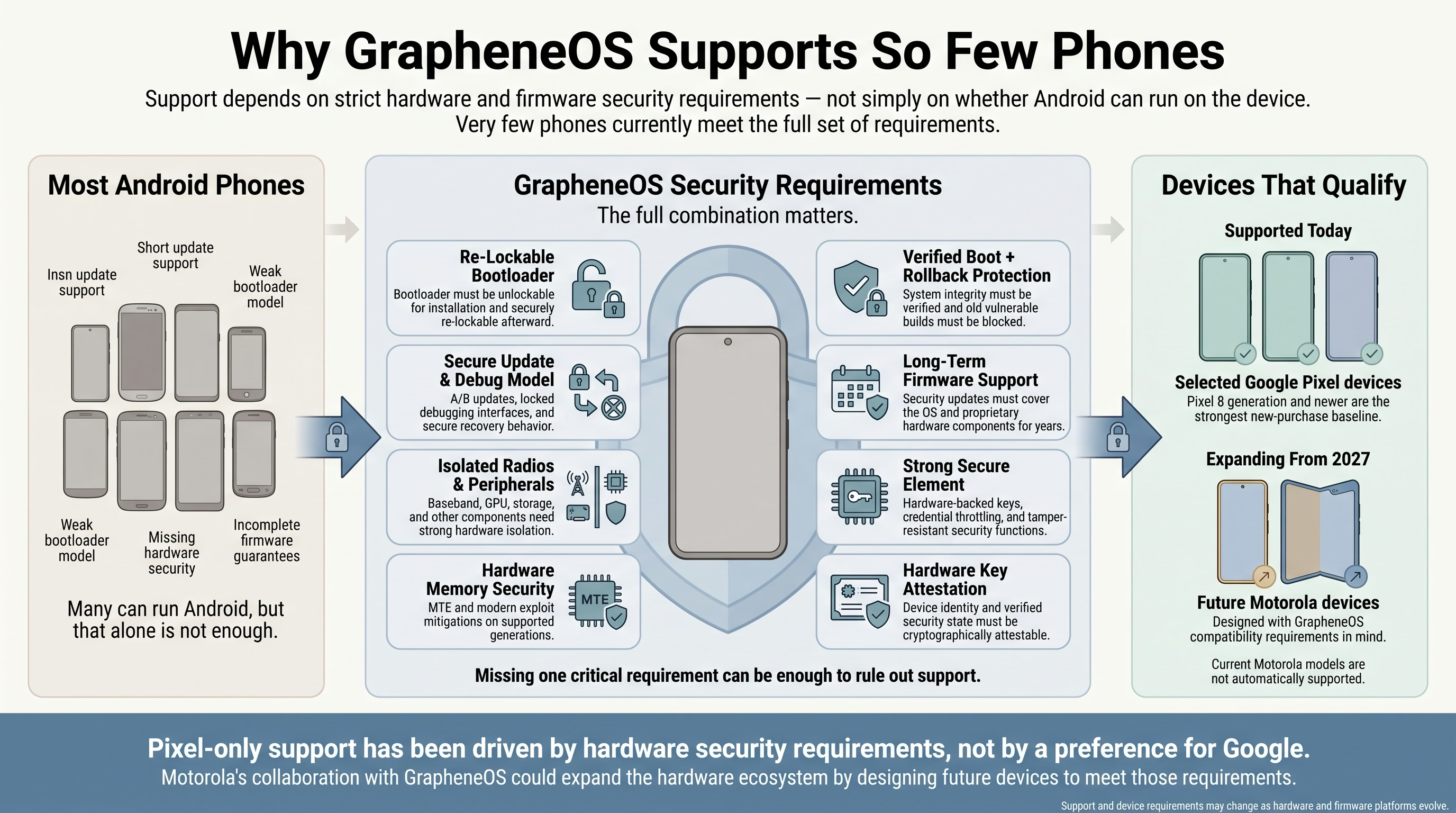
The Pixel relationship looks paradoxical because a project famous for reducing Google's software privileges has historically required users to buy phones manufactured by Google. The explanation is hardware security rather than brand loyalty.
GrapheneOS publishes unusually demanding device requirements covering bootloader relocking, verified boot, rollback prevention, long firmware support, secure elements, hardware key attestation, credential throttling, memory tagging, isolated radios and peripherals, A/B firmware updates, Wi-Fi identifier privacy, hardware USB controls, and locked debugging interfaces.
Most Android manufacturers can satisfy some of these requirements, but GrapheneOS has historically required the combination. A phone with an unlockable bootloader is not sufficient if it cannot be securely relocked afterward, while a device with good Android updates is insufficient if proprietary firmware goes unpatched. A "privacy phone" with an unlocked bootloader can actually weaken important integrity protections.
This is one reason GrapheneOS should not be treated as interchangeable with every alternate Android distribution.
Motorola Could Change the Hardware Story in 2027
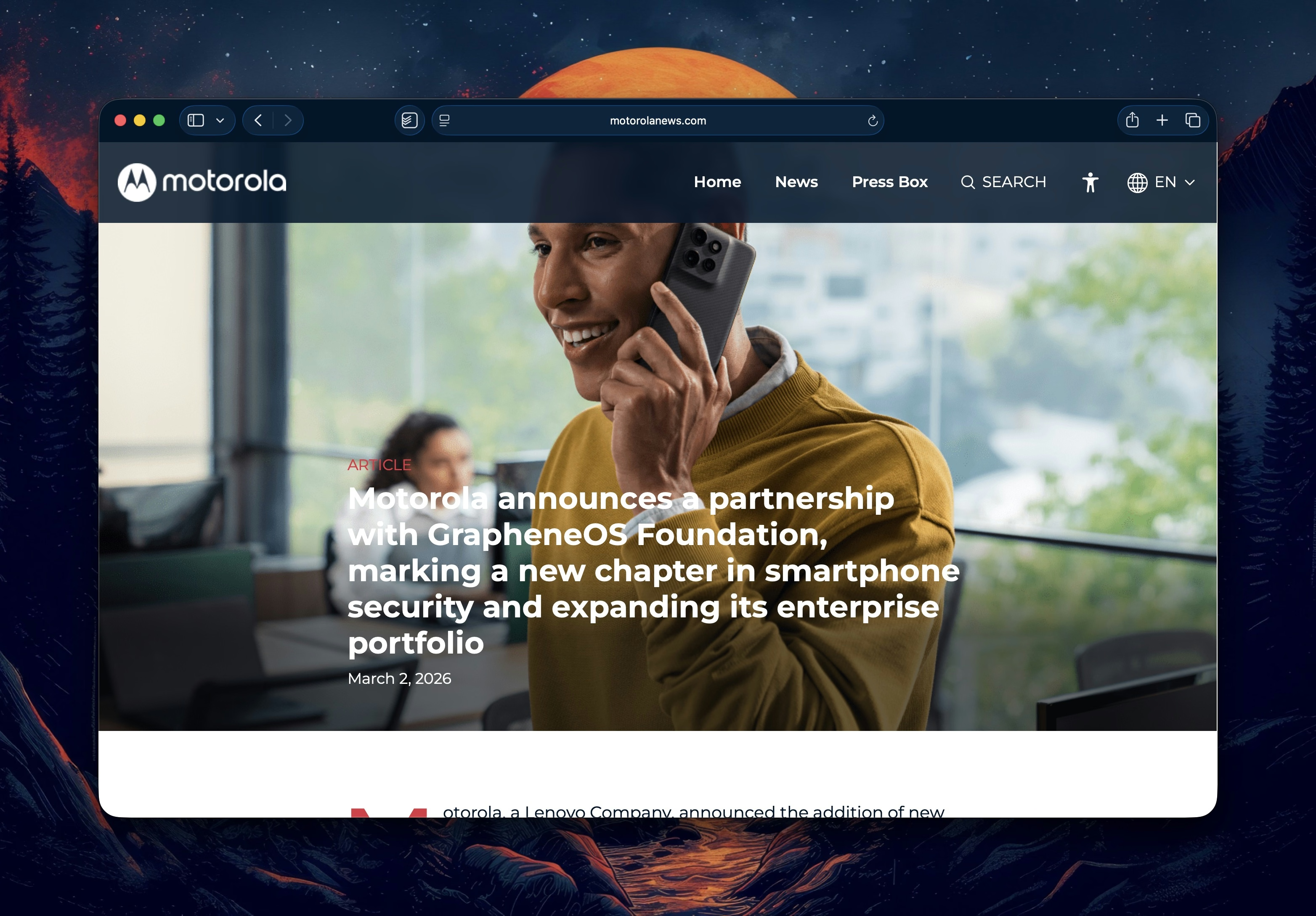
This is now one of the most strategically interesting GrapheneOS developments.
Motorola announced a long-term partnership with the GrapheneOS Foundation at Mobile World Congress in March 2026. The companies said they would collaborate on future devices engineered for GrapheneOS compatibility, security research, software improvements, and new capabilities.
More details emerged in August. GrapheneOS expects its first supported Motorola devices in 2027, with current reporting indicating that the initial target is a traditional non-folding flagship, followed by plans to expand into future Razr Fold and Razr Ultra families. Current Motorola devices are not expected to receive support retroactively.
That reporting is now confirmed. On September 25, 2026, GrapheneOS named the device: the Motorola Signature 27 will be the first non-Pixel phone with official production support, expected in 2027 as a traditional flagship-class slab rather than a fold. Reported specifications include a Snapdragon 8 Elite Extreme Gen 6 chipset, seven years of OS and security updates, hardware Memory Tagging Extension, and the secure-element integration GrapheneOS requires of every supported platform, the same requirements that held up Pixel 11's support earlier this year.
The hardware requirements explain why. GrapheneOS says current Motorola flagships are close to the target but still lack pieces such as the memory-tagging and secure-element integration expected from next-generation Qualcomm flagship platforms. We cover what ThinkShield does and doesn't protect on today's hardware in our Motorola security breakdown.
Motorola is also expected to provide firmware and driver resources in a form better suited to GrapheneOS development, with problems escalated through Motorola and Qualcomm instead of being worked around entirely by the GrapheneOS team. If this succeeds, the important story is bigger than getting GrapheneOS on another brand because GrapheneOS would move from merely selecting compatible hardware toward influencing how that hardware is designed.
How Do You Install GrapheneOS?
GrapheneOS supports a command-line installation method, but its official WebUSB installer is the recommended path for most users. The important requirement before starting is to buy the right hardware, because a Pixel being SIM unlocked does not necessarily mean its bootloader can be unlocked. Certain carrier-sold US models can restrict OEM unlocking, which makes GrapheneOS installation impossible even though the device may otherwise work on other networks.
The official installation process is broadly:
- Backup everything on the phone because installation wipes the device.
- Fully update the stock Pixel OS and firmware.
- Enable Developer Options and OEM unlocking.
- Boot the Pixel into Fastboot Mode and connect it directly to a supported computer.
- Use the official GrapheneOS installer to unlock the bootloader, which triggers a factory reset.
- Download and flash the correct GrapheneOS release and firmware through the installer.
- Relock the bootloader after flashing. This causes another wipe and is essential for restoring the verified-boot security model.
- Boot GrapheneOS, complete initial setup, and disable OEM unlocking.
- Verify the GrapheneOS boot identity and, for higher-risk deployments, configure Auditor or another independent attestation workflow.
Relocking deserves emphasis because an alternate Android system installed on a permanently unlocked bootloader does not have the same physical tamper resistance as a correctly installed GrapheneOS device whose boot chain is locked and verified.
GrapheneOS also discourages buying phones from third parties simply because they advertise GrapheneOS preinstalled. The project recommends installing it yourself, while users who do buy a pre installed device are advised to verify its boot key, factory-reset it, and configure attestation afterward.
Will Normal Android Apps Work?
Most will, and sandboxed Google Play has dramatically reduced the compatibility cost associated with using a Google-free Android base.
Carrier functionality such as ordinary calling, SMS, MMS, VoLTE, 5G, hotspot use, and many other standard features is intended to work where the underlying Pixel is officially supported by Google. Wi-Fi Calling can vary when a carrier depends on proprietary software not included with GrapheneOS.
The bigger difficulty comes from applications that do not merely test whether the device is secure. Some applications require Google certification through Play Integrity.
A GrapheneOS device can have a locked bootloader, verified boot, current firmware, a known OS signing identity, and hardware-backed attestation while still failing an application's policy because GrapheneOS itself is not certified by Google. This can affect certain banking applications, government ID systems, enterprise software, digital rights management, and contactless-payment functionality.
"Google has certified this environment" and "this environment has strong verifiable security properties" are not identical statements. GrapheneOS argues that developers should use hardware-backed Android attestation and explicitly recognize GrapheneOS where appropriate rather than treating Google certification as the sole definition of trust, although developers remain free to make different risk decisions.
Anyone considering a GrapheneOS migration should therefore test the actual banking, exchange, payment, employer, travel, eSIM, passkey, hardware-security-key, and vehicle applications they depend on before making the device their only phone.
Google's New Developer Verification System Makes the Platform Debate More Interesting
Google is simultaneously changing another part of the Android trust model.
Starting September 30, 2026, Android developer-verification protections begin taking effect for participating application stores in Brazil, Indonesia, Singapore, and Thailand, with broader global enforcement on certified Android devices planned for 2027.
The policy ties broadly distributed Android applications to registered developers. Early descriptions of the policy produced claims that Android was simply ending sideloading, but Google's current implementation is more nuanced because power users can still install unregistered applications through ADB or a new advanced installation flow, while the September 2026 enforcement applies only to specified participating stores in the initial countries.
Google's security argument is understandable: scam operators and malware developers benefit from quickly reappearing under new identities, and developer verification adds accountability and friction. The policy also raises a broader platform question about how much identity and distribution control should be centralized at the operating-system ecosystem level.
GrapheneOS provides an interesting counter-model because strong verified boot and endpoint security do not necessarily require Google's certification system to be the final authority over what the device owner installs. It would still be excessive to describe GrapheneOS as "the last open Android," but the direction of travel is worth watching.
What GrapheneOS Can Realistically Protect You Against
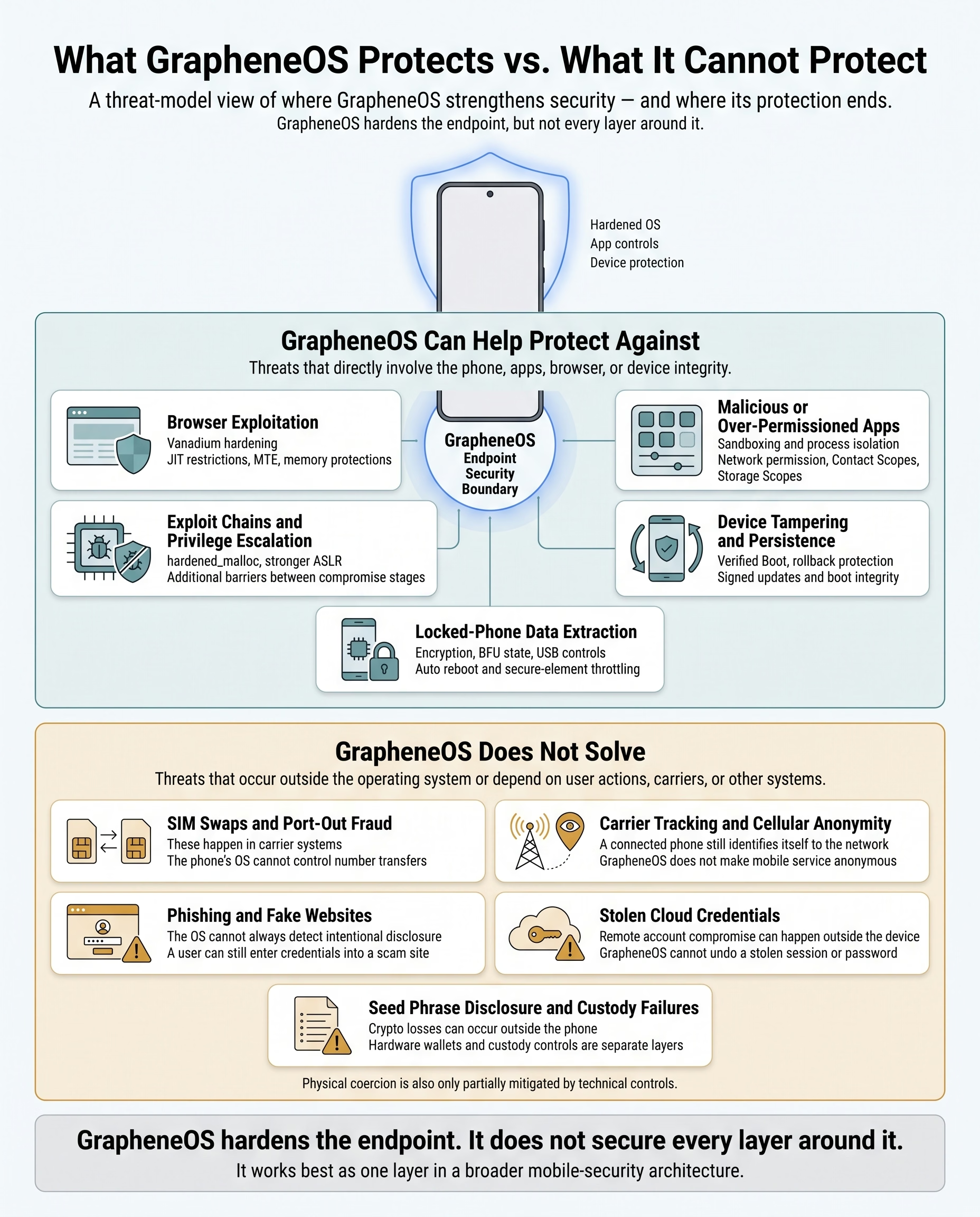
GrapheneOS's value becomes clearer when threats are evaluated one by one rather than through labels such as "private" or "secure."
This table is a better representation of GrapheneOS than either "unhackable phone" or "privacy ROM."
Who Is GrapheneOS Actually For?
The answer depends on the threat model. I would not start with whether someone considers themselves privacy-conscious, but with the consequences of compromise and the resources an attacker might rationally spend against that person.
A useful mental model is:
Expected security loss = likelihood of compromise × consequence of compromise
For an ordinary smartphone user with no particular reason to be individually targeted, the probability of a sophisticated multi-stage exploit may be very low. Keeping a current iPhone or Pixel fully updated, using strong authentication, and avoiding poor account-recovery practices may produce more practical security value than changing operating systems.
For a high-net-worth individual, the calculation can look very different even when the probability remains low. A phone may contain financial applications, access to cryptocurrency exchanges, authentication tools, sensitive contact networks, location history, private communications, identity documents, cloud access, and information useful for further social engineering.
For a founder or executive, compromise can extend into the company through email, collaboration applications, administrative accounts, board information, password managers, or personnel relationships. For journalists and attorneys, the sensitivity may lie in source identities or privileged communications rather than financial value, while public figures and people operating in hostile political or physical environments may care more about stalking, surveillance, targeted phishing, device seizure, and commercial spyware.
In those circumstances, increasing the cost of endpoint compromise is rational.
GrapheneOS is particularly suitable for users willing to maintain a supported device, review permissions, use profiles intelligently, test compatibility, install updates promptly, and tolerate occasional friction. It is a weaker fit for someone who needs every application and proprietary ecosystem feature to work exactly as it does on stock Android, or for someone likely to repeatedly disable security controls without understanding the consequences.
A badly maintained hardened phone can be a worse security decision than a well-maintained mainstream phone.
What GrapheneOS Cannot Protect You From
This is the part of a GrapheneOS review that matters most because an operating system can be extremely well hardened and still be irrelevant to the attack that ultimately succeeds.
A SIM swap, for example, happens in the carrier's provisioning infrastructure when an attacker persuades, compromises, bribes, or otherwise causes the provider to move the victim's number to another SIM or eSIM. The victim's GrapheneOS phone does not need to be touched. Fraudulent port-outs create the same problem because the number transfer occurs outside the device.
GrapheneOS also cannot make ordinary carrier communications end-to-end encrypted. Traditional SMS and carrier voice remain dependent on telecommunications infrastructure, so sensitive communications still require properly designed end-to-end encrypted applications. Nor can GrapheneOS prevent a carrier from knowing which subscriber is connected because cellular service inherently requires network participation.
Phishing remains another major boundary. If the user deliberately types a password into a convincing fraudulent website, the operating system cannot always determine that their intention is based on deception. Similarly, an attacker holding a valid cloud session or account credential may interact with the remote service without attacking the victim's phone at all.
Cryptocurrency security has the same limitation. A seed phrase written on paper, photographed, stored in insecure cloud storage, or entered into a phishing page does not become safe because the owner's daily phone runs GrapheneOS. Physical coercion also remains fundamentally human rather than purely technical, even though features such as profiles and duress credentials may alter particular scenarios.
This is why the best security architecture is layered rather than product-centric.
Where GrapheneOS and Efani Complement Each Other
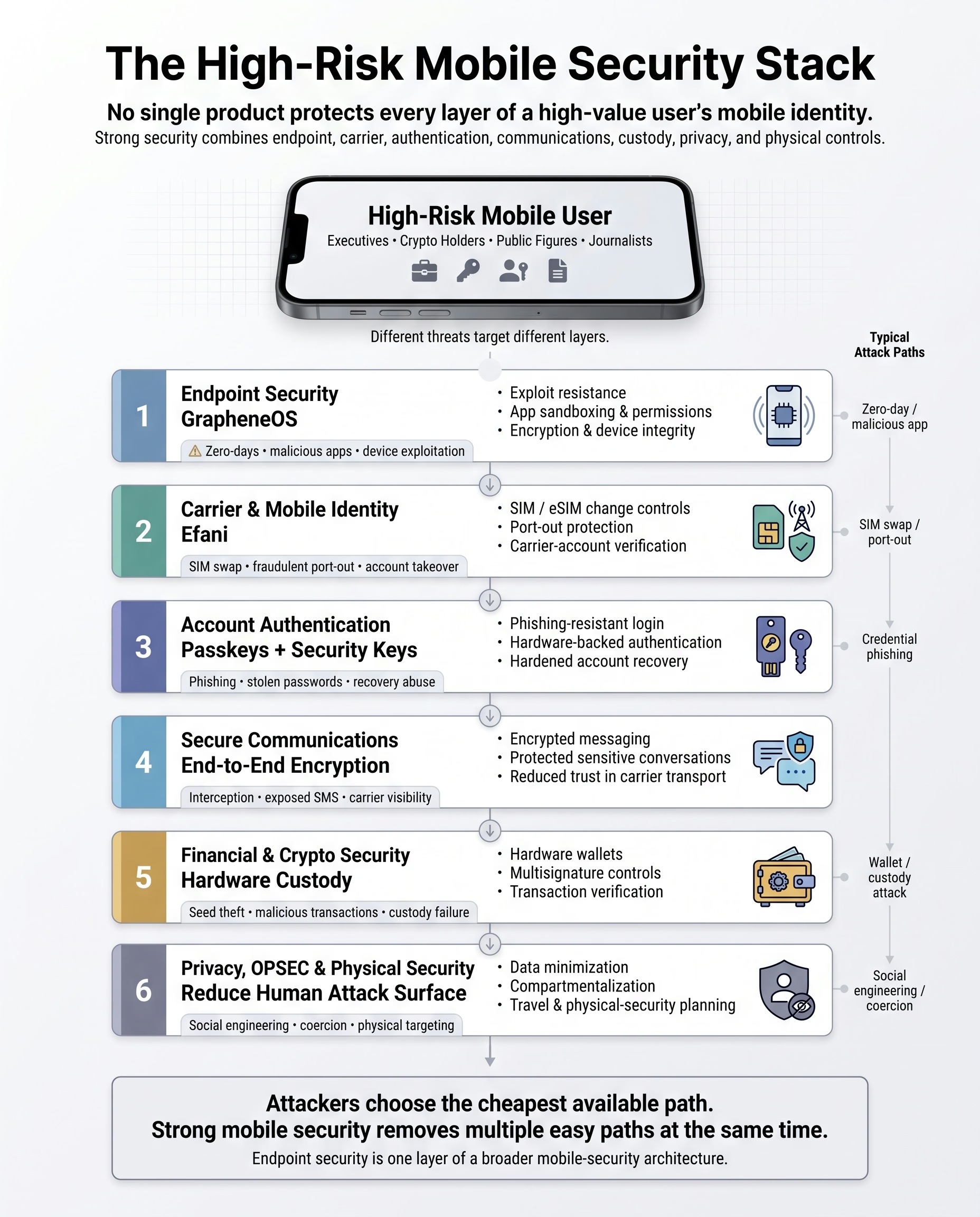
GrapheneOS primarily addresses the endpoint, while at Efani we operate at a different layer: protecting control of the mobile number and carrier account.
Imagine a high-value cryptocurrency holder running a fully updated Pixel 10 with GrapheneOS. The bootloader is locked, Google Play is sandboxed, financial applications are separated into their own profile, USB is restricted, and memory hardening is active. An attacker who finds endpoint exploitation too expensive may simply move to another attack surface.
If the mobile provider can be socially engineered into moving that person's phone number, the GrapheneOS device may remain completely uncompromised while the attacker starts receiving calls or SMS messages associated with that number. This is precisely the boundary we focus on at Efani: the operating system controls the handset, but the carrier controls whether a SIM, eSIM, or number-transfer request is authorized.
Our SAFE security model is designed to address this carrier-side threat through an 11-layer authentication process, default blocking of SIM changes, multi-person review for sensitive changes, and a cooling period for critical number changes. Our SAFE plan also includes up to $5 million in SIM-swap-related insurance coverage.
The inverse scenario is equally important. Even if we secure the carrier side against unauthorized SIM changes and number transfers, those controls cannot patch Vanadium, prevent a sandbox escape, protect application memory, or verify the operating-system boot chain if the user's device itself is compromised through a zero-day.
These are separate security layers.
I am not suggesting that Efani has a formal commercial partnership with GrapheneOS. This is a layered-security comparison between two controls operating at different trust boundaries: a hardened endpoint does not replace secure carrier processes, and strong carrier controls do not replace a hardened endpoint.
For genuinely high-risk users, my view is that these layers should be combined with phishing-resistant MFA or passkeys, hardware security keys, end-to-end encrypted communications, hardened email and account recovery, appropriate crypto custody, reduced public personal information, and physical-security planning.
Attackers tend to use whichever route is cheapest, so good security tries to remove several cheap routes at the same time.
Is GrapheneOS Better Than an iPhone With Lockdown Mode?
There is no universal answer.
Apple's Lockdown Mode is explicitly designed for the small population of users who may face highly sophisticated targeted attacks. Like GrapheneOS, it accepts some loss of functionality in exchange for reduced attack surface.
The philosophies overlap, but the platforms are fundamentally different. Apple controls the operating system, hardware, secure element, update infrastructure, application ecosystem, and much of the surrounding platform, giving it extraordinary ability to engineer and deploy protections vertically.
GrapheneOS operates in an open Android environment and offers more granular user control, optional Google integration, profile compartmentalization, extensive application-level permissions, an inspectable open-source codebase, and a more aggressive set of downstream Android hardening changes.
Apple has dramatically greater engineering resources and a much larger real-world deployment base, while GrapheneOS offers a security model with different assumptions and a different degree of user control. For some executives, an iPhone with Lockdown Mode may be the better operational choice because they will maintain it correctly and their required applications work. For technically capable users who value compartmentalization and control over platform privileges, GrapheneOS may offer properties they cannot reproduce on iOS.
The correct decision comes from the threat model rather than brand loyalty.
So, Is GrapheneOS Worth It?
For the right user, I think it can be.
What stood out to me in reviewing GrapheneOS with our team is that its strongest arguments are tied to concrete security mechanisms rather than vague promises about "privacy." A larger randomized address space is measurable, hardened_malloc can be inspected, MTE is a hardware capability with documented behavior, a locked verified boot chain can be attested, network access can be revoked, contacts and storage can be scoped, profiles can be cryptographically separated, USB attack surface can be restricted, and Google Play can operate without being granted its normal privileged role.
Independent research does not validate every GrapheneOS claim, but it does provide support for important parts of the technical case. Synacktiv's allocator analysis found meaningful exploit-hardening benefits, while the 2026 academic forensic study concluded that GrapheneOS improves Android security and complicates acquisition.
The limitations are equally important. GrapheneOS remains dependent on upstream Android and device firmware, its team is far smaller than Google or Apple, application compatibility is not perfect, and commercial forensic and spyware capabilities evolve in secret. No public evidence establishes immunity from a sufficiently sophisticated attacker.
More importantly, many of the attacks we see affecting high-value people do not begin with an operating-system exploit. They begin with an exposed phone number, a weak carrier workflow, compromised email, phishing, cloud recovery, leaked personal information, or a human being convinced to authorize the wrong action.
GrapheneOS does not solve those problems, and that is not a criticism of GrapheneOS. It is a reminder that every threat model has boundaries.
Final Verdict
GrapheneOS is much more than de-Googled Android. It is an attempt to take Android's already substantial security model and systematically increase the difficulty of exploitation, reduce unnecessary privileges, constrain data exposure, strengthen physical-device security, and give the user more control over trust relationships.
For most ordinary users, switching may not be essential. A fully updated modern Pixel or iPhone with strong authentication and sensible security practices already provides a strong baseline. For a person whose identity, assets, occupation, relationships, or public profile make them individually attractive to sophisticated attackers, GrapheneOS becomes much easier to justify.
The strongest reason to use it is not because it promises that nobody can hack your phone. Its architecture instead tries to ensure that attackers encounter fewer easy paths, less reliable exploitation primitives, stronger containment boundaries, and less unnecessary data exposure.
For high-risk users, that can materially change attacker economics. The mistake would be assuming that securing the phone means securing the entire mobile identity.
GrapheneOS protects the endpoint. At Efani, we focus on protecting the mobile number and carrier-account layer. Phishing-resistant authentication protects accounts, end-to-end encryption protects sensitive communications, hardware custody protects high-value cryptographic keys, while operational and physical security protects the human being carrying all of it.
A secure phone is useful because it strengthens one critical layer. The much harder problem, and the more important goal, is building a secure mobile architecture around it.


