
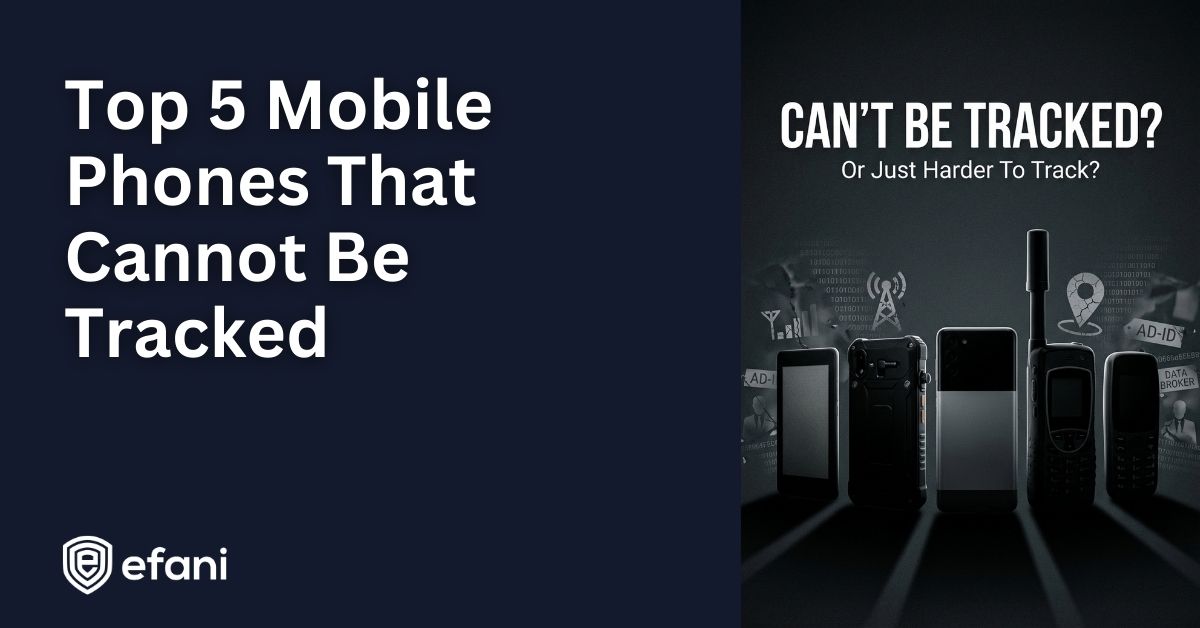
Top 5 Phones That Cannot Be Tracked in 2026 (And What “Untraceable” Really Means)


Introduction
In 2025, a large breach analysis that tracked password exposure across hundreds of incidents counted 19,030,305,929 leaked passwords in circulation. The ugly detail was reuse: only 6% were unique, meaning 94% were duplicated or reused, and the classic weak password "123456" showed up about 338 million times.
That matters because once a criminal resets your credentials, the next escalation is often your mobile identity: takeover your email, then your bank, then your number. From there, attackers can pursue SIM swaps, port-out fraud, and account takeover to intercept verification codes and reset everything tied to your phone.
In the FBI's 2024 cybercrime reporting, overall complaints reached 859,532 with reported losses of $16.6 billion, and SIM swap losses alone were about $25,983,946.
Mobile threats are also scaling fast. In Q2 2025, security monitoring reported 10.71 million blocked attempts involving mobile malware, adware, and unwanted mobile software, including 42,220 mobile banking trojan installation packages and 695 mobile ransomware packages.
Then there is the tracking economy. Investigations into data brokers have described location and ad-identifier datasets in the hundreds of millions, including claims of 500 million advertising identifiers paired with location data, and datasets representing 61 million unique devices in a single week.
This is why demand keeps climbing for the best burner phone, the most secure phone, and the mythical untraceable phone. The truth is simpler:
A phone that "cannot be tracked" is really a phone that creates less data exhaust, has fewer ways to betray you, and is backed by carrier protections that prevent number theft.
If you want the carrier-side angle first, start here:
- SIM swap basics: What Is a SIM Swap Scam
- Stop the most common transfer attack path: How Port-Out Locks Protect You From SIM Swap Attacks
- Free exposure check: Efani NumberScan and NumberScan tool guide
Is your cellphone vulnerable to SIM Swap? Get a FREE scan now!
Please ensure your number is in the correct format.
Valid for US numbers only!
What Makes a Phone "Untraceable"
To judge any "untraceable" phone, you need to understand the surveillance stack it is trying to reduce. Not eliminate. Reduce.
IMEI and IMSI logs
- How it tracks you: When you use cellular, towers and carriers can log device and subscriber identifiers and build a movement and usage profile over time.
- Safer countermeasures:
- Use devices that do less in the background so the network sees less chatter
- Keep radios off when you do not need them
- Treat your phone number as a security asset, not a casual identifier
- Harden carrier controls to prevent number theft: Efani port-out lock primer
Fake towers and IMSI catchers
- How it tracks you: IMSI catchers and fake towers can coerce devices into revealing identity information and can enable surveillance in high-risk areas.
- Safer countermeasures:
- Prefer modern networks and keep your device updated
- Reduce time connected in sensitive locations
GPS, Wi-Fi scanning, and sensor metadata
- How it tracks you: GPS, Wi-Fi SSIDs, Bluetooth beacons, and app permissions can leak location even when you never open a map.
- Safer countermeasures:
- Disable location services when not needed
- Say no to "always allow" location permissions
- Avoid installing apps that monetize location
App and OS telemetry
- How it tracks you: Many mainstream phone setups send analytics, identifiers, and usage signals into cloud ecosystems and ad tech pipelines.
- Safer countermeasures:
- Use minimal devices, privacy-forward operating systems, or strongly controlled app installs
- Separate "work mode" from "personal mode" when possible
Legal intercept and data retention
- How it tracks you: Even if your phone is clean, carrier records and lawful requests can still expose usage patterns.
- Safer countermeasures:
- Use end-to-end encrypted messaging for sensitive conversations
- Reduce reliance on SMS for authentication.
Satellites are Going Mainstream
A big shift is happening right now. In February 2026, a UK carrier launched a satellite-to-smartphone service priced at £3 per month and claimed it could raise landmass coverage from 89% to 95%.
Services like this are expanding, and similar satellite add-ons are being marketed elsewhere. Satellite connectivity is becoming a feature, not just a special device category.
That does not make phones untrackable. It changes who can log what, and what identifiers you are tied to.
The Top 5 Untraceable Phones (That Cannot Be Tracked)
Picked for their ability to reduce app-level telemetry, limit tracking surface, and make compromise harder, while still being usable.
1. Light Phone II or Light Phone III | Best everyday minimalist burner
A minimalist phone is one of the strongest ways to cut tracking because it reduces the biggest leak: the app ecosystem.
Light Phone II (current baseline)
- Price point: about $299
- SIM: nano-SIM
- Privacy advantage: no social media apps, no app store addiction loop, minimal background noise
- Quick disconnect: a one-toggle Airplane Mode disables antennas including Wi-Fi and Bluetooth
Light Phone III (newest model)
- Price point: $699 pre-order, with estimated deliveries in April 2026
- Network: 5G plus 4G LTE
- SIM: nano-SIM plus eSIM
- Battery: 1800 mAh (nearly double the Light Phone II's 950 mAh baseline)
- New hardware: fingerprint ID and NFC
Best for: people who want a phone that is useful, but does not run their life.
2. Purism Librem 5 USA | Open-source focused privacy build
If you care about transparency and physical controls, this is the "auditability first" option.
- Starting price: $1,999
- Hardware kill switches: physically disconnect key components such as cellular modem, Wi-Fi/Bluetooth, and camera/microphone
- OS posture: Linux-based approach that avoids the standard Google Play telemetry model
- Long-life angle: user-replaceable parts and batteries are part of the design story
Best for: privacy pros, engineers, and people who want physical switches that change what the device can do.
3. Bittium Tough Mobile 2 C | High assurance Android with real separation
This category exists for a different customer: security-critical organizations that want hardened separation.
- Core concept: two isolated operating systems so personal and confidential environments do not mix
- Security posture: hardened build with strong device integrity and anti-tamper focus
- Use case: controlled deployments, not casual consumer customization
Latest note: Bittium has also announced Tough Mobile 3, a 5G successor positioned for government-grade dual-OS and higher certification targets, but it is listed as available in 2027.
Best for: enterprises and high-risk roles that need hardened separation, not just "privacy settings."
4. Iridium Extreme 9575 | True satellite phone for off-grid resilience
No terrestrial towers, no classic cell-site triangulation, and built for harsh environments.
- Ingress and durability: IP65 and MIL-STD 810F
- Battery: 4 hours talk, 30 hours standby
- Weight: 247 g
- Important note: location-based services exist on this class of devices, so stealth depends on configuration and use, not just the network path
Legal warning: satellite phones are restricted or banned in some countries, and rules change. Always check local laws before travel.
Best for: expeditions, remote work, disaster response, and situations where towers are unreliable or shut down.
5. Nokia 105 4G (2024) | Disposable low-telemetry feature phone
Sometimes privacy is about reducing complexity.
- Weight: 92.99 g
- Display: 2.4-inch
- Battery: 1450 mAh removable battery with claims of up to 15 days standby
- Charging: USB Type-C
- Why it helps: no app ecosystem, fewer permissions, less ad-tech exposure by default
Best for: compartmentalization, basic calling and texting, and a "smaller attack surface" daily carry.
Comparison
SIM Swap Protection
Get our SAFE plan for guaranteed SIM swap protection.
Legal and ethical caveats of an untraceable phone
Using a privacy-forward handset does not create legal immunity, and it does not make you invisible.
- Any phone that connects to a network can leave records with operators and services.
- Many countries require identity checks for SIM activation and may restrict satellite communications.
- "Untraceable" is best understood as harder to track, not impossible to track.
If you need practical protection that does not depend on myths, start with the parts criminals actually target:
- Your number and carrier controls: How Port-Out Locks Protect You From SIM Swap Attacks
- How attackers weaponize your number: Can Someone Hack You With Just Your Phone Number
- Account takeover foundations: Account Takeover Fraud Guide
Monthly
Yearly
Keep Your Number Off the Hacker Menu
Even the best "untrackable phone" fails if your number gets stolen. If your phone number is tied to email resets, banking, and crypto, it becomes a master key.
Efani is built around preventing that theft, not just refunding you after it happens:
- 11-layer authentication plus default blocking
- A port-out cooling-off layer as a last-resort safeguard
- $5 million SIM swap insurance positioned as a performance pledge
Explore:
- How Efani works
- SIM swap insurance explained
- Most Secure Cell Phone Services in 2026, ranked
- Run a free NumberScan
Protect your line now at Efani.com
Looking for overall security beyond tracking? Check our Most Secure Phones ranking.
Conclusion
What today's "untraceable phones" really buy you is friction. Extra steps and fewer weak points for trackers, data brokers, and criminals to exploit.
A strong setup looks like this:
- A low-telemetry device choice (minimal phone, hardened phone, or feature phone)
- Fewer apps and fewer permissions
- Modern authentication that does not depend on SMS: How SIM Swaps Bypass 2FA
- Carrier defenses that stop number theft at the source: Port-out locks explained
Do that, and you shrink the attack surface that turns password leaks into full identity takeovers.
Also Read: Top 5 Most Hacked Phone Brands, What You Need to Know
FAQs
1. Are untraceable phones legal to own in the United States?
Owning privacy-focused phones is generally legal in the U.S., but laws and carrier policies vary. You still have to comply with telecom rules, and using any device for illegal activity is still illegal.
2. Can law enforcement still track a satellite phone?
A satellite phone avoids cell tower triangulation, but it can still create logs at the provider level, and specialized interception capabilities exist in some contexts. Also, local laws may restrict possession or use.
3. How do SIM swaps bypass 2FA so often?
Because SMS is delivered to a phone number, not to you as a person. If an attacker steals the number, they can receive verification codes. This is why moving critical accounts away from SMS is a major upgrade.
4. Does using an eSIM make my phone easier or harder to trace?
An eSIM can be safer against physical SIM theft, but it is often tied to a carrier profile with stronger identity linkage. For day-to-day security, eSIM plus carrier hardening can be great. For privacy and compartmentalization, physical SIMs can be simpler, depending on local rules.
5. Are feature phones safer than de-Googled smartphones?
Feature phones usually leak less app telemetry because they do not run the same ad-driven app ecosystem. But they also lack many modern security controls and encrypted messaging options. The "best" choice depends on your threat model, and your ability to securely configure the device you choose.


