Enterprise Mobile Security Explained, Protecting Identity, Devices, and Data at Scale


Introduction
Mobile devices are modern day identity tokens, authentication devices, data containers, approval systems, and access keys to cloud infrastructure. For many employees, the phone is now more critical to daily work than the laptop.
That reality has changed how security teams need to think.
Enterprise mobile security is not about locking phones down or installing one management tool and calling it a day. Rather, you’re building a security architecture that assumes mobile devices are always connected, frequently personal, and constantly interacting with sensitive systems.
Is your cellphone vulnerable to SIM Swap? Get a FREE scan now!
Please ensure your number is in the correct format.
Valid for US numbers only!
What Enterprise Mobile Security Really Is
At its core, enterprise mobile security is the discipline of protecting organizational data, identities, and systems when access happens through mobile devices.
That includes smartphones and tablets, whether they are corporate owned or personally owned, and whether they are used occasionally or as the primary work device.
Enterprise mobile security sits at the intersection of several domains:
- Endpoint security
- Identity and access management
- Application security
- Data protection
- Network access control
Unlike traditional endpoint security, mobile security has to operate in environments the enterprise does not fully control. Phones leave the office, join unknown networks, install consumer apps, and move across borders. The security model has to assume mobility, not fight it.
A useful way to think about it is this:
Enterprise mobile security is about controlling trust, not controlling people.
You are constantly answering questions like:
- Is this device healthy
- Is this user really who they claim to be
- Is this app allowed to access this data
- Is this network path acceptable
- Is the risk level low enough right now
The answers change over time, so the system has to adapt continuously.
Why Mobile Is A High Risk Enterprise Surface
Mobile devices concentrate risk in ways that desktops and servers never did.
- First, phones are identity hubs. They receive authentication prompts, MFA approvals, password resets, and account recovery messages. Compromise the phone and you often compromise the user.
- Second, phones are always connected. They switch between cellular, home Wi-Fi, office Wi-Fi, hotel networks, and public hotspots without the user thinking about it.
- Third, phones blend personal and work activity. Messaging apps, cloud storage, screenshots, keyboards, and notifications all blur the line between business data and personal behavior.
- And remember, phones are physically vulnerable. They are lost, stolen, borrowed, resold, and shared far more often than laptops.
From an attacker’s perspective, mobile devices are extremely attractive because they combine identity, access, and portability in one object.
Enterprise mobile security exists to make that reality survivable.
The Threat Model Enterprise Mobile Security Addresses
A full mobile security strategy is designed around a realistic threat model, not worst case paranoia.
Some of the most common threat categories include:
1. Device Loss And Theft
A lost phone can expose email, chat history, files, saved sessions, and authentication apps. Even without cracking the device, an attacker may gain access through notifications or unlocked apps.
2. Account Takeover And Identity Abuse
Phishing, credential reuse, MFA fatigue, and social engineering often lead to attackers signing in as real users from their own devices or from compromised phones.
3. Malicious And Risky Applications
Some apps are outright malicious. Others quietly collect data, inject ads, log keystrokes, or abuse accessibility features. Even legitimate apps can introduce risk when they interact with corporate data.
4. Untrusted Networks
Public Wi-Fi, captive portals, and hostile networks can intercept traffic, manipulate DNS, or redirect users to phishing pages.
5. OS And Platform Vulnerabilities
Devices that fall behind on updates expose known exploits. Rooted or jailbroken devices remove platform protections entirely.
6. Data Leakage Without A Breach
Screenshots, copy paste, personal cloud backups, forwarding email, and messaging files to personal accounts can leak sensitive data without any attacker involvement.
7. SIM Swap And Carrier Layer Attacks
If authentication or recovery relies on phone numbers, attackers may target the carrier itself to intercept messages or take over the number.
Enterprise mobile security does not eliminate these risks. It reduces their impact and shortens the window of damage.
SIM Swap Protection
Get our SAFE plan for guaranteed SIM swap protection.
The Foundational Pillars Of Enterprise Mobile Security
A real enterprise mobile security program is built from several pillars that reinforce each other.
Governance And Policy
Everything starts with policy. Not legal boilerplate, but practical rules that guide technical decisions.
This includes:
- Which device ownership models are supported
- What data is allowed on mobile
- Minimum OS and hardware requirements
- Acceptable authentication methods
- Compliance expectations and consequences
Without clear policy, mobile security tools become inconsistent and political.
Device Management And Posture Control
Mobile device management, often delivered through unified endpoint management, establishes baseline trust.
This layer handles:
- Device enrollment and identity
- Security configuration enforcement
- OS version and patch compliance
- Encryption and screen lock requirements
- Certificate distribution
- Remote lock and wipe capabilities
On modern platforms, this layer also enables work profiles, managed apps, and selective data removal.
Identity And Access Security
Identity is the real control plane of mobile security.
This includes:
- Centralized identity providers
- Strong authentication methods
- Conditional access based on device health
- Session controls and risk scoring
- Step up authentication for sensitive actions
Modern mobile security assumes identity is dynamic. Access decisions are continuously re-evaluated based on context.
Application Management And Isolation
Applications are where work happens, so they need their own controls.
This layer provides:
- Approved app distribution
- Managed configurations
- Work and personal separation
- Restrictions on data sharing between apps
- App level access control
On Android, this often means a work profile. On iOS, it means managed app flags and managed open-in rules.
Data Protection And Leakage Prevention
Protecting data means assuming it will move.
Controls here include:
- Encryption in transit and at rest
- Secure storage for credentials and tokens
- Restrictions on copy, paste, save, and share
- Backup and restore policies
- Certificate and key management
The goal is that data remains protected even if the device is not.
Network And Access Path Security
Mobile security cannot rely on trusted networks.
Modern approaches include:
- Per-app VPN
- App level access proxies
- Zero trust network access
- Secure DNS and web filtering
Access is granted to specific resources, not entire networks.
Threat Detection And Risk Signaling
Mobile threat defense adds visibility into:
- Malicious apps and behaviors
- Phishing attempts
- Network manipulation
- Device compromise indicators
When integrated properly, these signals feed directly into access control decisions.
Monitoring And Incident Response
No security system works without feedback.
This layer includes:
- Centralized logging
- Alerting and correlation
- Automated remediation actions
- Defined response workflows
The focus is speed and consistency, not blame.
Monthly
Yearly
Enterprise Mobile Security Architecture Explained
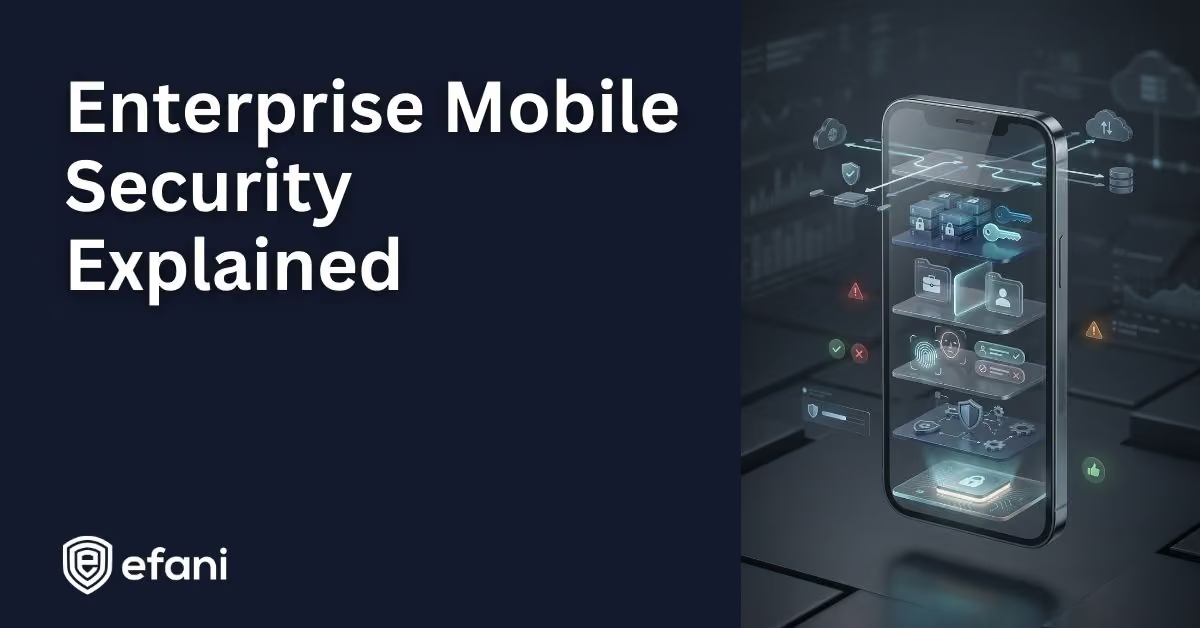
A modern enterprise mobile security architecture is layered and event driven.
At the bottom is the device itself, protected by hardware features like secure boot, trusted execution environments, and biometric authentication.
On top of that sits device management, which establishes configuration and compliance.
Identity systems sit alongside device management, evaluating who the user is and whether the device should be trusted right now.
Applications are managed and isolated so work data stays within approved boundaries.
Network access is mediated through identity aware controls rather than static network trust.
Threat signals continuously feed back into the system, adjusting access in near real time.
This architecture is designed around continuous verification, not one-time approval.
Device Ownership Models And Their Impact
Ownership defines how much control you can reasonably apply.
BYOD environments prioritize privacy and selective controls. The enterprise secures work data, not the entire device.
Corporate owned devices allow stronger enforcement but still require respect for personal use in many regions.
Fully managed devices can be locked down aggressively, often for frontline or shared use cases.
A common failure is trying to apply one model everywhere. Mature programs design controls per ownership type.
What A Mature Enterprise Mobile Security Program Looks Like
In practice, a strong program includes:
- Clear enrollment paths that users can complete without friction
- Baseline compliance enforced automatically
- Conditional access tied to device health and risk
- Strong authentication that does not rely on phone numbers alone
- Separation of work and personal data
- Automated response to lost or risky devices
- Visibility across the mobile fleet
Most importantly, it aligns with how people actually work.
Common Failure Patterns
Organizations struggle when they:
- Treat mobile as an afterthought
- Rely solely on MDM without identity integration
- Overreach on personal devices
- Depend on SMS for critical security flows
- Ignore user experience and support
Mobile security fails quietly when users route around it.
Why Enterprise Mobile Security Is Now Mission Critical
As work becomes more distributed, mobile devices are increasingly the primary interface to corporate systems.
They approve transactions, unlock accounts, authenticate sessions, and carry sensitive conversations.
That makes mobile security inseparable from identity security and account protection.
Enterprises that treat mobile security as a core architecture problem, not a tool purchase, are far better positioned to handle modern threats.
Final Perspective
Enterprise mobile security is about controlling trust in a world where work happens everywhere.
When done right, it fades into the background. People work normally. Access feels seamless. Risk is reduced quietly and continuously.
That is what modern enterprise mobile security is designed to achieve.