
DeniableOS Review: Can a Phone Keep Secrets When Its Owner Is Forced to Unlock It?


Introduction
Mobile security is usually discussed in terms of stopping someone from breaking into a device. DeniableOS approaches the problem from a different direction: what happens when the attacker does not need to break the encryption because they can force the person holding the phone to unlock it?
That is an important question for high-risk individuals. Executives, cryptocurrency holders, journalists, public figures, attorneys, and others with valuable information or financial authority increasingly have to consider physical coercion alongside malware, phishing, account takeover, SIM swapping, and conventional device theft.
For this review, Efani examined DeniableOS as a complementary security service within that broader protection stack. We looked at what the company says its technology does, how it differs from GrapheneOS, the cryptographic ideas behind it, the types of attacks it could realistically help with, and the assumptions that have to remain true for its concept of plausible deniability to work.
As I worked through the research, what stood out to me was the gap between how straightforward the idea sounds and how difficult it is to validate in practice. The security problem DeniableOS addresses is legitimate, and parts of its design are technically interesting. However, its most important differentiating technology remains closed source, and some of its strongest claims about forensic invisibility cannot currently be independently verified from the public evidence we found.
That matters because DeniableOS is not designed for low-stakes privacy. It is marketed toward people who may rely on it during robbery, kidnapping, detention, confiscation, or other coercive situations where failure can have serious consequences.
Is your cellphone vulnerable to SIM Swap? Get a FREE scan now!
Please ensure your number is in the correct format.
Valid for US numbers only!
What DeniableOS Is Trying to Solve
Modern smartphones already contain formidable security controls. Encryption, secure elements, verified boot, hardware-backed credential protection, application sandboxing, biometric authentication, and exploit mitigations can make unauthorized access extremely difficult. Those controls work best when the attacker is fighting the device. They become less useful when the attacker targets the owner instead.
Security researchers and cryptocurrency communities have long referred to this as the "$5 wrench attack": rather than spending enormous resources breaking strong cryptography, an attacker applies physical pressure to the person who already knows the password. DeniableOS is designed around this coerced-key problem.
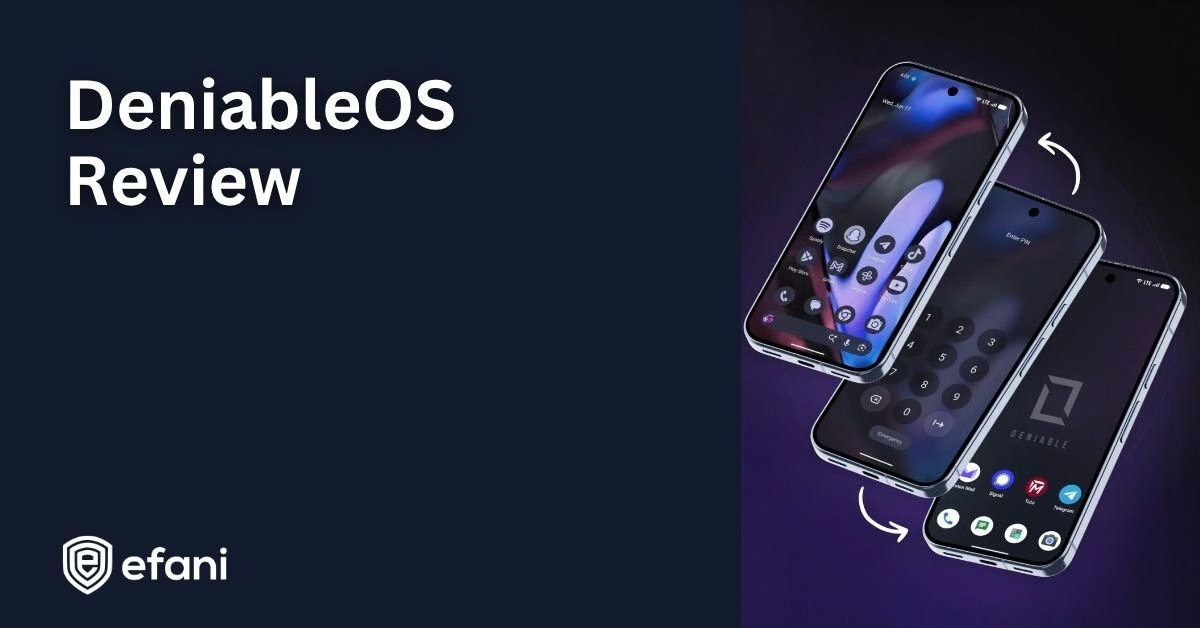
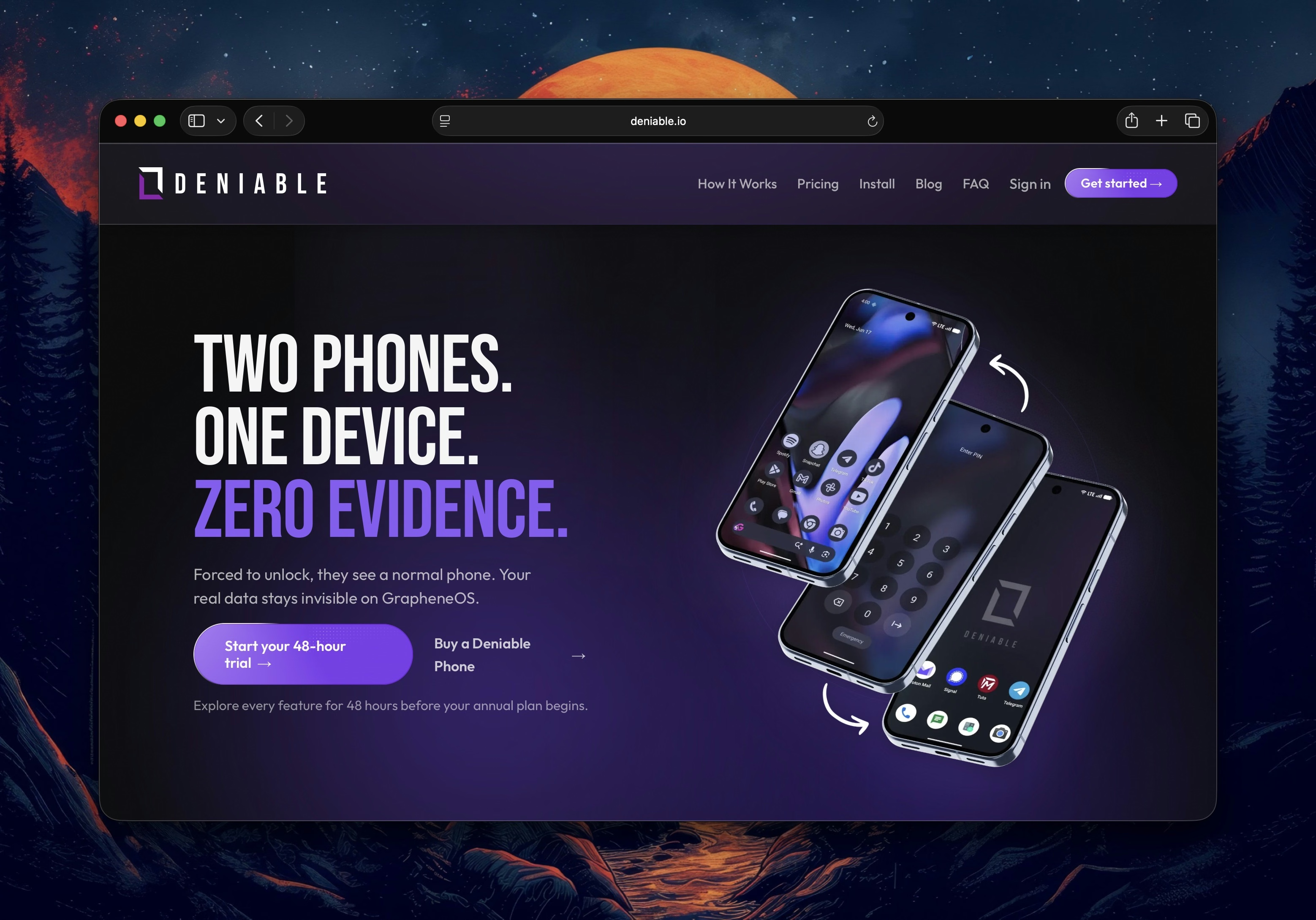
The operating system is developed by UK-based Deniable LTD and is built on GrapheneOS, the hardened Android operating system known for strengthening the security and privacy of Google Pixel devices. Deniable adds its own layer intended to separate an ordinary public phone environment from a concealed environment containing more sensitive information.
Deniable LTD itself is relatively young. UK Companies House records show that the company was incorporated in July 2024, with Joshua David Thomas listed as director and person with significant control. Deniable is also associated with venture builder Karakoram, which describes it as a "cyberphysical security" company.
Karakoram says Deniable has been used by journalists, NGOs, intelligence personnel, legal teams, and an unnamed international media organization. Those deployment claims are worth noting, but they remain largely first-party assertions. We did not find enough public, independently attributable evidence to verify the customers or operational results behind them.
That does not invalidate the product. It does mean that product capabilities and field-performance claims need to be separated from independently established evidence throughout this review.
How the Three-PIN System Works
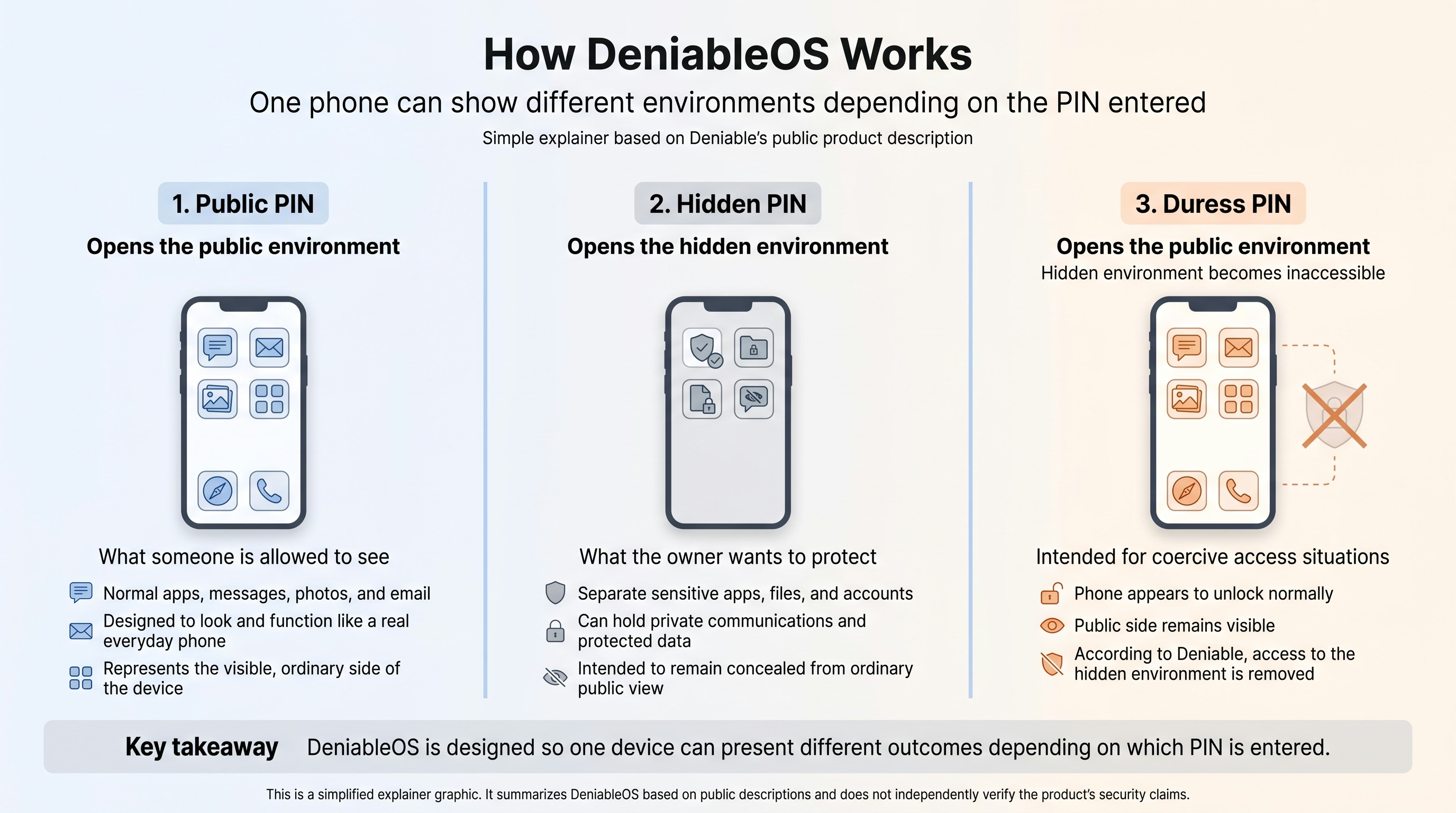
DeniableOS is easiest to understand through its credential model. A normal public PIN opens an ordinary Android environment that is meant to look and function like a real phone rather than an obviously empty decoy. It can contain legitimate photographs, messages, applications, email, browsing activity, contacts, and other everyday information.
A separate hidden PIN opens another environment containing the information the owner actually wants to protect. According to Deniable, the hidden space can contain different applications, accounts, communications, files, and cryptocurrency-related information without appearing as an obvious second Android user profile.
The third credential is a duress PIN. Deniable says entering it opens the public environment normally while silently destroying access to the concealed environment. The difference between that approach and an ordinary emergency wipe is primarily psychological. A visibly wiped phone tells the person demanding access that information has just been destroyed, while Deniable tries to make the interaction look like successful cooperation by showing a usable public environment.
For certain threat models, that is a meaningful distinction. The system is attempting to address not only confidentiality, but also the behavior and expectations of the person demanding access.
How This Differs From GrapheneOS
DeniableOS should not be understood as an alternative to GrapheneOS in the usual sense because GrapheneOS provides much of its security foundation. GrapheneOS already offers substantial Android hardening, including stronger exploit mitigations, enhanced sandboxing, hardware-backed security, verified boot, improved user profiles, USB protections, automatic reboot functionality, and a duress PIN or password feature.
Its duress credential can irreversibly wipe the device and installed eSIMs. That can be effective if the objective is to make data unavailable quickly, but it does not attempt to hide the fact that a destructive action occurred.
Deniable's claimed addition is therefore more specific: preserve a believable public phone while concealing, or under duress eliminating, a second environment. The two systems are complementary at the technical level. GrapheneOS focuses heavily on protecting the endpoint against compromise, while Deniable attempts to add a layer for situations where the user is being pressured.
There is an important security implication, however. Building on GrapheneOS does not automatically mean every additional modification inherits the same level of assurance as the upstream project. Changes to security-sensitive components can introduce new bugs, metadata leakage, patch delays, filesystem issues, or unexpected interactions with existing protections.
For a downstream operating system, questions such as update cadence, operating-system signing, verified boot, bootloader locking, device attestation, and the behavior of newly introduced storage mechanisms matter. Public information gives us a reasonable picture of the intended architecture, but not enough detail to independently validate every aspect of the Deniable-specific layer.
Deniable Encryption Is a Real Cryptographic Idea
The theory behind DeniableOS is not invented marketing terminology. Deniable encryption has existed in cryptographic research for decades. Traditional encryption is primarily concerned with preventing someone who lacks a key from reading protected information, even though the existence of the encrypted information itself may still be obvious.
Deniable encryption addresses a different problem: can a system prevent an adversary from proving that additional protected information exists? Hidden volumes in tools such as VeraCrypt illustrate a related concept. Encrypted hidden data can be placed in storage that otherwise appears to contain random information, making it harder to distinguish meaningful ciphertext from unused encrypted space.
The theoretical idea is legitimate. Applying it to a modern smartphone is more difficult because phones create far more potential evidence than a simple encrypted container. Applications maintain databases and caches, operating systems produce logs and metadata, notifications can leave traces, cloud services synchronize data, and flash storage has allocation and wear characteristics. Devices also communicate with update servers, licensing systems, mobile networks, and external accounts.
As a result, successfully hiding encrypted blocks is only one part of creating a genuinely deniable mobile environment.
What Does "Invisible" Mean in Practice?
This is where Deniable's claims require the most careful interpretation. Some of the company's public materials have used strong language around hidden storage being "provably invisible," leaving "zero evidence," or giving forensic investigators nothing to find. Deniable explains that the concealed storage is designed to resemble random unused encrypted space, meaning statistical examination of the encrypted blocks should not reveal which areas contain meaningful hidden information.
The cryptographic logic behind that narrower claim is understandable. The broader forensic claim is harder to establish because an investigator does not have to prove what a particular block of ciphertext contains in order to look for evidence that a hidden environment existed.
A forensic examination could potentially include the operating-system image, partition layout, boot configuration, application state, filesystem metadata, memory, flash-storage behavior, update infrastructure, device attestation, caches, notifications, licensing records, or traces elsewhere in the user's digital environment. Historical research into deniable storage has demonstrated why this distinction matters. A hidden encrypted file can remain unreadable while an operating system or application still leaves evidence that something was opened, created, cached, or referenced.
In reviewing Deniable's own material, I found the company's more qualified explanation more convincing than the broadest marketing language. Deniable acknowledges that plausible deniability should not be interpreted as a universal mathematical guarantee and distinguishes its intended coercion scenario from a forensic laboratory that already knows the device uses this type of system and can examine it extensively.
Based on the public evidence we reviewed, I think that narrower framing is the more useful way to evaluate DeniableOS. The system appears primarily designed to improve a user's position during a coercive encounter where an attacker expects immediate access and may be satisfied by a credible public environment. That is different from claiming that a well-resourced forensic laboratory with advanced knowledge and extended possession of the device can never detect evidence associated with the system.
SIM Swap Protection
Get our SAFE plan for guaranteed SIM swap protection.
Plausible Deniability Has More Than One Layer
One of the most important findings from reviewing DeniableOS is that "plausible deniability" should not be treated as a single yes-or-no property. At the cryptographic level, the question is whether hidden ciphertext can be distinguished from ordinary random-looking encrypted storage. At the forensic level, the question expands to whether other technical artifacts on the device reveal that concealed activity occurred.
The problem then moves outside the phone. Operational records can matter. A person may have purchased a Deniable license, created an account, ordered a preconfigured device, contacted support, or communicated with update and licensing infrastructure. Deniable's own privacy disclosures describe normal commercial processing involving accounts, purchases, licensing, shipping, analytics, and external service providers. Those records do not reveal what is stored inside a hidden environment, but they illustrate why storage deniability and operational deniability are not the same thing.
Human deniability adds another variable because the attacker has to believe what they are shown. A technically effective public environment may still fail if it conflicts with what the attacker already knows about the victim. Legal deniability is separate again. Whether revealing one environment satisfies a lawful disclosure requirement depends on jurisdiction, the authority making the demand, and the specific circumstances involved.
What stood out to me here is that the cryptography is only one part of the security claim. The encryption mechanism could perform exactly as intended while outside evidence, prior knowledge, or the coercer's behavior still undermines the overall strategy.
The Closed-Source Trust Gap
Deniable confirms that its differentiating layer is currently closed source. There is nothing inherently disqualifying about proprietary security software, but it creates a different trust relationship. GrapheneOS has benefited from years of public development and scrutiny, and outside researchers can inspect its code, examine design decisions, and study its security properties.
The same level of visibility is not currently available for Deniable's core deniability mechanism. As of our review, we also did not find a publicly available independent security audit validating that layer. Deniable has referenced independent auditing as part of its roadmap, but a planned assessment cannot provide the same assurance as a completed and reviewable one.
This leaves important implementation details difficult to verify externally. Public materials do not provide enough information to independently establish exactly how hidden storage allocation behaves over time, whether activity produces identifiable filesystem or flash-wear patterns, how the duress process eliminates access to hidden information, or what survives if that operation is interrupted by a crash or loss of power.
The absence of public answers does not demonstrate a vulnerability. It does, however, create a substantial trust dependency for a product whose customers may rely on those mechanisms in unusually high-consequence situations.
From my perspective, this is the area where independent scrutiny would add the most value. The more severe the threat model, the more important it becomes to validate the proprietary layer that differentiates the product from the already well-documented GrapheneOS foundation.
Monthly
Yearly
Crypto Holders Present a Particularly Difficult Test
Cryptocurrency is one of the clearest examples of why the distinction between encryption and believable deniability matters. Consider a victim who is forced to unlock a phone and reveals a legitimate wallet containing a modest amount of cryptocurrency. If the attacker has no reason to believe additional assets exist, the public environment may serve its intended purpose.
The calculation changes dramatically when the victim is publicly known to control significant wealth. An attacker targeting a prominent investor may already have researched wallet addresses, previous transactions, exchange activity, NFTs, public statements, leaked information, or other financial indicators. Showing a wallet containing $10,000 will not necessarily persuade someone who believes the victim controls several million dollars.
External knowledge is the problem here, and a phone cannot erase a blockchain. For high-net-worth cryptocurrency holders, coercion resistance therefore should not depend on one hidden wallet or one device. Multisignature arrangements, geographically separated signing keys, withdrawal limits, transaction delays, and independent authorization requirements can reduce the value of coercing any one person.
My view is that this is where structural security becomes more important than concealment alone. A victim who refuses to reveal a key may remain useful to an attacker because continued pressure could change that decision. A victim who genuinely cannot authorize a transaction alone presents a different problem for the criminal. DeniableOS can complement a well-designed custody model, but it should not replace one.
A Convincing Public Environment Requires Operational Discipline
Deniable's decision to make the public side of the phone a genuine working environment is sensible because a visibly fake decoy could create suspicion. The difficulty is maintaining that credibility over time.
Real phones accumulate digital history, including conversations, photographs, browser activity, notifications, applications, contacts, email, and financial interactions. A public environment that remains largely untouched while the hidden environment contains all meaningful activity could eventually become inconsistent with the owner's real life.
This is especially relevant for executives and other publicly visible individuals. Someone known to communicate constantly, travel frequently, or conduct significant financial activity may struggle to make an unusually sparse device appear complete. The public environment therefore cannot simply be configured once and forgotten. Its credibility depends partly on how it is used and how well it matches what an adversary could reasonably expect to find.
That is a human and operational requirement rather than a cryptographic one.
Where DeniableOS Fits and Where It Does Not
The product makes the most sense in a relatively specific set of circumstances: the user carries genuinely sensitive information, an adversary may obtain physical control of both the person and device, the interaction is likely to be time-limited, and presenting a believable subset of information may realistically end the encounter.
The value decreases when the attacker already knows DeniableOS is installed, has extensive knowledge of the victim's assets or communications, can retain the device for prolonged forensic analysis, or is willing to continue coercion regardless of what appears on the screen.
It is equally important not to confuse deniable storage with complete personal security. An operating system cannot prevent a phishing victim from surrendering credentials, secure a cloud account compromised elsewhere, erase blockchain records, remove a home address from a data broker, protect a conversation stored on another person's device, or prevent an attacker from manipulating a user through social engineering. Carrier security remains another separate layer because protecting an endpoint does not automatically protect the phone number and mobile account associated with it from takeover attempts.
For high-risk users, these controls work best as complementary layers. Endpoint hardening, secure mobile service, account protection, data minimization, secure communications, cryptocurrency custody, and physical-security planning address different parts of the same threat landscape.
One Secure Phone, Two Phones, or Less Data?
DeniableOS also raises a broader operational question: is it safer to conceal two environments on one phone, carry two separate devices, or avoid carrying highly sensitive data altogether? There is no universal answer.
Two physical phones can expose the existence of a second digital identity and introduce additional inconvenience. A single DeniableOS device reduces that visible separation, but it also concentrates both environments in the same physical object. If the phone is lost, destroyed, confiscated, or compromised, both environments are affected by the same event.
For some high-risk travel, a clean device containing only the minimum required information may be more defensible than attempting to conceal a large body of sensitive data. In other circumstances, maintaining a credible public environment alongside a protected one may provide more practical flexibility.
The correct approach depends on whether the primary risk is remote exploitation, casual inspection, street robbery, kidnapping, border search, prolonged forensic analysis, or some combination of them. Security controls should follow the threat model rather than the other way around.
What DeniableOS Gets Right and What Still Needs Proof
DeniableOS deserves attention because it focuses on a weakness that conventional discussions of mobile security often overlook. Strong encryption protects a device very well when an attacker must defeat the technology. It offers far less certainty once the attacker can apply pressure directly to the person who knows the credential.
The three-PIN model is a thoughtful response to that problem, and using GrapheneOS as the underlying platform gives Deniable a strong starting point. The broader cryptographic principles behind deniable storage are also legitimate and well established.
Where greater caution is warranted is in moving from a credible concept to a proven implementation. The Deniable-specific layer remains proprietary, and we found no public independent audit demonstrating its claimed security properties. The company's broadest marketing language around invisibility also needs to be read alongside its more qualified acknowledgement that a determined forensic laboratory with advanced knowledge and extensive access represents a different threat model.
For most high-risk users, that distinction is more useful than a simple recommendation for or against the product. DeniableOS may add a valuable layer where physical coercion is a realistic concern, particularly when it forms part of a wider security architecture. It should not be treated as evidence that sensitive information has become universally undetectable or that operational mistakes, external records, known wealth, cloud activity, or determined attackers no longer matter.
Ultimately, plausible deniability depends on more than whether encrypted data looks random. The device must tell a coherent story, information outside the phone must not contradict that story, and the person applying pressure must believe what they are seeing. DeniableOS is trying to solve an unusually difficult security problem, and the strongest claims deserve independent scrutiny proportionate to the consequences of failure.
Where Efani and DeniableOS Complement Each Other
DeniableOS and Efani address different parts of the same high-risk security problem. DeniableOS is focused primarily on the endpoint and on what happens when someone gains physical access to the device or pressures its owner to unlock it. Efani focuses on the mobile identity and carrier layer, where attackers may try to take control of a phone number through the carrier layer of your security stack, unauthorized port-outs, account recovery abuse, or other carrier-level attacks.
Neither layer replaces the other. A hardened or deniable phone does not stop an attacker from taking over the mobile number connected to sensitive financial, email, or recovery accounts. In the same way, protecting the number at the carrier level does not secure confidential information on a device that has been unlocked, seized, or exposed through poor endpoint security.
I see the two services as addressing different failure points within the same broader security model. DeniableOS can add protection around sensitive local data and coercive access scenarios, while Efani can protect the mobile identity that often sits behind account recovery, communications, and authentication. Secure messaging, strong account authentication, data minimization, privacy controls, appropriate cryptocurrency custody, and physical-security planning can then address additional attack paths.
This is why Efani views DeniableOS as potentially complementary rather than competitive. Combining controls across different layers can make it harder for an attacker to succeed simply by moving from the device to the phone number, or from the phone number back to the device.
For high-value targets, that layered approach is ultimately the more important lesson. No single product can make every part of a person's digital and physical exposure disappear, but each well-designed control can remove another viable path available to an attacker.


