Are Companies Moving Away From BYOD and Back to Company Phones?


Introduction
For years, businesses encouraged employees to use their own phones for work. It seemed like a sensible decision. Companies could reduce hardware costs, employees could use devices they were already comfortable with, and IT departments didn't have to manage thousands of additional phones.
The Bring Your Own Device model, commonly known as BYOD, became the standard for many businesses. But the security landscape has changed dramatically, and the smartphone has become one of the most important and potentially vulnerable devices an employee can carry.
The question companies should be asking today is whether BYOD still makes sense, or whether it is time to reconsider company provided mobile phones.
Is your cellphone vulnerable to SIM Swap? Get a FREE scan now!
Please ensure your number is in the correct format.
Valid for US numbers only!
From BlackBerry to BYOD
There was a time when companies took mobile security seriously by controlling the devices employees used.
BlackBerry became synonymous with corporate communications. Businesses provided employees with phones, controlled access to corporate email, and established policies governing how those devices could be used. IT departments had considerably more control over the mobile environment.
Then smartphones changed everything.
The iPhone and Android devices made personal smartphones increasingly capable of handling business email, documents, messaging, video conferencing and access to corporate applications. Employees wanted to use their own phones, and businesses saw an opportunity to reduce costs and simplify operations.
BYOD seemed to offer the best of both worlds. Employees could use the phones they preferred, while companies could provide access to business applications without purchasing a device for everyone.
Mobile device management software helped businesses establish policies, control access to company resources and manage certain security settings. For many organizations, this became the new normal.
But the mobile threat landscape did not stand still.
The smartphone has become a Trojan horse
A modern smartphone is much more than a telephone. It is a gateway to email, cloud storage, financial accounts, business applications, messaging platforms, customer information and sometimes the entire corporate network.
Employees carry these devices everywhere. They connect to networks, install applications, receive messages, click links, scan QR codes and interact with people they may never have met.
The problem is that businesses are increasingly relying on employees to make security decisions that can have consequences far beyond the employee's personal digital life.
A compromised phone can expose business communications, credentials, sensitive documents and access to corporate systems. A convincing message, a malicious application, a compromised website or a stolen account can create an opportunity for an attacker.
The phone itself can become a Trojan horse, bringing threats directly into the environment a company is trying to protect.
This does not mean every employee phone is compromised, or that BYOD is inherently unsafe. It means that companies need to recognize that personal devices are operating in an environment where security threats are constantly evolving.
Why companies may reconsider BYOD
The original appeal of BYOD was largely economic and operational. Businesses could avoid purchasing phones and allow employees to work using familiar devices.
But cost savings should not be evaluated in isolation.
A company may have little control over the applications an employee installs, the websites they visit, the networks they connect to, or the security settings they maintain on a personal phone. Even when mobile device management software is installed, the organization may not have the same level of control it would have over a dedicated company device.
There is also a privacy issue.
Employees may be uncomfortable with the idea of their employer managing a personal phone. Companies may be reluctant to monitor a device containing personal messages, photographs, banking applications and private information.
This creates a difficult balance between protecting corporate assets and respecting employee privacy.
Providing a company phone can help resolve some of these concerns. The business can establish security policies for the device it owns, while employees retain greater separation between their personal and professional lives.
For organizations handling sensitive financial information, confidential client data, intellectual property, executive communications or cryptocurrency assets, that separation may be worth the additional expense.
SIM Swap Protection
Get our SAFE plan for guaranteed SIM swap protection.
Company phones and mobile device management
Returning to company provided phones does not automatically solve mobile security problems. A company phone can still be compromised, and employees can still make mistakes.
However, providing a dedicated business device gives an organization greater control over the mobile environment.
Mobile device management, or MDM, allows businesses to enforce certain security policies, manage applications, configure devices, control access to corporate resources and respond to security issues.
Depending on the platform and configuration, companies can require security updates, restrict certain applications, enforce device encryption, manage business accounts and remotely remove corporate information.
The combination of a company owned device and properly configured mobile device management can provide a more consistent security environment than relying exclusively on employee owned devices.
It also makes it easier to establish clear expectations.
Employees know which device is used for business, which applications are permitted, and what security policies apply. IT departments can manage a fleet of devices without having to accommodate the wide variety of personal phones and configurations employees may bring to work.
For some businesses, this is a reason to reconsider BYOD and return to company provided phones.
Monthly
Yearly
The mobile network is part of the security equation
Even when a company provides a secure phone and manages it properly, there is another layer of mobile security that is often overlooked.
The cellular account itself.
Companies frequently assume that using a major mobile carrier automatically means their mobile accounts are adequately protected. But a phone number is often connected to email accounts, banking, authentication systems, password recovery and other sensitive services.
SIM swapping and unauthorized number transfers can put those accounts at risk.
Device security and mobile account security are not the same thing. A company can manage an employee's phone while still relying on a mobile account that may be vulnerable to social engineering or unauthorized changes.
This is why secure mobile service should be considered part of a company's broader cybersecurity strategy.
Efani SAFE: Protecting the mobile service and account
Efani SAFE is designed for people and businesses that actually need to use their mobile phones while taking mobile account security seriously.
Rather than treating a mobile phone number as an ordinary consumer service, Efani places additional security around the mobile account and the processes used to manage it.
Efani uses multiple layers of verification designed to protect against unauthorized SIM changes and number transfers. Its protection includes an enforced 14 day cooling off period for port outs, helping reduce the risk of an attacker quickly transferring a phone number to another provider.
Efani SAFE includes mobile service through AT&T or Verizon, depending on the selected service, along with calling, messaging, data and international connectivity features.
For businesses, the goal is straightforward. Employees need reliable mobile service, and companies need to reduce the risk of their phone numbers being taken over.
Efani SAFE focuses on protecting the mobile service and the account itself.
But there is another layer to consider.
Black Seal Protection: Protecting connectivity
Black Seal Protection, or BSP, adds another layer of protection focused on mobile connectivity and privacy.
While Efani SAFE protects the mobile service and account, Black Seal Protection focuses on the connections a phone makes when accessing the internet.
BSP includes mobile DNS filtering designed to help identify and block connections to known malicious destinations. This can help reduce exposure to certain phishing sites, malicious domains and other potentially harmful online destinations.
Encrypted DNS adds another layer of privacy by helping protect DNS queries from being easily observed or manipulated by parties along the network path, depending on the network and configuration.
It is not a replacement for device security, mobile device management, careful application selection or employee awareness. No single security service can eliminate every mobile threat.
Instead, BSP adds another layer to the mobile environment by helping protect connectivity.
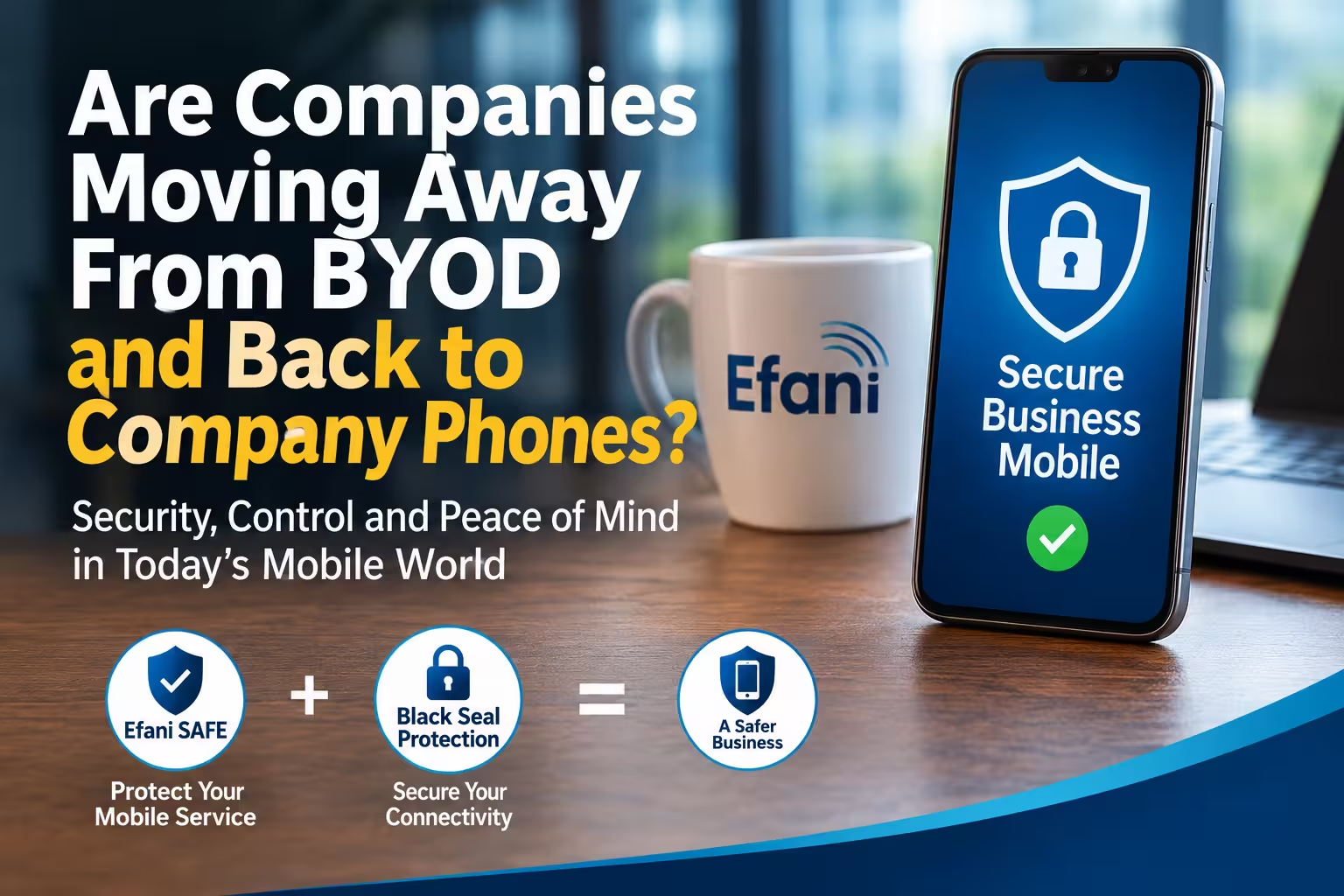
Together, SAFE and BSP address different parts of mobile security.
Efani SAFE protects the mobile service and account. Black Seal Protection helps protect connectivity.
Should companies move back to company provided phones?
There is no universal answer. BYOD can still make sense for many businesses, particularly those with strong security policies, effective mobile device management, limited access to sensitive information and a workforce that understands its security responsibilities.
But companies should no longer assume that BYOD is automatically the cheaper or better solution.
The smartphone has become one of the most important gateways into a company's digital environment. It deserves the same thoughtful security consideration as a laptop, server or other business asset.
For organizations handling sensitive information, providing company phones, managing those devices and selecting secure mobile service may be a worthwhile investment.
The debate should not be about whether BYOD or company provided phones are inherently better. It should be about whether the business has sufficient control over the devices, accounts and connections employees use to access company information.
Mobile security has changed. It may be time for corporate mobile policies to change with it.
Businesses that take mobile security seriously should evaluate their device policies, mobile device management, mobile account protection and connectivity security together, rather than treating them as separate problems.
A secure mobile strategy begins with recognizing that the phone is no longer just a phone. It is one of the keys to the business.
Save $99 on Efani using www.efani.com/promo