
No single
point of trust.
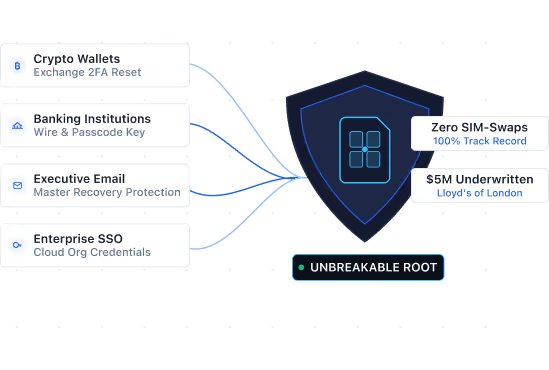
Every large phone-number theft on public record ran through one person, one system, or one step that was allowed to act alone. Efani is built so that nothing can. Here is the architecture — layer by layer, including what each layer does not cover.
11
14 days
$5M
Zero
The weakness isn't the lock. It's who can open it.
Ask most carriers how they protect your phone number and you get a feature: a PIN, a port-out lock, a toggle in an app. Features are easy to name and easy to defeat, because almost all of them share one weakness.
Somewhere behind the feature sits an employee, a script, or an automated workflow with the authority to override it. That is not hypothetical. In the largest documented SIM-swap cases, the attacker never broke encryption and never touched the victim's phone. They walked into a retail store with a forged ID, or they paid someone on the inside.
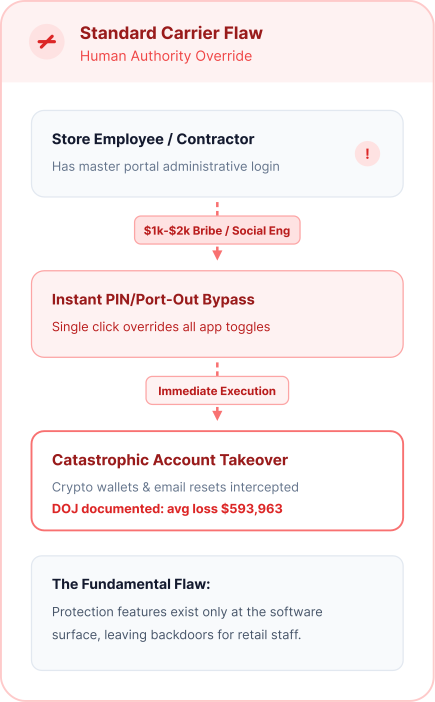
Paid to a phone-store employee for each SIM swap performed, in a 2026 federal sentencing.
U.S. DOJ, C.D. CAL.
Intended loss across the victims of that single bribed employee, who also performed swaps on further customers.
U.S. DOJ, C.D. CAL.
Defendants in a November 2025 SIM-swap and identity-theft indictment who were carrier store employees.
U.S. DOJ, C.D. CAL.
Six controls in series, not one checkpoint.
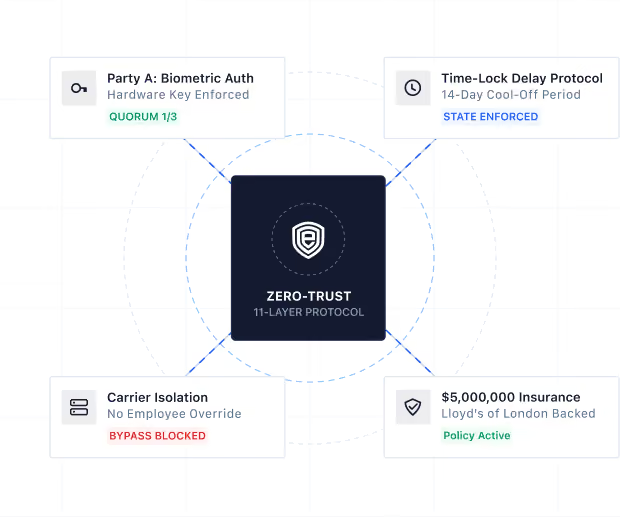
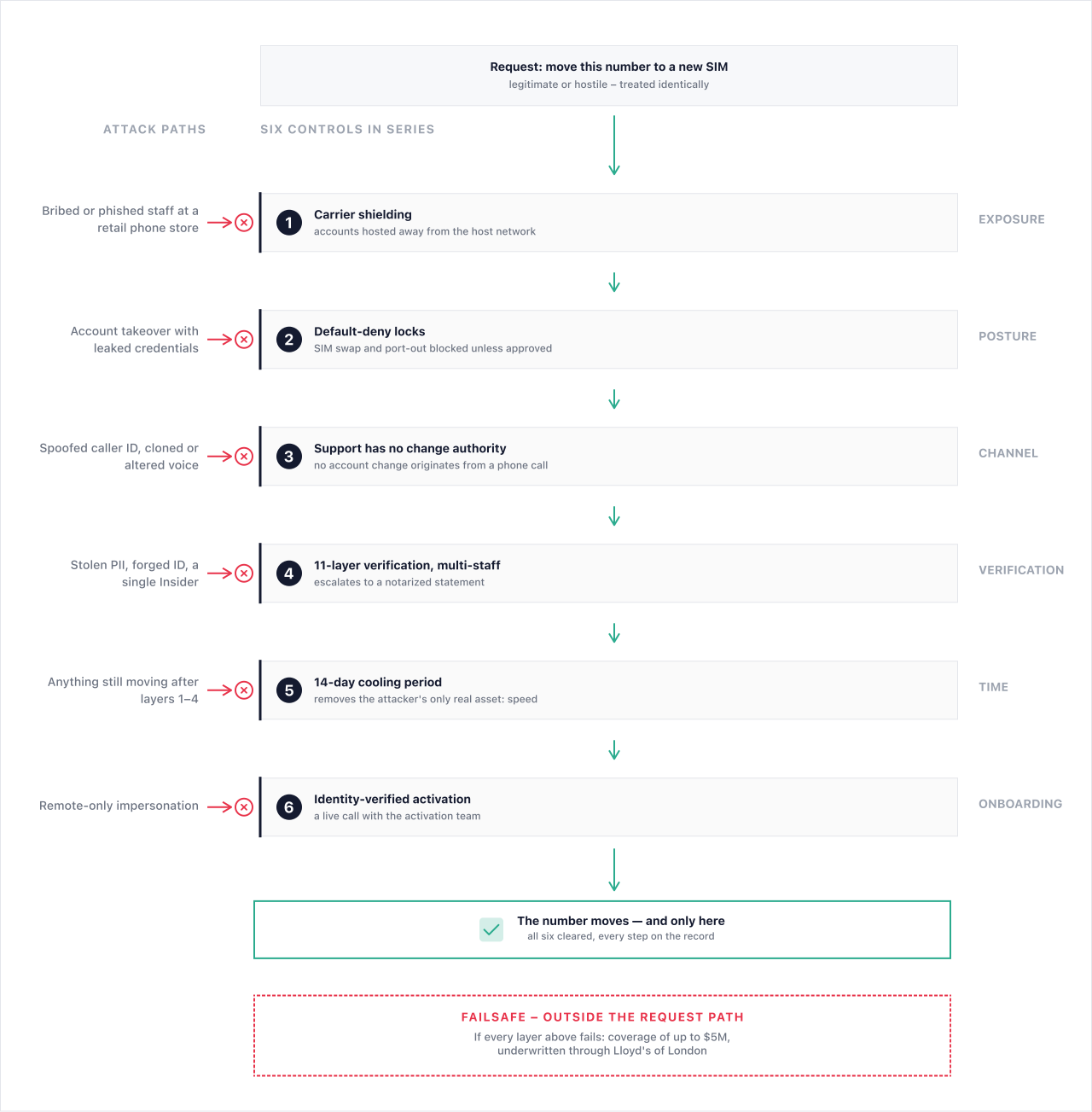
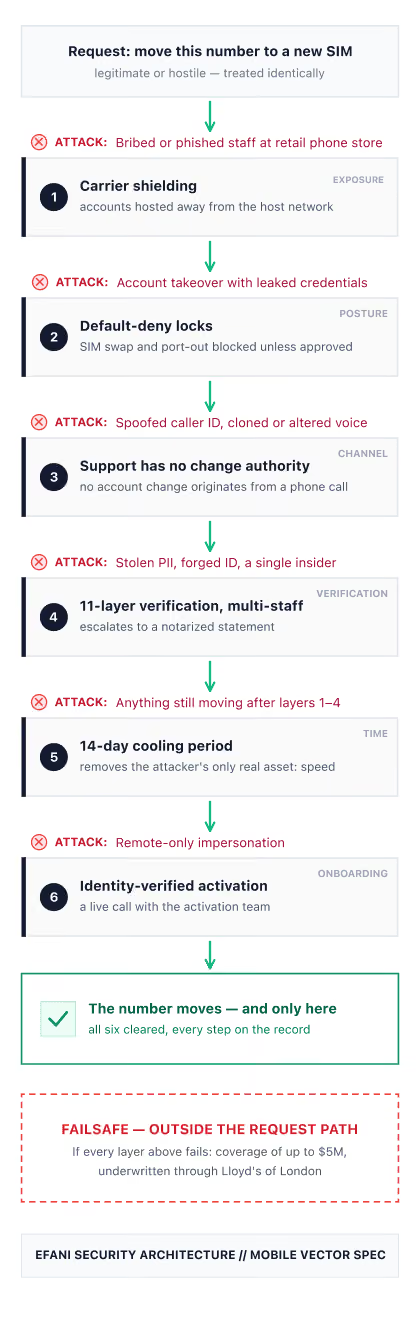
A request to move a phone number to a new SIM does not arrive at a single gate. At Efani it passes through six controls in sequence, and each one is designed to catch a different class of attack. The drawing shows where each attack path terminates.
What each control actually does.
Defense in depth is only real if you can say, for each layer, which attack it defeats and what it assumes has already failed.
Efani runs on top of a major U.S. network — subscribers choose between two of them — but the subscriber record does not sit in that network's retail and support systems. Efani calls this carrier shielding: all accounts are hosted away from major telecom carriers to reduce internal risk.
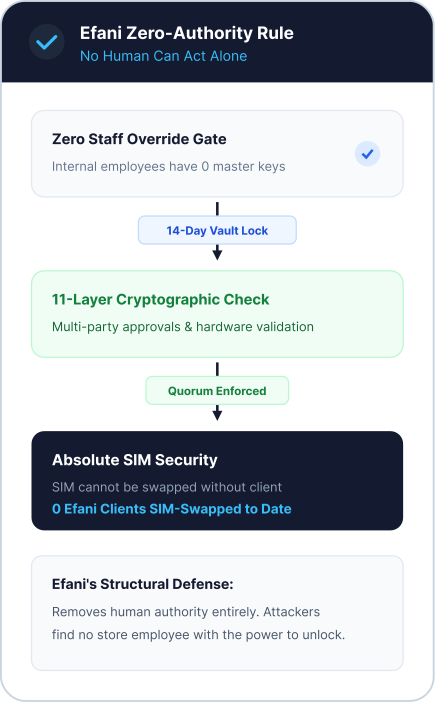
This is the least visible control and the most consequential one. The bribery cases above did not defeat a security mechanism; they used a legitimate mechanism from inside a store. A clerk who can look your number up, see your name and address, and issue a replacement SIM is a complete attack path on their own. The defense is not a better PIN. It is that the clerk has nothing to look up.
On most networks, protection is opt-in: a lock you have to know about, find, and enable, and which can be lifted through the same channels an attacker is already working. Efani inverts the default. SIM swap requests are blocked by default and can only proceed through an approved multi-person process, with aggressive default locks applied to both port-outs and internal SIM changes.
The difference matters most for the customer who never reads a security page. A default-deny posture means the protection is in force on day one, for everyone, including the accounts nobody hardened.
Efani's published comparison against traditional carriers names the gap plainly: at a conventional carrier, support agents have authority to make major account changes. That single sentence describes the channel through which most consumer account takeovers actually run — a convincing caller, a sympathetic agent, an urgent story.
Efani's support is 24/7 and white-glove, and it is deliberately not an authorization channel. Talking to a person does not move your number. This is why caller-ID spoofing and synthetic voice — the two techniques that have made phone-based social engineering dramatically cheaper — do not buy an attacker a route here. There is no decision at the end of the call to capture.
This is Efani's core mechanism and the one that most distinguishes it. Any major change goes through an 11-layer proprietary verification protocol: a multi-step process approved by multiple staff members, escalating for high-risk changes to a notarized statement. Efani states that no hacking attempt has ever passed beyond the third step of that protocol.
There is a common objection worth answering directly: does putting humans in the loop not reintroduce the insider risk that layer 1 removed? It would, if the human were a single decision-maker. The design point is that authority is split. One employee cannot approve a swap; a compromised employee cannot approve a swap; and the steps that resist automation — the ones that require a notary, a document, a second and third reviewer — are precisely the steps that resist a bribe, because they require several people to be corrupted at once rather than one.
Attackers optimize for cost. The published DOJ prices tell you what one insider costs. Nothing in that case law suggests anyone has priced a notary plus a review panel.
Every other layer is a test of identity. This one is a test of patience, and it is the layer that assumes all the others failed. A SIM swap can only proceed after a 14-day cooling-off period.
Number theft is a speed business. The value of a hijacked number decays to near zero within hours, because that is the window in which one-time codes are useful and before the victim notices their phone has gone dark. A fourteen-day hold does not merely slow an attacker down; it inverts the economics of the entire attack. It also creates something the victim never gets on a conventional network: two weeks of warning, and time to act, rather than a silent handset and a drained account.
It is also, honestly, the layer customers feel. A legitimate change takes time too. That is the trade Efani has made deliberately, and it is not the right trade for everyone.
A layered model is worth little if the account can simply be created or activated fraudulently in the first place. Efani applies strict KYC and human-backed activation checks: a new line is activated only after a scheduled call with the activation team to verify identity, and Efani maintains a documented audit trail of these controls. Porting an existing number in is the recommended path, and eSIM is the preferred format — there is no physical card in the post to intercept.
The network layer, where SMS codes get stolen without touching your account.
Account takeover is the dominant threat, but it is not the only one. Two network-level attacks deserve naming because they defeat SMS-based security without going near your account.
IMSI catchers — false base stations — impersonate a legitimate tower to identify and locate handsets nearby, and classically work by forcing a phone down to 2G, where encryption is weak or absent. SS7, the inter-carrier signaling protocol that still routes calls and texts between networks, was designed in the 1970s on the assumption that every network on it could be trusted. It authenticates nothing. That assumption is why a one-time passcode sent over SMS can be redirected by a party with signaling access who has never seen your phone, your SIM, or your password.
No downgrade to the legacy standards that IMSI catchers depend on. LTE and 5G use mutual authentication — the tower must prove itself to the device, not only the reverse.
Modern networks stop broadcasting the permanent IMSI after initial attachment, substituting a temporary identifier that rotates.
Applied to international roaming across roughly 500 partner networks in more than 175 countries.
Separates the identity carrying your voice and SMS from the one carrying your data traffic.
Efani declines to offer IMEI or IMSI spoofing, which some privacy products market as anti-tracking. The reasons are published: it sits in a legal grey area under 18 U.S.C. § 1029; it gives a false sense of security, because a handset re-sends its identifiers on every reconnection; and it generates anomalous traffic that carrier fraud systems flag. A control that creates legal exposure and an illusion of safety is not a layer. It is a liability.
Which layer stops which attack.
Defense in depth is only credible if you can name, for each attack, the specific control that defeats it.
What we can do, and what we can't
Take your Efani number into a retail store of the underlying network and ask them to pull up the account. What they can see is the boundary in layer 1, and you can see it with them.
The 14-day cooling period and the multi-staff review are not tiers for high-value customers. Request a change and you will meet them. A control you can feel is a control that exists.
Coverage of up to $5 million is underwritten through Lloyd's of London, not self-insured from Efani's balance sheet. An external underwriter accepting that risk is an outside party taking a position on the architecture.
It pays after a failure; it prevents nothing. Coverage is up to $5 million and specific to loss resulting from a SIM swap — read the terms and ask about your case rather than assuming a number applies to it.
Cellular encryption is hop-by-hop. If you need content confidentiality, use an end-to-end encrypted messaging app — which is also what CISA told highly targeted individuals to do in December 2024.
NIST's current digital identity guidance classifies SMS and voice one-time passcodes as a restricted authenticator, and names SIM change and number porting as risk signals verifiers should check. Use a hardware key or an authenticator app wherever your bank or exchange allows it.
A compromised email account or a reused password is outside this architecture — and outside what a carrier can defend.
Frequently asked questions
Is a port-out PIN enough to stop a SIM swap?
On its own, no. A PIN is a credential checked by an employee or a workflow that also has the authority to reset it. Federal prosecutions have documented store staff paid four figures to bypass exactly these controls. A PIN raises the cost of the easiest attack; it does nothing about the insider path, which is the path the largest recorded cases actually used.
Can a carrier employee override my SIM lock?
At a conventional carrier, support agents generally hold authority to make major account changes — that is the design. At Efani they do not: SIM swaps are blocked by default and require an approved multi-person process, so no single employee, at Efani or at the underlying network, is a sufficient path.
Do carriers manually verify account changes, or is it automated?
Industry practice is automated or call-centre driven. Efani’s process is deliberately manual for major changes: an 11-layer verification protocol, approval by multiple staff members, and escalation to a notarized statement for high-risk requests. The friction is the product.
What is a 14-day cooling period and why does it matter?
It is a mandatory hold before a SIM swap or port-out completes. It matters because number theft depends on a window measured in hours — the time before you notice and before one-time codes stop working. A two-week hold destroys that window even in the scenario where every identity check has somehow been passed.
Does an eSIM stop SIM swapping?
No. An eSIM removes the physical card as a theft or interception target, which is why Efani prefers it, but a SIM swap is an authorization failure rather than a hardware failure. The attacker persuades the carrier to reissue your identity; the format of the card is incidental. Only the authorization process defends against it.
Does the $5 million coverage mean I am guaranteed a payout?
It means coverage of up to $5 million, underwritten through Lloyd’s of London, for financial loss resulting from a SIM swap on an Efani line. Limits, exclusions and a reporting deadline apply, as with any policy, and no Efani customer has been SIM-swapped to date. Treat it as a failsafe behind the architecture, not as the architecture.
Secure the number everything else resets to.
Your phone number is the recovery key for your bank, your email, and your exchange accounts. It deserves more than a PIN that a store employee can reset.
$99/month or $999/year
Unlimited talk, text & data in North America
eSIM or physical SIM
No contract
60-day money-back guarantee