
Verizon vs Xfinity Mobile (2026): Coverage, Data Priority, Pricing & Hotspot Compared


Introduction
On the surface, Xfinity Mobile vs Verizon still looks like an easy match. Both run on the same Verizon-owned network, with the same coverage map and the same 5G footprint. If you live in a city with strong Verizon signal, you'll usually have the same bars on either service.
So why does the debate "is Xfinity Mobile as good as Verizon" keep popping up? Because while the coverage is similar, the experience can be very different.
That difference matters more in 2026 than it did a year ago. Xfinity Mobile's Premium Unlimited tier has become more "premium" (more high-speed data, better hotspot rules, and extras like WiFi PowerBoost). Verizon, meanwhile, has pushed harder into its myPlan setup with a 3-year price lock message and bigger top-tier benefits like much heavier hotspot use on Unlimited Ultimate.
Is your cellphone vulnerable to SIM Swap? Get a FREE scan now!
Please ensure your number is in the correct format.
Valid for US numbers only!
The Core Difference: MNO vs MVNO
This is where the whole comparison begins. Verizon is a full Mobile Network Operator (MNO). It owns the towers, spectrum, and core routing equipment. Xfinity Mobile is a Mobile Virtual Network Operator (MVNO). It rents access from Verizon at wholesale rates.
Here's why that still matters in 2026:
- Verizon customers on premium tiers are usually first in line when a tower is crowded.
- Xfinity customers use the same tower, but priority depends on plan tier and how much data you've used that month.
- Under normal conditions, the difference can be invisible. But at a packed stadium, a Verizon premium plan will usually feel steadier than an MVNO plan that has hit its high-speed limit.
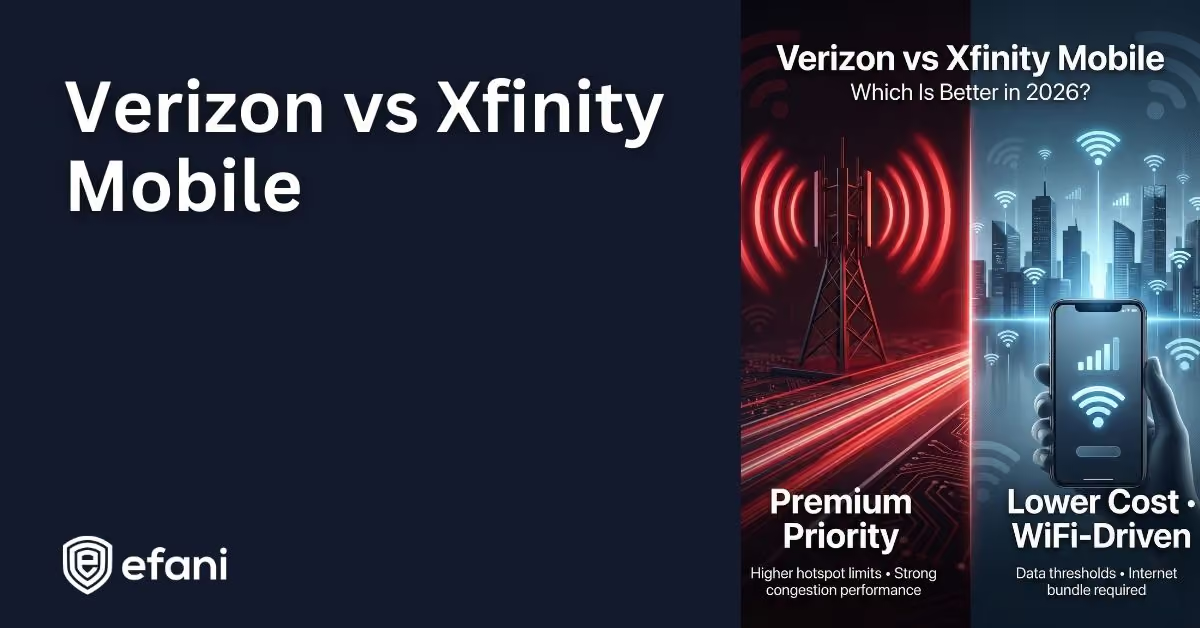
That system is called data prioritization, and it's still the biggest divider in the Verizon vs Xfinity Mobile debate.
Network Coverage
Coverage is not the argument. Both services run on Verizon's nationwide LTE and 5G networks. If you see Verizon signal in your area, you'll see the same core cellular coverage on Xfinity.
- Recent third-party testing continues to rank Verizon as one of the strongest networks overall, especially for reliability and broad coverage.
- Xfinity Mobile customers benefit from that same footprint, including access to Verizon's 5G Ultra Wideband areas on compatible devices.
So, if you're choosing between the two, the real questions are about priority, pricing, and perks rather than signal strength.
Xfinity’s WiFi Offload Trick (Now With PowerBoost)
The hidden ace up Xfinity's sleeve is still WiFi. Xfinity Mobile devices can automatically connect to Xfinity WiFi hotspots, and Comcast says the overwhelming majority of Xfinity Mobile traffic runs over WiFi instead of cellular. On current Xfinity plans, data used on those hotspots does not count toward your premium data threshold.
Comcast also backs this strategy with a huge hotspot footprint, including millions of secure hotspots that phones can auto-join in supported areas. In 2026, the more notable upgrade is WiFi PowerBoost, which is designed to push faster speeds (often advertised up to gig-class) when you are on your Xfinity home WiFi or participating hotspots.
Why does that matter? Because it keeps cellular usage lower, which saves Comcast money and lets them price aggressively. At home you're mostly on WiFi anyway. Around town, you might hop on a hotspot without realizing it. That means less time competing for Verizon's cellular lanes.
SIM Swap Protection
Get our SAFE plan for guaranteed SIM swap protection.
Verizon's Premium Approach
Verizon sells certainty. It charges more, but in exchange you get:
- Premium priority data on higher-tier plans (Plus and Ultimate), which tends to hold up better in congestion.
- Stronger hotspot policies, especially on Unlimited Ultimate.
- Flexible add-on perks through Verizon's myPlan system (streaming, travel, cloud storage, and more, depending on what's offered at the time).
- 3-year price lock messaging on eligible plan base rates (perks, taxes, fees, and add-ons can still change).
- Standalone service, no Comcast home internet required.
It's built for people who don't want surprises, even in crowded networks. If you need to upload a deck in a conference hall or hotspot your laptop at the airport, Verizon's premium tiers can be worth paying for.
Monthly
Yearly
How Data Priority Actually Works in 2026
Think of a cell tower as a highway with multiple lanes. Premium plans get the express lanes. Value plans may still drive on the same highway, but can be pushed into slower lanes when traffic builds up.
Here is how the big plan tiers line up right now:
- Verizon Unlimited Plus and Unlimited Ultimate = premium priority data.
- Verizon Unlimited Welcome = no premium priority, so you can be slowed any time the network is congested.
- Xfinity Unlimited = about 30GB of full-speed data, then speeds drop to a reduced rate for the rest of the billing cycle (often around 1.5 Mbps down and 0.75 Mbps up).
- Xfinity Premium Unlimited = 100GB of high-speed data, then it can slow during congestion rather than hard-throttling immediately.
So depending on your plan, the debate can swing either way. A Premium Unlimited user can have a better experience than someone on Verizon's base Welcome plan. A Verizon Plus or Ultimate user will usually have the edge when things get crowded.
Where the Gap Between Verizon and Xfinity Widens
Here's the part that drives people to ask "how does Xfinity Mobile compare to Verizon": the price.
Typical plan pricing in 2026 looks like this (taxes, fees, and promotions vary):
- Xfinity Unlimited: $40 for one line, then $20 per additional line. A four-line account averages about $25 per line.
- Xfinity Premium Unlimited: $50 for one line, then $30 per additional line. A four-line account averages about $35 per line.
- Verizon Unlimited Welcome: $65 for one line, $30 per line with four lines (with Auto Pay and paper-free billing).
- Verizon Unlimited Plus: $80 for one line, $45 per line with four lines (with Auto Pay and paper-free billing).
- Verizon Unlimited Ultimate: $90 for one line, $55 per line with four lines (with Auto Pay and paper-free billing).
Savings are obvious. A family of four on Xfinity Premium Unlimited pays about $140 total. The same family on Verizon Unlimited Plus pays about $180 total for the plan base before perks, and that gap grows if you add extras.
But remember: Xfinity Mobile is tied to maintaining a qualifying Xfinity service. If you drop Xfinity Internet (or certain other qualifying services), a standalone mobile fee can kick in (often $25 per month per account on current pricing, or $25 per line on older plans). That can wipe out the value fast.
Hotspot and Streaming Differences
Hotspot and streaming are two areas where Verizon usually wins, although Xfinity's Premium Unlimited tier narrowed the gap.
- Xfinity Unlimited: hotspot is reduced-speed, and video is capped at 480p.
- Xfinity Premium Unlimited: 30GB of faster hotspot use, then reduced speeds. Video streams up to 4K UHD.
- Verizon Unlimited Welcome: video is typically capped at 480p on 5G and LTE. (Hotspot is limited unless you add a feature.)
- Verizon Unlimited Plus: 30GB of premium hotspot, then reduced hotspot speeds. Streaming quality is typically higher than Welcome, and can reach 4K on 5G Ultra Wideband on capable devices.
- Verizon Unlimited Ultimate: high streaming quality (up to 1080p on 5G and LTE, and up to 4K on 5G Ultra Wideband) plus unlimited hotspot data. After a large premium hotspot allowance (often 200GB per month), hotspot continues at reduced speeds instead of shutting off.
For people who tether laptops or care about HD video, Verizon feels less restrictive, especially on Ultimate.
Perks and Ecosystem
- Xfinity Premium Unlimited: includes WiFi PowerBoost, Call Guard spam filtering, 4K streaming, and Elite Upgrade (upgrade up to two times per year under program rules). You’re also tied into the Xfinity Rewards ecosystem and internet bundle promos.
- Verizon: offers add-on perks through myPlan, typically priced monthly. Verizon also leans on plan stability features like the 3-year price lock messaging and strong phone promotion cycles.
So it comes down to philosophy. Xfinity bundles more into its premium tier, but expects you to stay in Comcast’s orbit. Verizon unbundles more, letting you customize, but you generally pay for it.
Customer Service
Ask anyone who has dealt with Xfinity Mobile support and you’ll still get polarized answers. Some love the savings and coverage. Others say the support experience can be frustrating, especially when an issue touches both internet and mobile billing.
By contrast, Verizon support isn’t perfect, but its in-store wireless presence and long experience make it more reliable for complex issues.
So if you rarely need to call support, Xfinity can be fine. If you want fast resolutions when things break, Verizon still feels safer, and it's worth understanding what carrier security features do and don't actually protect against either way.
International Roaming
Frequent travelers should ask if Xfinity Mobile versus Verizon matters abroad, because the details changed on the premium tiers.
- Xfinity Global Travel Pass: $10 per day for 5GB of high-speed data in 215+ destinations, then 3G speeds. Premium Unlimited lines also include 10GB of international high-speed data per month in 215+ destinations.
- Verizon TravelPass: $12 per day for 5GB of high-speed data in 210+ destinations, then 3G speeds. Verizon’s Unlimited Ultimate plan includes international talk, text, and data in 210+ destinations, with a monthly high-speed allowance (often 15GB) before dropping to reduced speeds.
For international business travelers, Verizon still has the strongest toolkit overall. For casual trips, Xfinity’s $10 per day pass is solid, and Premium Unlimited’s included international data can be a sneaky advantage.
Device Flexibility
Both support new devices and BYOD, as long as the phone is unlocked and compatible with Verizon’s network. Xfinity has leaned heavily into eSIM for easy activation, and Verizon also supports eSIM widely on modern devices.
Verizon usually has the larger selection of promotional deals, especially around major iPhone and Galaxy launches.
Who Should Choose What?
Choose Verizon if you are:
- A power user who needs predictable performance in crowded places.
- Someone who uses hotspot often, especially for a laptop.
- A frequent international traveler who wants roaming built in.
- Someone who wants standalone service without needing Xfinity Internet.
Choose Xfinity Mobile if you are:
- Already an Xfinity Internet customer (or otherwise eligible for Xfinity Mobile).
- A budget-conscious family looking to cut the bill dramatically.
- Someone who uses WiFi most of the day and doesn’t mind reduced speeds after hitting a data threshold.
- Comfortable with support that can be hit or miss, as long as the savings are big.
Conclusion
The short version: is Xfinity Mobile the same as Verizon? No. Same core coverage, different rules. Verizon sells priority, perks, and independence. Xfinity sells savings tied to your internet relationship and plan tier.
If your top priority is cost and you're already with Comcast, Xfinity can be the better value, especially on Premium Unlimited. If your top priority is guaranteed performance, hotspot flexibility, and travel features that are built in, Verizon is still the safer pick. And if your top priority is protecting the number itself, since neither carrier offers dedicated SIM-swap insurance, learn more about their approach to carrier-level security.
FAQs
Is Xfinity Mobile as good as Verizon?
Coverage is effectively the same, but the experience depends on plan tier. Xfinity Premium Unlimited narrows the gap with 100GB of high-speed data, while Xfinity Unlimited slows much sooner. Verizon premium plans generally keep stronger priority treatment in congestion.
Is Xfinity Mobile better than Verizon?
It’s better for saving money, especially on family plans if you already have Xfinity Internet. It’s usually not better for heavy hotspot use or maximum consistency in crowded places.
Is Xfinity Mobile the same as Verizon?
No. Xfinity is an MVNO that leases Verizon’s network. Same towers, different prioritization and plan rules.
How does Xfinity Mobile compare to Verizon?
Xfinity offers lower prices and strong value for multi-line accounts, but requires qualifying Xfinity service and has stricter limits on the base tier. Verizon costs more but offers stronger priority data on premium tiers, bigger hotspot allowances (especially on Ultimate), and more robust roaming options.
Is Xfinity vs Verizon cell service a fair fight?
Coverage-wise, yes. Experience-wise, it depends on how you use data. WiFi-heavy households and budget-focused families often win with Xfinity. Road warriors and hotspot users usually win with Verizon.


