Why Does My Phone Have Two IMEI Numbers? (2026 Guide to Dual SIM & eSIM)


Introduction
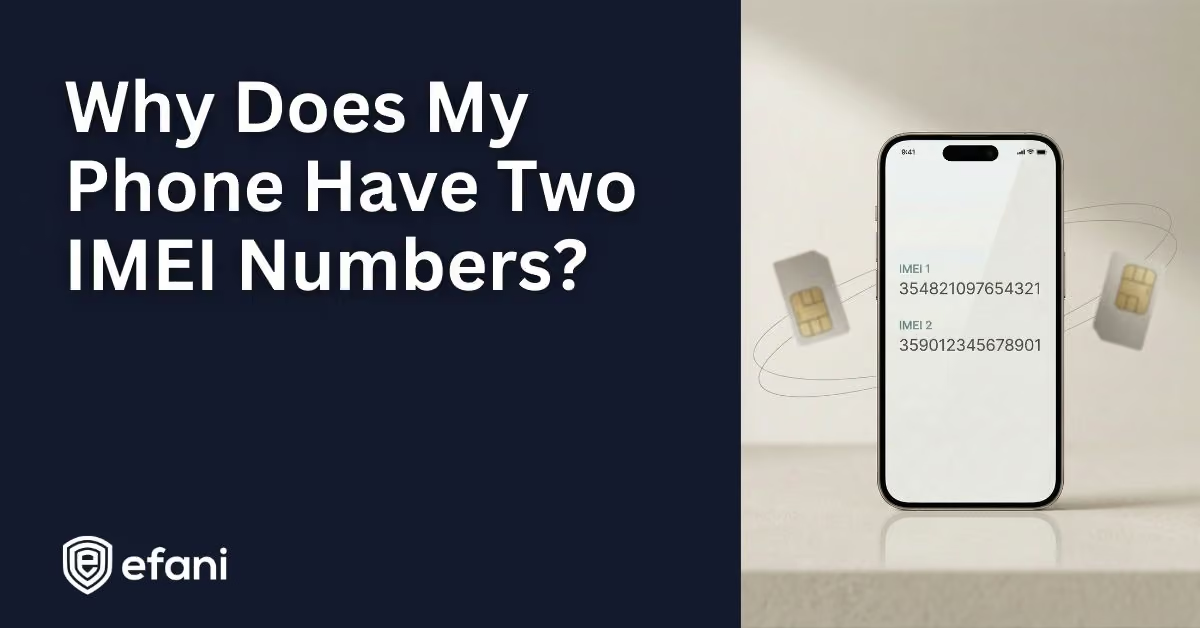
You probably know your phone has a unique ID called an IMEI number. What might surprise you is that sometimes you find two of them. If you have ever asked yourself "Why does my phone have two IMEI numbers?" or "How many IMEI numbers should a phone have?" you are not alone. A lot of people only discover this when they go digging through settings or dialing the *#06# code.
So let's clear up the confusion. A phone can have one IMEI or two, and both are normal. Whether your phone has one or two depends on its design, its SIM setup, and how it handles cellular radios.
Dual SIM is mainstream, eSIM is common, and many phones can store multiple eSIM profiles even if they can only keep two lines active at once. That combination makes it easy to see "IMEI 1" and "IMEI 2" and assume you have a duplicate or a problem. In most cases, it is simply how modern phones are built.
Is your cellphone vulnerable to SIM Swap? Get a FREE scan now!
Please ensure your number is in the correct format.
Valid for US numbers only!
What Is An IMEI Number?
IMEI stands for International Mobile Equipment Identity. Think of it as your phone's license plate number on the mobile network. Carriers use it to identify your device, track stolen phones, and authenticate whether your handset is allowed to connect.
Unlike your SIM card number, which belongs to your line and can move between phones, the IMEI is tied permanently to your hardware. If you change carriers, your IMEI doesn't change. If your phone is blacklisted for theft, the IMEI is what gets flagged.
Quick detail many people miss: IMEIs have structure
An IMEI is typically 15 digits long. The first part (often called the Type Allocation Code, or TAC) identifies the device model, and the remaining digits identify your specific unit, with a final check digit used to validate the number.
You do not need to memorize this, but it explains why two phones of the same model often start with similar digits.
IMEI vs serial number vs EID
- A serial number is mainly for the manufacturer, warranty, and inventory tracking.
- An IMEI is what cellular networks use to identify the device equipment that is connecting.
- If you use eSIM, your phone may also show an EID (Embedded Identity Document). Carriers sometimes ask for your IMEI, your EID, or both when setting up eSIM.
How Many IMEI Numbers Does A Phone Have?
The short answer:
- Most single-SIM phones have one IMEI number.
- Dual-SIM phones usually have two IMEI numbers.
So if you asked "How many IMEI numbers does a phone have?" the answer depends on how many cellular modems or active line pathways it supports.
Each one gets its own IMEI, because the network treats each as a separate identity.
Dual eSIM still equals two IMEIs
Many newer phones support two active lines without using two physical SIM cards. For example, a phone might support two active eSIM lines, or one physical SIM plus one eSIM. That still shows up as IMEI 1 and IMEI 2.
Also, storing multiple eSIM profiles does not automatically add more IMEIs. The IMEIs are tied to the phone's cellular identities, not the number of saved profiles.
Why Does My Phone Have Two IMEI Numbers?
Now for the heart of the question: "Why does my phone have 2 IMEI numbers?" The reason is simple. Your phone supports two SIMs, either physical SIMs, eSIMs, or a mix of both. Each SIM slot (or active line) needs its own IMEI number so that carriers can differentiate them.
When you insert SIM cards from two different carriers, each one registers independently on the network using its own IMEI. This way your calls, data sessions, and text messages can be managed separately.
If your phone did not have two IMEIs but tried to juggle two lines, things would get messy fast. Carriers wouldn't know which line is which, and fraud systems would be confused.
Dual SIM does not always mean "everything works twice"
Most dual SIM phones are "dual standby." That means both lines can be available, but they may share radio resources.
You still see two IMEIs because the network needs two identities, but you might not get full, simultaneous performance on both lines in every situation.
SIM Swap Protection
Get our SAFE plan for guaranteed SIM swap protection.
Why Two IMEI Numbers Actually Matter
Having two IMEI numbers isn't just a technical quirk. It comes with real-world benefits and some quirks you should understand.
1. Convenience For Dual SIM Users
Many people buy dual-SIM phones so they can carry one device for both personal and work numbers.
Each IMEI makes sure both numbers work without conflict.
2. Travel Flexibility
When you travel, you can keep your home SIM in one slot and insert a local SIM for data.
Each line registers with its own IMEI, so both remain active.
If you use travel eSIMs, you may also be asked for your IMEI during activation so the provider can tie the plan to the correct device identity.
3. Carrier Tracking
Carriers use IMEIs for fraud prevention and blocking stolen phones. Having two means both SIM slots can be monitored.
If one IMEI is blacklisted, that slot will stop working, but the other might still be valid.
4. eSIM Growth
With eSIM adoption rising, many phones support one physical SIM and one eSIM. That setup still requires two IMEIs.
So even if your phone has only one visible slot, you might still see two IMEI numbers in your settings.
5. Device registration rules in some countries
In 2026, one of the biggest "real world" reasons people care about IMEI 2 is that some countries enforce IMEI-based device registration, taxes, or whitelists.
If you live in or travel through a country that does this, you may need to make sure both IMEIs are in good standing. Otherwise one line can work while the other line gets blocked.
Monthly
Yearly
My Phone Has Two IMEI Numbers, But I Only Use One SIM
This is a very common situation. You might check your phone's "About" screen and see IMEI 1 and IMEI 2, even though you only ever use one SIM card. That's normal. Manufacturers include both IMEIs because the phone hardware supports dual SIM capability, whether you use it or not.
Think of it like having two parking spots on your property. You might only park one car, but the second spot still exists.
Why Do I Have Two IMEI Numbers But Only One Phone?
The answer is again about SIM capability. The IMEIs don't mean you have two devices. They mean your single device can present itself to the network as two identities.
So instead of seeing it as duplication, see it as flexibility. Your phone is ready to host two lines.
Why Two IMEI Numbers Can Be Confusing
Of course, not everything about having two IMEIs is straightforward. Here are some situations where it creates head-scratching moments:
- When Reporting Theft - If your dual-SIM phone is stolen, you should provide both IMEI numbers to your carrier. Otherwise, blocking only one may leave the other line usable.
- When Unlocking A Phone - Carriers that lock devices sometimes tie the lock to each IMEI. You may need to request an unlock for both.
- When Checking Blacklists - Online IMEI checkers will show you the status of one IMEI at a time. If you only check one, you might miss that the other is blacklisted.
- When Activating eSIM - Some carriers ask you to enter an IMEI manually. If you choose the wrong IMEI, the activation can fail or attach the plan to the wrong line.
- When Registering A Phone In Certain Countries - Some systems require both IMEIs. Registering only one can lead to partial service that is hard to diagnose.
- When Flashing Firmware - Advanced users who tinker with firmware sometimes forget that each IMEI has to be preserved. Corrupting either one can lead to network issues. Changing IMEIs can also be illegal in many places.
IMEI and Security
Here's where things tie back to secure phone service and most secure cell phone carriers like Efani Secure Mobile.
Attackers sometimes try to clone IMEI numbers as part of fraud schemes. With two IMEIs, that attack surface doubles. That doesn't mean dual-SIM phones are unsafe, but it does mean carriers must monitor both.
Are Two IMEIs a Risk?
If your phone has two IMEI numbers, you want to make sure both are protected against SIM swaps and fraudulent registration. A secure cell phone service can help because it adds extra layers of identity verification before allowing any changes tied to your IMEIs or SIMs.
For everyday users, the presence of two IMEIs isn't a risk on its own. What matters is whether your carrier's systems are strong enough to prevent abuse.
That's why you often see security-focused carriers positioning themselves as the most secure cell phone carrier: they defend not just the SIM, but the entire identity chain, including IMEIs.
Why Does My Phone Show Two IMEIs But I Can Only Use One At A Time?
Some dual-SIM phones are "dual standby." That means they can keep two lines reachable, but they do not always do everything at once. For example, many phones let both lines receive calls and texts, but only one line uses cellular data at a time. Even so, both IMEIs exist and are valid.
Higher-end models offer "dual active" support, letting both IMEIs work at the same time more consistently. That's when you can take a call on one line while browsing data on the other.
Tips For Handling Two IMEIs
- Know Both Numbers: Write them down or screenshot your settings. If your phone is stolen, you'll want both.
- Save Your EID If You Use eSIM: It can help with support and some eSIM transfers.
- Use Carriers That Respect Security: Make sure your provider enforces checks before making changes to your line. This matters whether your phone has one IMEI or two.
- Check Compatibility When Traveling: Some countries block devices by IMEI. If you insert a local SIM or add an eSIM, confirm that both IMEIs are clean and, where required, registered.
- Map Which SIM Is Which: Usually IMEI 1 belongs to SIM slot 1 (or the primary line) and IMEI 2 to slot 2 (or the secondary line). Keep track if you swap often.
Conclusion
So, why does your phone have two IMEI numbers? Because it supports two SIM identities. That's it. It doesn't mean your phone is broken, cloned, or suspicious. It means your device is flexible enough to juggle more than one line, and the network needs separate IMEIs to keep them straight.
The important part is not the count, but the security around them. That is why carriers that specialize in hardened mobile security are often called the most secure cell phone carriers.
FAQs
1. How many IMEI numbers does a phone have?
A single-SIM phone usually has one IMEI. A dual-SIM phone almost always has two.
2. Why does my phone have 2 IMEI numbers?
Because it can handle two SIMs or two lines at once. Each line needs its own IMEI for carriers to tell them apart.
3. My phone has two IMEI numbers but I only use one SIM. Is that normal?
Yes. The second IMEI is there in case you ever activate the second slot or an eSIM.
4. Do multiple eSIM profiles mean multiple IMEIs?
No. Many phones can store several eSIM profiles, but they still typically have only two IMEIs because only two lines can be active at a time.
5. What is the EID, and why do carriers ask for it?
The EID identifies the embedded SIM hardware used to store eSIM profiles. Some carriers use the IMEI and the EID together during eSIM setup.
6. How many IMEI numbers should a phone have for security?
There is no "safer" number. One is normal for single-SIM, two is normal for dual-SIM. The security comes from how the carrier and the phone protect those IMEIs, not from how many exist.