Does Encrypted DNS Actually Stop Your ISP From Seeing What You Do?


Introduction
Encrypted DNS is increasingly promoted as a way to stop internet service providers (ISPs) from tracking which websites their customers visit. Services such as Cloudflare 1.1.1.1, Google Public DNS, and Quad9 offer encrypted DNS connections, while modern browsers and operating systems have made the technology accessible without requiring users to understand its underlying protocols.
The privacy benefits are real, but they are frequently overstated. Your ISP may no longer see the domain names inside encrypted DNS requests, yet it can still observe destination IP addresses, information exchanged during certain connection handshakes, and traffic patterns that reveal aspects of your online activity.
There is another important complication: the DNS resolver receiving your encrypted requests can still process those queries. If your ISP operates that resolver, encrypting the connection does not prevent the ISP from learning which domains it resolves on your behalf.
At Efani, we approach mobile privacy by examining what information remains accessible across the entire connection. I believe that distinction is especially important when a security feature is described as preventing surveillance, because protecting one source of information is not the same as eliminating an observer's ability to identify what someone is doing online.
To understand what encrypted DNS actually delivers, we need to examine how DNS works, what happens after a lookup is completed, and how technologies such as Encrypted Client Hello (ECH) and VPNs address the remaining gaps.
What Is Encrypted DNS Traffic, and How Does It Work?
The Domain Name System (DNS) translates human-readable domain names into information that devices use to locate internet services. When someone opens a website such as example.com, their device may ask a DNS resolver for the IP address associated with that domain. The resolver supplies the necessary information, allowing the device to establish a connection.
Traditional DNS commonly communicates over UDP or TCP port 53 without encryption. Anyone capable of observing those DNS messages along the network path may be able to identify the domains being requested. Depending on their position and capabilities, an attacker may also attempt to manipulate DNS responses and redirect users toward malicious infrastructure.
For an ISP, this information can provide a useful picture of the services a subscriber contacts, including financial institutions, cryptocurrency exchanges, corporate applications, and messaging platforms. However, DNS requests are not a perfect record of browsing history. Applications perform background lookups, browsers prefetch resources, and cached responses can allow connections without generating new DNS queries.
Encrypted DNS traffic consists of DNS queries and responses transmitted through a protected connection between a device and a compatible resolver. This prevents ordinary passive network observers from reading the contents of those exchanges.
DNS over HTTPS, DNS over TLS, and DNS over QUIC
Three standardized protocols provide the principal mechanisms for encrypted DNS.
DoH is standardized under RFC 8484, DoT under RFC 7858, and DoQ under RFC 9250. All three protect DNS exchanges in transit, although their network behavior and compatibility differ.
DoH commonly uses the same port as ordinary HTTPS traffic, which can make it more difficult for networks to distinguish from regular web connections. DoT uses a dedicated port that administrators can identify and restrict more easily. DoQ offers QUIC-based transport characteristics, but its practical performance depends on implementation and network conditions.
The important limitation is that DNS encryption generally ends at the recursive resolver. The resolver receives the decrypted query and may subsequently communicate with authoritative DNS servers using ordinary DNS. DNSSEC can separately help authenticate DNS data, but it does not encrypt queries or conceal them from the resolver.
Encrypted DNS therefore protects a specific communication path. It does not automatically encrypt subsequent website connections or make the requested domain name secret from every organization involved in resolution.
Is your cellphone vulnerable to SIM Swap? Get a FREE scan now!
Please ensure your number is in the correct format.
Valid for US numbers only!
What Does "This Network Is Blocking Encrypted DNS Traffic" Mean?
iPhone, iPad, and Mac users may encounter a Wi-Fi privacy warning stating:
"This network is blocking encrypted DNS traffic."
Apple explains that when this warning appears, the names of websites and other servers accessed through the affected network may be transmitted without DNS encryption and could be monitored or recorded by devices along the network path.
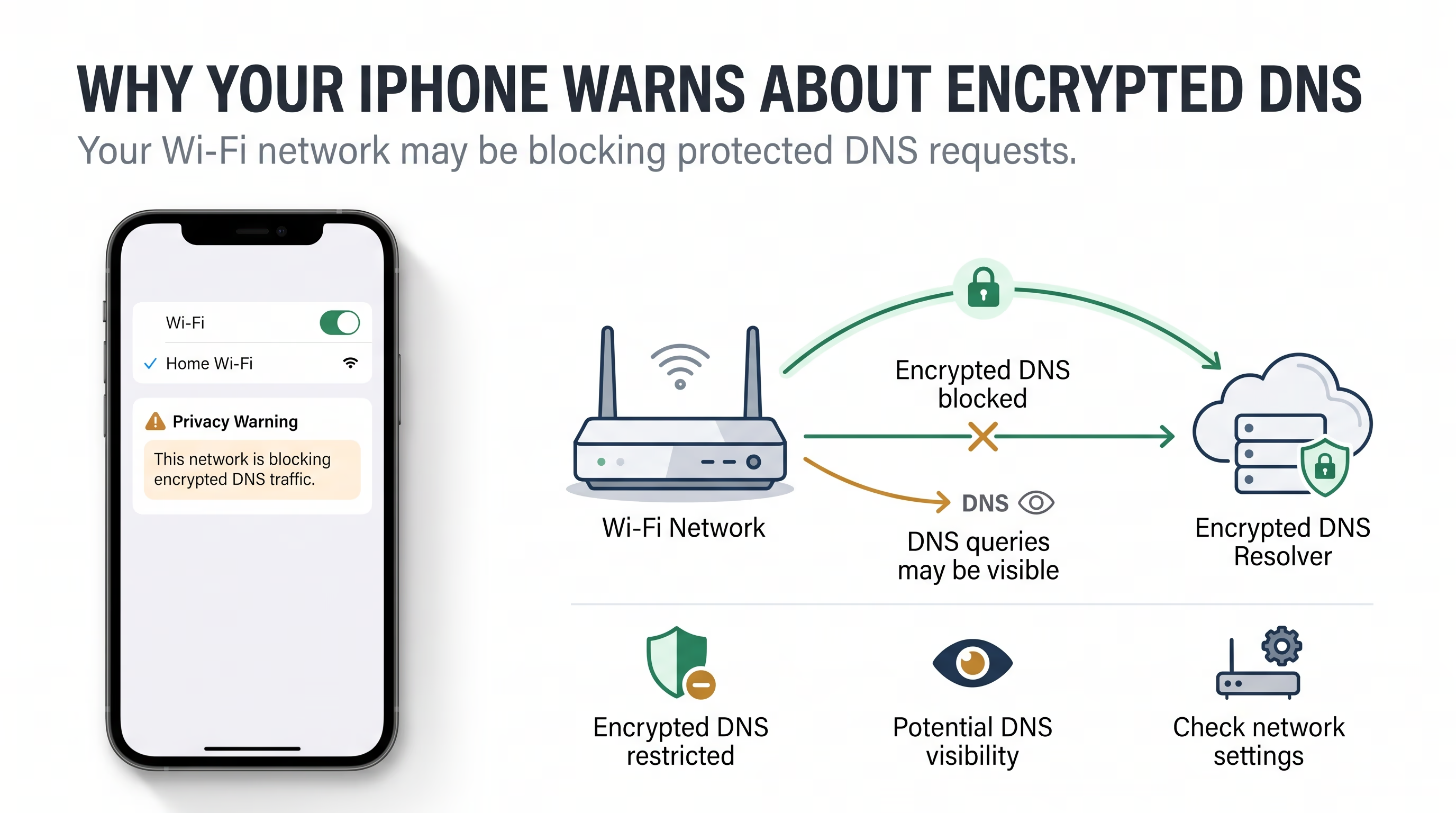
The notification is useful because it alerts users to a privacy problem they might otherwise never notice. Most people cannot directly determine whether a router, public hotspot, or network administrator is interfering with encrypted DNS, particularly when websites continue loading normally.
However, the warning does not automatically mean that the network has been compromised or that someone is actively collecting browsing histories.
Why would a network block encrypted DNS?
Corporate networks may require employees to use approved DNS resolvers for malware filtering, internal domain resolution, and security monitoring. Schools frequently enforce content restrictions, while home routers sometimes include parental controls or security features that depend on redirecting DNS requests.
Public Wi-Fi networks introduce additional complications. Hotels, airports, and conference venues often use captive portals that require authentication before allowing internet access. Some networks also restrict encrypted DNS endpoints or interfere with particular DNS transport protocols.
An ISP could deliberately block external encrypted resolvers to enforce its preferred DNS service, although similar symptoms may arise from outdated router firmware, incompatible security applications, or configuration errors.
The warning establishes a potential privacy exposure, but it does not explain why the restriction exists.
Does the warning mean your DNS has become unencrypted?
The exact outcome depends on how encrypted DNS is configured.
Some implementations permit fallback to traditional unencrypted DNS when a protected connection becomes unavailable, prioritizing connectivity. Others require encryption and prevent resolution rather than silently weakening the connection.
Apple's encrypted DNS developer documentation describes configurations in which application connections fail when the required encrypted resolver cannot be reached. A browser may also use different DNS settings from the operating system or other installed applications.
It would therefore be inaccurate to assume that every application automatically switches to plaintext DNS whenever this warning appears.
How to fix the encrypted DNS warning on iPhone or Mac
Apple recommends reviewing network settings, installing software updates, restarting affected equipment, and reconnecting to the Wi-Fi network.
A practical troubleshooting process includes:
- Update the device and router. Install supported iOS or macOS updates and current router firmware.
- Restart and reconnect. Restart the affected equipment, then forget and rejoin the Wi-Fi network if necessary.
- Review network security settings. Check DNS profiles, VPNs, parental controls, filtering applications, and router DNS restrictions.
- Test another trusted network. Determine whether the warning is specific to one Wi-Fi connection.
- Contact the administrator or ISP. Ask whether encrypted DNS restrictions are intentional, particularly on managed networks.
Disabling encrypted DNS simply to remove the message may weaken privacy rather than correct the problem.
For high-risk users, I would be more concerned about an unfamiliar network unexpectedly interfering with encrypted DNS than a personally managed router running an intentionally configured filtering service. In either case, the objective should be to understand the restriction rather than assume that clearing the warning guarantees privacy.
Even when encrypted DNS functions correctly, the ISP may still observe information outside the DNS connection.
What Can Your ISP Still See When DNS Is Encrypted?
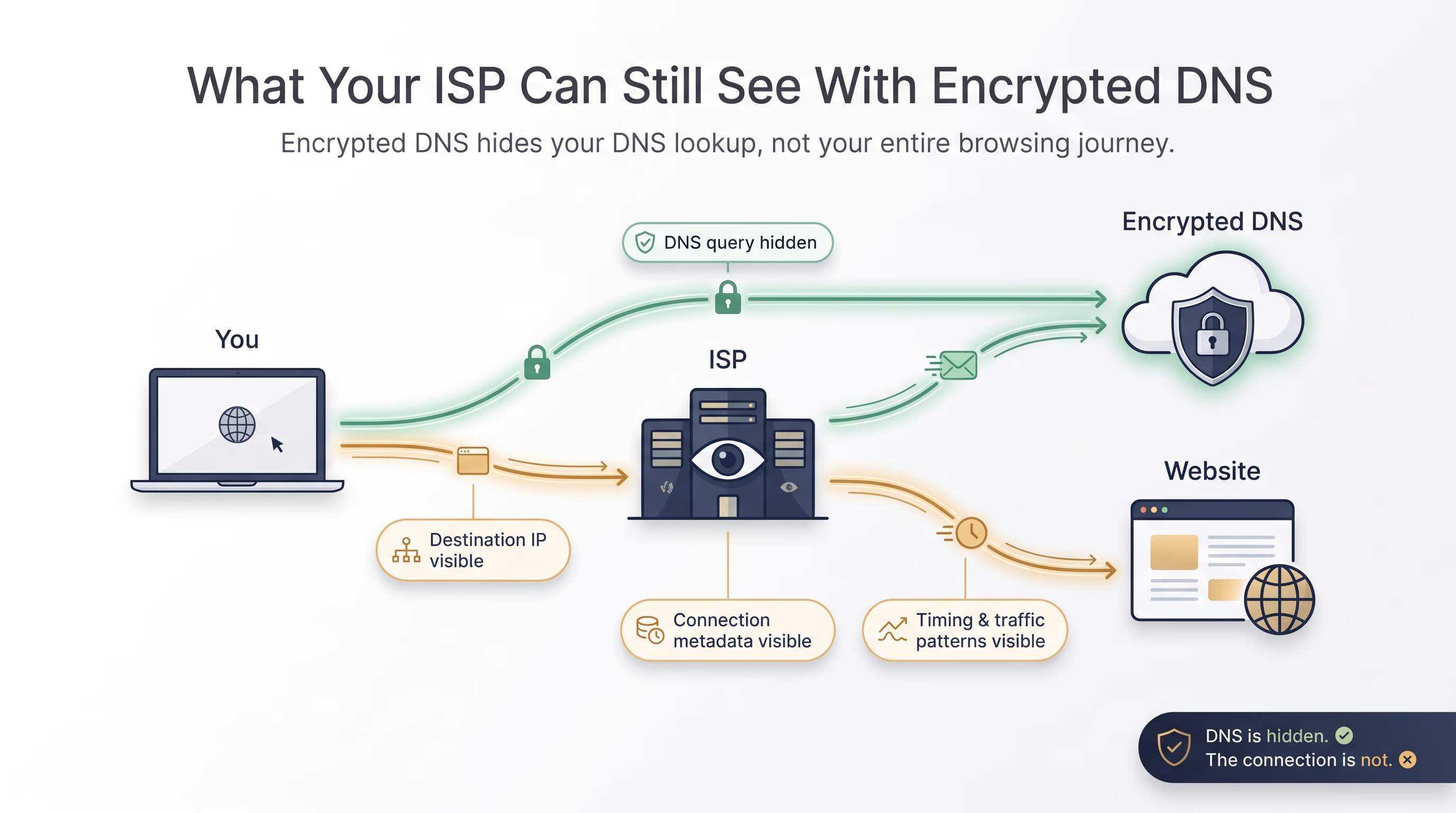
Encrypted DNS removes a direct source of browsing information, but internet connections expose several additional signals. An ISP does not necessarily need access to the original DNS request to identify the service receiving a subscriber's traffic.
Destination IP addresses remain visible
After DNS resolution, a browser or application generally establishes a connection to the destination server. The ISP must route that traffic, which ordinarily exposes the destination IP address.
An IP address can sometimes identify a website or service, particularly when it is associated with relatively few domains. However, modern cloud infrastructure and content delivery networks frequently host unrelated websites behind shared IP addresses, making individual destinations harder to distinguish.
A study published at ACM ASIA CCS 2020, Assessing the Privacy Benefits of Domain Name Encryption, examined hostname-to-IP relationships using measurements from nine geographic vantage points.
The researchers found that approximately 20% of the domains in their dataset had a one-to-one hostname-to-IP mapping. For those domains, concealing the hostname provided relatively little additional protection against someone who could still observe the destination IP.
Conversely, roughly 30% of measured domains shared IP addresses with more than 100 other domains, creating substantially greater uncertainty about the actual destination.
These findings reflect the study's 2020 measurements rather than the entire internet in 2026, but they demonstrate a lasting architectural limitation: DNS encryption provides less destination confidentiality when an IP address already identifies a particular service.
For someone accessing private banking infrastructure, cryptocurrency services, or corporate applications, distinctive IP addresses can remain informative even when DNS requests are fully encrypted.
TLS Server Name Indication can reveal the hostname
HTTPS encrypts the application data exchanged between a browser and a website, but establishing that connection involves a TLS handshake.
Traditionally, the handshake includes a Server Name Indication (SNI) extension identifying the hostname the client wants to reach. Without additional protection, SNI is commonly transmitted in plaintext.
An ISP observing a connection might therefore see a hostname such as exchange.example during TLS negotiation, even though the preceding DNS request traveled through DoH or DoT.
This creates an important distinction between DNS confidentiality and website destination confidentiality. The DNS question may be protected while a separate protocol exposes the requested hostname.
Encrypted Client Hello, discussed in the next section, is designed to address this weakness.
Traffic analysis reveals additional information
Even when DNS requests, TLS hostnames, and application contents are encrypted, the ISP can still observe connection timing, duration, data volumes, and packet-size patterns.
Researchers have demonstrated that these characteristics can sometimes be used to identify websites through traffic fingerprinting.
At the 2020 Network and Distributed System Security Symposium (NDSS), researchers published Encrypted DNS → Privacy? A Traffic Analysis Perspective, investigating whether protected DNS exchanges remained vulnerable to website identification.
Their experiments demonstrated that encrypted DNS traffic patterns could support accurate identification under defined conditions, including attacks requiring substantially less observed traffic than some comparable HTTPS fingerprinting approaches.
The research establishes a potential surveillance technique, but it does not prove that commercial ISPs routinely deploy these methods or that they can reliably identify every website visited by every subscriber.
What the ISP generally cannot see
There is a meaningful difference between identifying the service receiving a connection and reading the user's activity inside that service.
With properly configured HTTPS, an ordinary passive ISP observer generally cannot directly read full URL paths, submitted passwords, private messages, account balances, or transaction details contained within the encrypted application exchange.
For example, identifying a connection to a cryptocurrency exchange does not establish whether the subscriber checked prices, logged into an account, transferred funds, or executed a trade.
Exceptions include unencrypted HTTP, compromised endpoints, and environments where an organization performs TLS interception using a trusted certificate and managed-device configuration.
The distinction between visible connection metadata and encrypted application contents is essential when evaluating claims about ISP surveillance.
These represent typical passive-observer conditions. Actual visibility depends on the network architecture, applications, encryption settings, and any additional privacy protections in use.
Encrypted Client Hello: Can Websites Finally Hide Their Names?
Encrypted Client Hello (ECH) is one of the most important recent developments in web privacy.
Standardized by the Internet Engineering Task Force in March 2026 through RFC 9849, ECH protects sensitive information in the TLS ClientHello, including the true hostname that would otherwise appear in plaintext SNI.
The protocol separates connection information into an encrypted inner ClientHello and a publicly visible outer ClientHello. When ECH is successfully negotiated, an observer cannot simply inspect the TLS handshake to recover the protected destination hostname.
This is particularly useful when multiple websites share compatible hosting infrastructure. However, ECH does not conceal the destination IP address, and its effectiveness depends on adoption across browsers, websites, and supporting services.
A 2026 study revealed significant deployment gaps
Researchers examined ECH deployment in The Fragile Privacy of Encrypted Client Hello: Quantifying Systemic Gaps in a Centralized Ecosystem, presented at IFIP Networking 2026.
The study combined measurements of more than 13 million domains, Firefox telemetry, and browser-based testing of complete webpage loads.
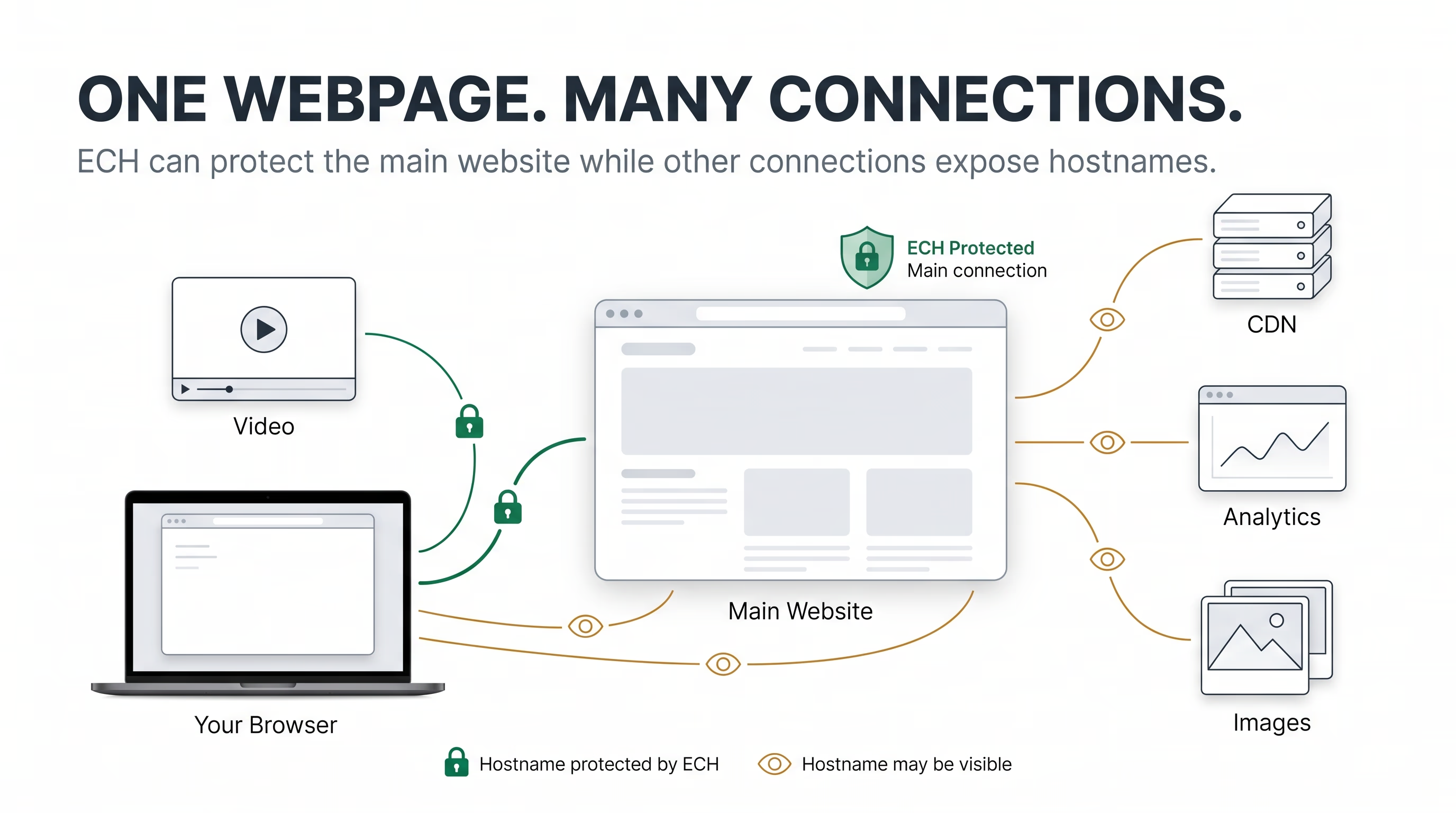
Its findings showed a substantial difference between protecting the initial connection to a website and protecting every hostname contacted while that page loads.
In a July 2025 browser measurement covering 150,778 domains advertising ECH, the researchers reported:
- 97.28% protected the hostname during the initial connection.
- 91.10% maintained hostname protection across requests to the same registered domain.
- 0.26% completed the entire measured page load without exposing any hostname under the study's criteria.
The last figure needs context. The researchers counted a full-page privacy failure when even one request, including a third-party resource, lacked the necessary protection. This does not establish that the primary website was identified in 99.74% of all browsing sessions.
Modern websites routinely load images, fonts, analytics scripts, advertising resources, authentication components, and embedded media from different domains. Even when the primary website uses ECH successfully, secondary connections may expose additional hostnames.
The researchers also found that 99.99% of ECH-enabled domains in their measured deployment dataset were associated with Cloudflare, highlighting how concentrated adoption was during the study period.
These figures describe specific measurement populations and dates, not universal deployment levels for November 2026. Nevertheless, the research illustrates a problem that deserves more attention: protecting the first connection does not necessarily protect the entire browsing session.
In my view, ECH is a meaningful advancement, but assessing its effectiveness requires looking beyond whether a browser or website advertises support. The privacy outcome depends on the complete set of connections involved in accessing a service.
SIM Swap Protection
Get our SAFE plan for guaranteed SIM swap protection.
Encrypted DNS Resolvers: Who Can You Actually Trust?
Encrypted DNS introduces a different privacy question: who receives the information that the ISP can no longer read directly?
When someone uses an independent encrypted resolver, the ISP generally loses access to the contents of the protected DNS requests. However, that resolver must process the queries, potentially receiving domain names, request times, and client connection information.
The resolver's logging practices, retention policies, infrastructure, and legal obligations determine how that information may be handled.
If the selected encrypted resolver is operated by the ISP itself, the ISP still receives the decrypted queries. Transport encryption protects the communication from other observers, but not from the organization operating the resolver.
Comparing major encrypted DNS resolvers
Cloudflare published another independent privacy examination in April 2026 addressing its public resolver's stated commitments. The company also disclosed limited packet sampling for troubleshooting and attack mitigation, illustrating why the scope and exceptions of a privacy policy deserve attention.
Google documents temporary DNS logging and longer-term aggregated information, while Quad9 emphasizes data minimization and malicious-domain blocking.
These distinctions can influence provider selection, although a published policy should not automatically be treated as independent proof of every implementation detail.
ISP data collection is a documented concern
In October 2021, the US Federal Trade Commission published A Look at What ISPs Know About You, examining privacy practices across six major internet service providers.
The FTC identified extensive collection and use of consumer information, including browsing-related data, application activity, and location information. The report also raised concerns about advertising practices, data aggregation, and the effectiveness of consumer privacy choices.
These findings demonstrate why network visibility matters beyond protocol theory. However, they do not establish that every ISP collects identical information or routinely uses sophisticated traffic fingerprinting techniques.
Choosing an encrypted resolver therefore involves examining both the data collection practices of the access provider and the information-handling commitments of the replacement resolver.
One common configuration mistake is worth emphasizing: changing your DNS server to 1.1.1.1, 8.8.8.8, or another public address does not automatically encrypt DNS traffic. The device must actually use an encrypted transport rather than ordinary plaintext DNS to that address.
Monthly
Yearly
Encrypted DNS vs. VPN vs. iCloud Private Relay
Encrypted DNS, VPNs, and privacy relays address different forms of network visibility.
A properly configured full-tunnel VPN encrypts and routes internet traffic through a VPN server. The local ISP generally observes the VPN endpoint rather than the final destinations carried inside the tunnel.
This can conceal DNS requests, destination IP addresses, and TLS handshakes from the ISP, provided the relevant traffic remains inside the tunnel.
However, the VPN operator becomes another important intermediary and may observe destination metadata after traffic exits. DNS leaks, split tunneling, connection failures, and application-specific routing can also affect the protection.
Apple's iCloud Private Relay uses a different architecture. For supported traffic, particularly Safari browsing, two relays separate the user's source IP address from destination information.
Apple describes a design in which the first relay knows the user's IP address but not the requested website, while the second handles destination information without receiving the original client IP directly from the first relay.
Private Relay does not protect every application or protocol in the same way as a full-device VPN.
Tor offers a multi-relay anonymity architecture for users with stronger privacy requirements, although application configuration, performance, and operational behavior remain important limitations.
No single option is universally superior. The appropriate protection depends on which observer the user is concerned about and what information that observer can already access.
What High-Risk Mobile Users Should Do
For executives, cryptocurrency investors, founders, and other high-risk individuals, network privacy is rarely an isolated problem.
Information about connections to financial services, corporate infrastructure, or sensitive platforms can become more revealing when combined with public records, exposed personal information, location data, and other intelligence.
Encrypted DNS reduces one source of that information, but meaningful protection requires several independent controls.
Use encrypted DNS with a deliberate resolver choice
Configure a supported encrypted DNS protocol and verify that the intended transport is active.
Review the provider's logging practices and understand whether the operating system, browser, and installed applications use the same DNS configuration. Users should also determine whether their setup allows unencrypted fallback when the protected resolver becomes unavailable.
Android provides a system-level Private DNS mechanism using DoT, while Apple supports encrypted DNS through compatible networking configurations, applications, and profiles.
Use broader network protection when necessary
A properly configured full-tunnel VPN can reduce the local ISP's visibility into final destinations, particularly on unfamiliar networks or when destination confidentiality matters.
However, selecting a VPN should involve reviewing ownership, logging policies, independent assessments, DNS routing, and connection-failure behavior.
The VPN operator remains part of the trust model, even when the local network can no longer inspect the traffic inside the tunnel.
Protect the mobile account independently
Mobile carriers possess information that DNS encryption cannot conceal. They manage subscriber authentication, cellular connectivity, and network infrastructure, which gives them access to subscription information and network-derived metadata.
Even with encrypted DNS and a VPN, the carrier generally knows which subscriber is connected, where the connection is being served, and when mobile data is being used.
At Efani, we address these risks through complementary security layers rather than treating network encryption as a complete solution.
Our Black Seal Security Platform includes advertised capabilities such as VPN-based protection, encrypted DNS, malicious-domain filtering, and Wi-Fi security features. These are designed to address different aspects of network exposure, although their effectiveness remains dependent on implementation and configuration.
Our SAFE mobile service focuses on another category of risk through layered account verification and protections against unauthorized SIM changes and number transfers.
A DNS resolver cannot prevent a SIM swap, just as strong carrier account protection does not automatically conceal destination IP addresses or browsing metadata.
This separation is particularly important for high-value financial accounts, where attackers may target both the user's online activity and the recovery mechanisms attached to their phone number.
Reduce exposure outside the network connection
Encrypted network traffic does not compensate for compromised devices, exposed credentials, insecure recovery processes, or unnecessary publication of sensitive information.
For high-value accounts, phishing-resistant authentication such as passkeys and hardware security keys can reduce dependence on SMS verification. Separating public-facing identities from private financial accounts, limiting sensitive information on travel devices, and reviewing carrier privacy preferences can further reduce opportunities for targeting.
I would prioritize controls that remain useful even when one protective mechanism fails. That means protecting the connection, the device, the account, and the mobile identity independently, rather than relying on any one technology to provide complete privacy.
Conclusion: Encrypted DNS Protects Your Queries, Not Your Entire Digital Footprint
Encrypted DNS delivers a genuine privacy improvement by protecting DNS communications against straightforward observation and manipulation along the network path.
However, an ISP may still identify destinations through visible IP addresses, unencrypted TLS information, and traffic characteristics. The DNS resolver also remains an important point of trust because it receives and processes the requests.
Technologies such as ECH, VPNs, and privacy relays can reduce additional forms of exposure, but their effectiveness depends on deployment, configuration, and the organizations operating the infrastructure.
My view is that encrypted DNS belongs in a well-designed security strategy, but it should never be mistaken for complete protection against ISP surveillance. For high-risk individuals, the stronger approach combines network privacy with secure devices, carefully controlled accounts, and independent safeguards for mobile identity.
The objective is not simply to encrypt more traffic. It is to understand who can still observe it, what information they can obtain, and how to reduce the consequences of that exposure.