Is TikTok Safe to Use in 2026


Introduction to TikTok Security
TikTok has remained one of the most-used apps in the world for several years running, and its short-video format has reshaped how people discover entertainment, news, and shopping alike. In terms of privacy and security, it is not fundamentally different from other major social platforms like Instagram or Facebook. TikTok's security engineering is comprehensive enough that using the app is generally safe for your device, and standard payment methods on the platform are reasonably well protected.
Is your cellphone vulnerable to SIM Swap? Get a FREE scan now!
Please ensure your number is in the correct format.
Valid for US numbers only!
How Safe is TikTok?
TikTok is safe in specific, narrow ways, and it will still subtly test your privacy (and in some cases your security) in others. So is TikTok secure?
Because it's a major app with a large security engineering team, there is only a small chance you'll pick up malware on your device simply from using the official TikTok app. Looked at purely through the lens of malicious technical activity on your device, you are reasonably safe when you use TikTok as intended.
However, TikTok's privacy and security measures were never designed to fully protect you from malicious users and bots on the platform itself. Trolling remains common on TikTok, and creators frequently run into it. While trolling rarely has physical real-world consequences, it can weigh heavily on the mental health of people on the receiving end.
Younger users are also still a significant part of TikTok's audience. The platform has creators of all ages, but children and teenagers remain heavily represented among its users. TikTok does offer parental-control settings, but that does not make children automatically safe. Minors can still encounter inappropriate, mature, or disturbing content that shapes how they see the world, so sustained, unsupervised use remains a real concern for parents.
It's also worth repeating what was true in last years and remains true now: TikTok, like Instagram, Snapchat, and X, is built to be habit-forming. Before you realize it, an afternoon can disappear into the scroll. The longer you spend on any platform, the more exposed you are to the scams and manipulation that tend to cluster wherever attention concentrates.
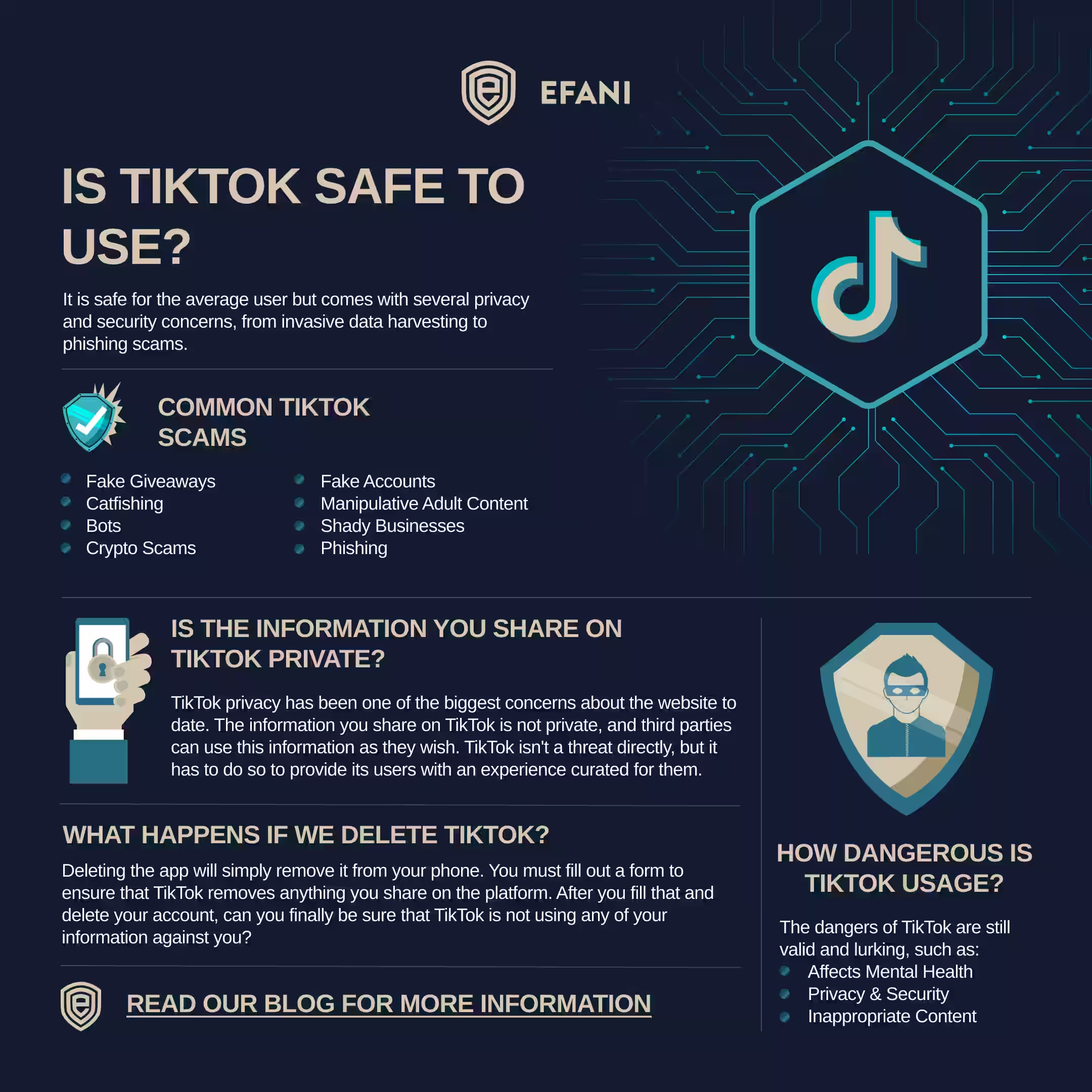
Common TikTok Scams
Fake Giveaways. Promises of free iPhones, cash, or other high-value prizes remain one of the most common lures on the platform. Scammers show stacks of cash or boxes of devices "about to be given away" to bait engagement and personal information.
Catfishing. Fake romantic profiles that build trust over time before asking for money or gift cards are still an age-old TikTok problem, as they are across nearly every major platform.
Bots. Automated accounts that interact with you just enough to redirect you to a scam website or extract sensitive information remain widespread, and they have gotten more conversational as AI text generation has improved.
Crypto and investment scams. "Guaranteed return" pitches and fake trading groups pushed through comments and DMs are, if anything, more common now than in last years.
Fake accounts. Impersonation of celebrities and public figures to promote cryptocurrency, NFT, or giveaway scams remains a persistent problem for the platform's trust and safety teams.
Manipulative or scam adult content. Content designed to lure users toward malicious off-platform links continues to circulate despite moderation efforts.
Shady marketplace businesses. TikTok's built-in shop has added another surface for fake storefronts offering bogus products at steep discounts.
Phishing. Phishing itself generally happens off-platform through email or text, not inside the TikTok app, but you can still receive a message posing as TikTok, dangling a reward, a verification badge, or more followers, as a pretext to steal your account credentials.
Is the Information You Share on TikTok Private?
TikTok's data practices remain one of the most-debated aspects of the platform. No, the information you share on TikTok is not private in any strong sense. TikTok and the third parties affiliated with it can use this information broadly, within the bounds of its published privacy policy and applicable law.
The information TikTok collects and uses still includes, by its own disclosures:
- General account details including phone number, profile photo, email address, and age
- Photos and videos you upload to the platform
- Search activity on the app itself
- Approximate location, and precise location only with your permission
- Technical signals like device type and IP address
- Any information TikTok can infer from accounts you've linked to it
TikTok's own privacy policy has, in past versions, allowed for collection of "faceprints and voiceprints," and that disclosure is worth checking in the current version of the policy before assuming it no longer applies.
SIM Swap Protection
Get our SAFE plan for guaranteed SIM swap protection.
How Dangerous Is TikTok Usage?
Affects mental health. Like most social media, TikTok is designed to be habit-forming, and the curated version of other people's lives it surfaces does appear to affect how users, especially younger ones, feel about their own lives.
The ownership and security story has changed since previous years. The original version of this article discussed U.S. government concern over TikTok’s Chinese ownership, including reported device bans at agencies like the Department of Defense. That concern moved from a policy debate into actual law and a concrete corporate transaction: the U.S. Supreme Court upheld a national-security law requiring TikTok’s parent company, ByteDance, to divest its U.S. operations. After a series of enforcement-deadline extensions through 2025, the deal closed on January 22, 2026. TikTok’s U.S. operations are now run by TikTok USDS Joint Venture LLC, a majority American-owned entity. Oracle, Silver Lake, and MGX each hold 15% as managing investors; ByteDance retains a 19.9% minority stake. Reported deal values were cited around $14 billion, with Oracle also serving as the security partner that hosts U.S. user data. Readers should still confirm the latest public statements from TikTok and the joint venture, but the ownership structure itself is no longer provisional.
Young and impressionable users. Children can still come into contact with strangers who have bad intentions and can learn to switch off safety settings on their own. Parents need to actively limit how much time their children spend on the app and stay engaged with what they're seeing.
Monthly
Yearly
What Happens If We Delete TikTok?
If you delete the app from your phone, it simply removes the application itself; your account data does not automatically disappear with it. To have your information removed from TikTok's systems, you generally need to separately request account deletion and data removal through the app's settings or TikTok's privacy tools, rather than assuming uninstalling the app accomplishes the same thing.
The Risk Most TikTok Safety Guides Still Skip: Your Phone Number
Almost everything above is standard advice you’ll find on most TikTok safety guides. Here’s the part that gets skipped: TikTok’s account recovery and verification flow, like most apps, can lean on your phone number. If someone performs a SIM-swap attack (convincing or bribing your mobile carrier into moving your number to a SIM card they control), they can potentially intercept the SMS codes TikTok sends for login or password-reset verification, giving them a path into your account that has nothing to do with how strong your TikTok password is.
The same risk applies to port-out fraud, where the number is transferred to another carrier entirely. Both attacks succeed when the carrier’s authentication and port-out lock / transfer PIN controls are weak.
For creators, public figures, or anyone whose TikTok following carries real financial or reputational value, that’s a meaningful gap. This is exactly where Efani’s SAFE plan is built to help: it’s designed around preventing SIM swaps and unauthorized number port-outs in the first place, so the phone number behind your TikTok account (and everything else tied to it) can’t be hijacked out from under you. You can check your current exposure with Efani’s free SIM-swap vulnerability scan in a few minutes.
If you ever lose service and suspect a swap is underway, follow the first 60 minutes after a SIM swap checklist immediately.
Conclusion
TikTok, in 2026-27, is much like other major social platforms in terms of core security: it is unlikely to infect your device with malware, but its privacy trade-offs are real, its scam landscape is active, and its ownership structure has fundamentally changed since this article first ran. TikTok's privacy and security measures have given users a largely functional experience, but genuine concerns remain, and a few of them are now closer to being resolved than they were in last years. Using any social platform safely still requires a bit of healthy skepticism, strong account settings, and treating your phone number itself as a security asset worth protecting.
FAQ
Q: Is TikTok safe from viruses or malware?
A: Generally, yes. There is no credible evidence that the official TikTok app installs malware or steals files from your device. The more realistic risks are data collection, scams, and account takeover, not viruses.
Q: Is TikTok still owned by a Chinese company?
A: Not in the same way it was when this article was first written. Following a US Supreme Court ruling upholding a divestiture law and a subsequent sale, TikTok's US operations are now majority-owned by a new American-led investor group, with ByteDance holding a minority stake. Confirm the current ownership structure, since deal terms continued to be finalized through late 2025.
Q: Is the information I share on TikTok private?
A: No. TikTok collects account details, content, search activity, approximate location, and technical identifiers, and uses them according to its privacy policy, which has in the past disclosed the ability to collect "faceprints and voiceprints."
Q: Does deleting the TikTok app delete my data too?
A: No. Deleting the app only removes it from your device. You need to separately request account and data deletion through TikTok's own settings or privacy tools to have your information removed from its systems.
Q: What's the biggest TikTok security risk for creators or public figures?
A: Account takeover via SIM-swap or port-out fraud. Because many of TikTok's account-recovery flows can rely on SMS, anyone who hijacks your phone number can potentially bypass even a strong password.
Q: How can I protect my TikTok account from being hijacked through my phone number?
A: Use the strongest verification method TikTok offers, avoid oversharing location, and protect the phone number itself, for example with a carrier plan built specifically to block SIM swaps and unauthorized port-outs, such as Efani's SAFE plan.