What Are 5G Small Cells? How They Work and Why 5G Depends on Them


Introduction
If 5G were built only with the tall cell towers you see on highways and rooftops, it would struggle badly in the places where people actually use their phones the most. Dense downtowns. Stadiums. Airports. Office buildings. Shopping districts.
That is where 5G small cells come in.
Small cells are not a marketing feature and they are not optional add ons. They are core infrastructure. Without them, modern 5G networks would be slower, less reliable, and far more congested than users expect.
This article goes deeper than the surface explanation. We will cover what 5G small cells really are, the radio technology behind them, how they integrate into carrier networks, and why they matter for performance, latency, battery life, and privacy.
Is your cellphone vulnerable to SIM Swap? Get a FREE scan now!
Please ensure your number is in the correct format.
Valid for US numbers only!
What A 5G Small Cell Actually Is
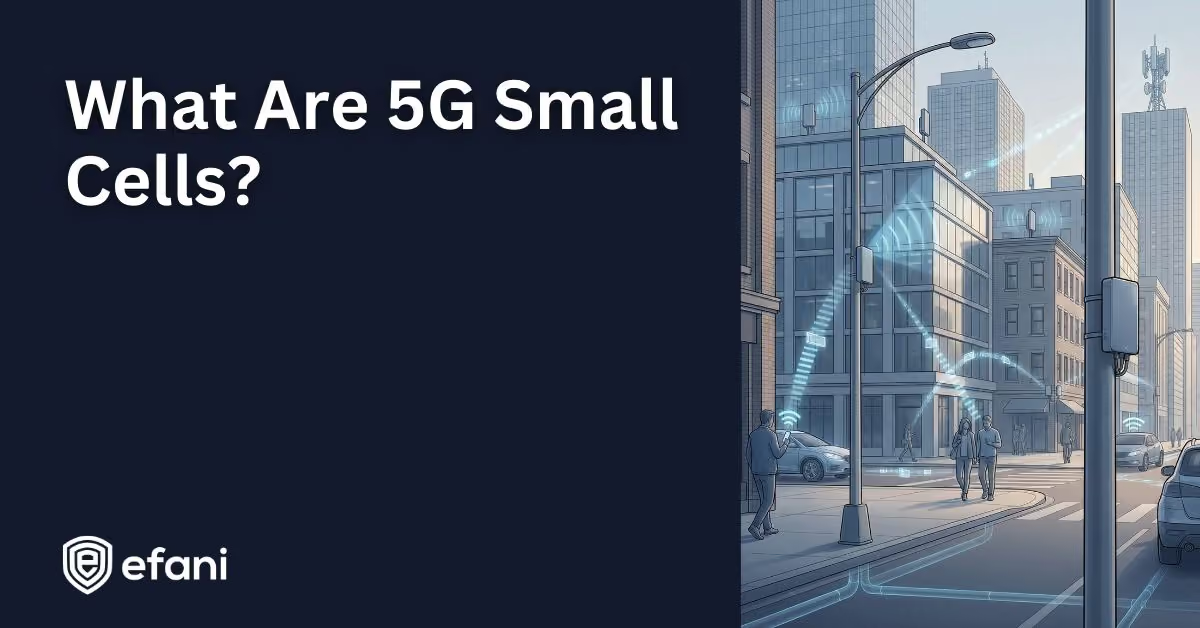
At its core, a 5G small cell is a fully functional cellular base station with a limited coverage area and lower transmit power than a traditional macro tower.
Functionally, it does the same jobs as a large tower:
- Transmits and receives radio signals to and from phones
- Handles scheduling, modulation, and error correction
- Manages mobility and handoffs
- Authenticates devices through the carrier network
- Routes user data toward the core network
The difference is scale.
A macro tower might cover several square miles. A small cell might cover a few hundred feet or a single building floor. That smaller footprint is intentional and essential for how 5G works.
Why 5G Networks Depend On Density
Cellular networks are not limited by distance alone. They are limited by physics and math.
Every cell site has a finite amount of spectrum. That spectrum is shared by every connected device within the coverage area. When too many users are active at once, speeds drop even if signal strength looks perfect.
The solution is not always more spectrum. It is more cells.
By shrinking coverage areas and deploying more access points, carriers can reuse the same frequencies many times within the same city. This is called frequency reuse, and it is one of the most important ideas in cellular engineering.
Small cells are the primary tool that makes dense frequency reuse practical.
The Frequency Side Of The Story
5G operates across a wide range of frequencies, and each one behaves differently.
Low Band 5G
Low band 5G uses frequencies similar to older cellular generations. These signals travel far and penetrate buildings well. They are excellent for coverage but limited in capacity.
Low band 5G can be delivered by macro towers alone, but it does not deliver the dramatic speed increases people associate with 5G.
Mid Band 5G
Mid band frequencies offer a balance between coverage and capacity. They travel far enough to be useful at city scale but can carry much more data than low band.
Mid band is where many carriers see their biggest real world 5G gains, and small cells are often used to boost mid band capacity in dense areas.
High Band And Millimeter Wave
High band 5G, often called millimeter wave, operates at very high frequencies with enormous bandwidth.
The tradeoff is brutal signal propagation. These signals travel short distances, struggle with walls and glass, and are easily blocked.
Millimeter wave only works when access points are close to users. Small cells make that possible.
Without small cells, high band 5G would be almost unusable outside of controlled test environments.
SIM Swap Protection
Get our SAFE plan for guaranteed SIM swap protection.
What Is Inside A 5G Small Cell
A modern 5G small cell is a tightly integrated system. While designs vary by vendor, the internal architecture usually includes several core components.
Radio Unit And Antennas
The radio unit generates and receives the RF signal. In 5G, this often includes advanced antenna arrays capable of beamforming.
Beamforming allows the small cell to steer energy toward specific devices instead of broadcasting equally in all directions. This improves signal quality, reduces interference, and increases overall capacity.
At higher frequencies, antennas are physically smaller, which allows many antenna elements to be packed into compact arrays.
Baseband Processing
The baseband handles digital signal processing tasks such as modulation, coding, scheduling, and error correction.
In older networks, baseband units were often centralized. In many small cell designs, baseband processing is integrated directly into the unit or virtualized elsewhere in the network.
This processing layer is where a lot of 5G’s efficiency gains come from.
Power And Environmental Control
Small cells draw far less power than macro towers, but they still require stable electricity and protection from the environment.
They are designed to operate in heat, cold, rain, dust, and vibration, often with passive cooling to reduce maintenance needs.
Backhaul Connectivity
Backhaul is one of the most critical and least discussed parts of small cell deployment.
A small cell is useless without a high capacity connection back to the carrier’s core network. Fiber is preferred because it offers low latency and high bandwidth. In some cases, high capacity wireless backhaul links are used.
As 5G speeds increase, backhaul requirements become more demanding. A fast radio link is meaningless if the backhaul is slow or congested.
Monthly
Yearly
How Small Cells Integrate Into The 5G Network
Small cells are not standalone islands. They are tightly integrated into a broader network architecture.
Centralized And Virtualized Network Functions
Modern 5G networks rely heavily on virtualization. Functions that once lived in dedicated hardware are now often software running in centralized data centers or edge locations.
Small cells connect into this system, offloading some processing locally while relying on centralized components for coordination, authentication, and traffic management.
Handoffs And Mobility Management
As you move, your phone transitions between cells. In dense small cell environments, these handoffs happen frequently.
5G networks are designed to manage this efficiently using predictive algorithms and coordination between cells. Done well, the user never notices. Done poorly, it leads to dropped connections or latency spikes.
This is one reason small cell placement and tuning matter so much.
Standalone And Non Standalone Architectures
In non standalone deployments, small cells may rely on LTE infrastructure for control signaling. In standalone deployments, they connect directly to a 5G core.
From a user perspective, this mostly affects latency, network slicing support, and future capabilities rather than basic connectivity.
Latency And Edge Computing
One of the quieter advantages of small cells is latency reduction.
Because small cells are often deployed closer to users and connected to local edge infrastructure, data does not always need to travel as far.
This is especially important for:
- Real time applications
- Cloud gaming and streaming
- Augmented and virtual reality
- Industrial control systems
Small cells pair naturally with edge computing because both are about pushing capability closer to where data is generated.
Indoor Small Cells And Enterprise Deployments
Outdoor coverage is only part of the problem.
Modern buildings are extremely effective at blocking radio signals. Energy efficient glass, metal framing, and dense materials make indoor coverage challenging, especially at higher frequencies.
Indoor small cells solve this by bringing the network inside.
These systems are widely used in:
- Office buildings
- Hospitals
- Warehouses
- Hotels
- Campuses
Enterprise small cell deployments can be public, private, or hybrid, depending on whether they serve carrier subscribers, private networks, or both.
Capacity, Interference, And Network Planning
Adding more cells does not automatically improve performance. Poorly planned deployments can create interference problems and inefficiencies.
Carriers carefully plan:
- Transmit power levels
- Antenna orientation
- Frequency allocation
- Timing and synchronization
- Coordination between neighboring cells
5G introduces more advanced interference management techniques, but dense networks still require careful engineering.
Small cells succeed when density is matched with smart design.
Battery Life And Device Behavior
Being closer to a cell site often reduces the power your phone needs to transmit. This can improve battery life during active use.
However, dense networks can increase signaling activity and handoff frequency. In practice, most users experience neutral or slightly improved battery performance in well designed small cell environments.
The bigger benefit is consistency. Fewer drops, fewer retransmissions, and steadier throughput all help devices operate more efficiently.
Small Cells And Location Accuracy
Cellular networks estimate device location using signal timing, signal strength, and triangulation across multiple cells.
More cells in closer proximity can improve location accuracy. This benefits emergency services and network optimization.
It also reinforces an important reality. Cellular connectivity inherently involves location awareness at the network level. Small cells do not create this, but they can refine it.
Privacy conscious users should focus on device security, account protection, and application behavior rather than the presence of small cells themselves.
Security Considerations
Legitimate small cells are authenticated and managed as part of the carrier network. They use encrypted signaling and are monitored like other network elements.
They are not the same as rogue base stations or surveillance devices sometimes discussed online. Those are separate threats with different detection and mitigation strategies.
As networks evolve, security remains layered. Strong device security, updated software, and secure account management matter far more than whether your phone is connected to a macro tower or a small cell.
Are Small Cells Safe Around People
Small cells operate at much lower power levels than macro towers. Their proximity to users is balanced by reduced transmit power and directional antennas.
They are deployed under regulatory limits designed to keep exposure well below safety thresholds.
Visibility does not equal risk. Small cells are noticeable because they are closer, not because they are stronger.
Will Small Cells Replace Macro Towers
No.
Macro towers remain essential for wide area coverage, rural connectivity, and baseline service.
Small cells complement macro towers by adding capacity and precision where demand is high.
Modern networks are layered systems. Macro coverage, small cell density, indoor solutions, and advanced radio techniques all work together.
A Useful Mental Model
Think of the network like a transportation system.
Macro towers are highways. They move traffic across long distances efficiently.
Small cells are local streets. They handle dense, local traffic and connect users to the broader system.
You need both for a city to function.
Conclusion
5G small cells are compact, low power cellular base stations that make modern 5G networks possible in dense, high demand environments.
They exist because spectrum is finite, high frequency signals travel short distances, and user demand keeps growing.
Technically, they are full base stations with advanced antennas, beamforming, high speed backhaul, and tight integration into virtualized network cores.
Practically, they mean faster speeds, lower congestion, better indoor coverage, and more consistent performance where people actually use their phones.
They are already everywhere, quietly doing the work that makes 5G feel like 5G.